Showing posts with label Public Service. Show all posts

Monday, April 10, 2017

Comedy of the commons?


"I'm a rambler, I'm a rambler 
from Manchester way.
I may be a wage slave on Monday 
But I am a free man on Sunday."
Ewan MacColl.

Free men 

We ramble, we ramble...

We roam, we search, we browse, we surf, we hack.

We are nomads of the steppes.

We are urban flâneurs.

We rove the range.

We free-ride, we couch-skate, we long-board, 4G wifi, 360°


Wingsuit revolutions will now be televised.

Red Bull crashes Go Pro - viral death spiral.


Olé.

Internet Service Provider Free has its Freebox Révolution.

La Révolution Française.

(designed by Starck.)

Liberté, Egalité, Fraternité!


Declarations of independence.

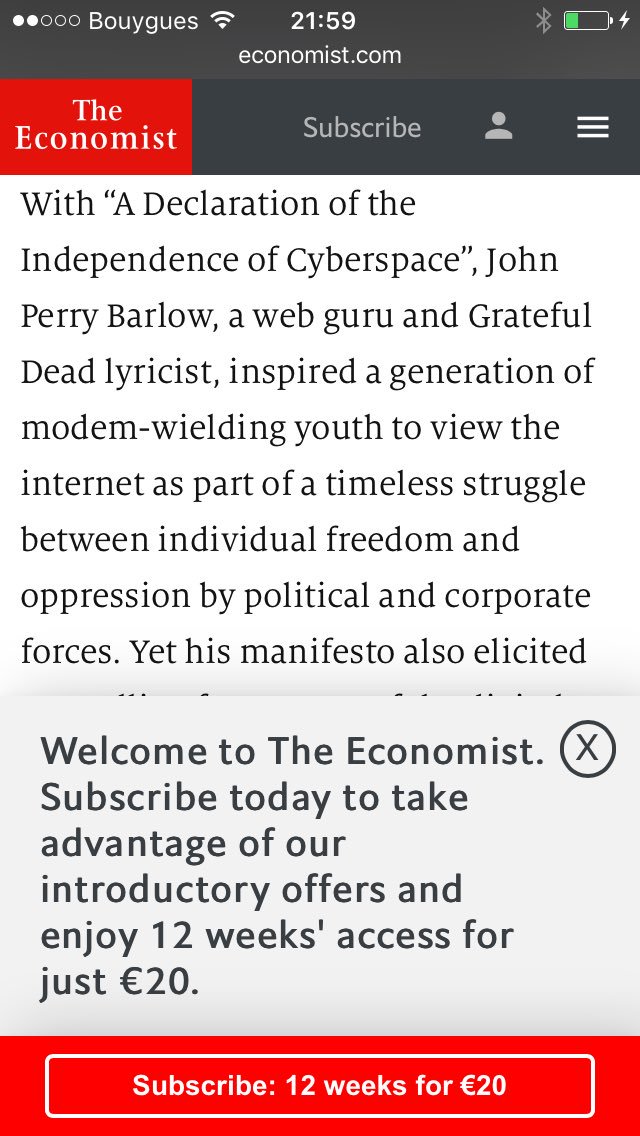
"Governments of the Industrial World, you weary giants of flesh and steel, I come from Cyberspace, the new home of Mind. On behalf of the future, I ask you of the past to leave us alone. You are not welcome among us. You have no sovereignty where we gather." 


John Perry Barlow, Davos 1996

(The Economist)


Dreams of freedom.

Stories of freedom are pervasive. 

Imagined communities.

Mass movements have powerful hold. 

Massaged egos, echoes of the twenties.

TALE SPIN.

Viral market crashes into a Wall, echoes of the thirties on the streets.

Some have more money, more time to dream...in neoliberal eagle's nest, Davos.

Une Révolution (virtuelle)

Don't worry about the mob.

Let them eat Youtube and Fifa 2017

Let them eat Semtec.

Sad losers will get to ruffle the feathers of the great and good, only occasioning the odd Breivik.


Who gives a fuck for collateral damage?  

Bigger bangs for their bucks.

Dream wilder, think bigger, grasp further, dig deeper, sow hate, love and manipulate.


We'd have to be an ostrich with our heads in the sand not to hail this virtual reality as "freedom."


Building the Commons.

Any doubters among you?  

We can save the world. 

We can build the commons "freely."

(With a modest fee for charitable Free or your local friendly ISP)

Not happy with that?  

We shall build fucking Jerusalem...bigger.


Or Middle Earth, complete with brave hobbits and trolls.

Pure fantasy?

We shall hark back to untrammelled images of Empire and hymns of colonial philanthropy. 

We shall nurture our green commons "freely."

We shall scatter seeds...or bomblets.


We shall provide "public service" "freely."


We shall save some millions, "freely."


Tragedy of the commons.

No worries of spoiling the commons is there?


We can't overload the virtual information commons, surely?

OK, you can overload the wifi, I give you that, above all, in soon to be "developed" corners of the globe.

What use is the world with no wifi?

The more you share your lol cats the more lol cats and joy there is for the others!

The internet commons does not deteriorate like land!

No sirree!

OK, so there are piles of tech waste in soon to be "developped" corners of the globe, out of view.


Comedy of the commons.

Wikipedia is a great example of the comedy of the commons! 

Contributors distribute widely, give freely their expertise to inform the world!


What a beautiful sight, an army of erudite slave ants!

Joy to the world.

We shall train them.

Hail Wikimedia!


Recant deviant!

Attack wikiants!


Comedy of commons.

'Tis a comedy of commons, the internet.

Oh ha, ha.

NOT!


IT AIN'T!

Funny.


...you shall not pass!


"I'm a rambler, I'm a rambler 
from Manchester way.
I may be a wage slave on Monday 
But I am a free man on Sunday."
Ewan MacColl.


Come on ramblers!

Get your laptop backpacks, your sarnies, let us occupy the virtual commons!

ER?

Sorry?

I'm a game-keeper.

Come again?

I'm going for a pint.

Well whatever did happen to public space?

Er, well, after the pub, he rambles.


Blimey! 

Who are these bleeding game-keepers? 

Well there's us and...then  there's....them.


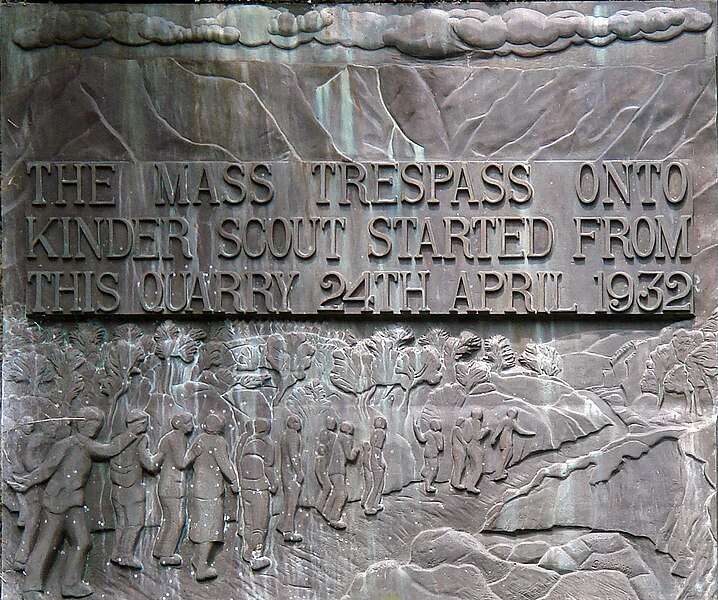
Don't forget the Kinder Scout.

We're going to need that mass trespass, feet on the ground, in the street.

Act local.

Think Global.

Mass trespass.

Do a public service.

Fire the game-keepers.

Reclaim the commons.

Tragedy of the commons.

"I'm a rambler, I'm a rambler 
from Manchester way.
I may be a universal basic wage slave on Monday, Tuesday, Wednesday, Thursday, Friday, Saturday, and Sunday. 
But I am a free man on Twitter."

With apologies to 

Ewan MacColl.


Footnotes.

The commons is the cultural and natural resources accessible to all members of a society, including natural materials such as air, water, and a habitable earth. These resources are held in common, not owned privately.

https://en.wikipedia.org/wiki/Commons


Mayo Fuster Morell proposed a definition of digital commons as "as an information and knowledge resources that are collectively created and owned or shared between or among a community and that tend to be non-exclusivedible, that is, be (generally freely) available to third parties. Thus, they are oriented to favor use and reuse, rather than to exchange as a commodity. Additionally, the community of people building them can intervene in the governing of their interaction processes and of their shared resources".[15][16]
Examples of digital commons are Wikipedia, a type of Free Software and Open-source hardware projects.
https://en.wikipedia.org/wiki/Commons#Digital_commons


Afterthought.

Are we their commons?

Oh what the hell.


Sunday, October 2, 2016

An indian summer.

"Do you want to stay here, or would you prefer to go outside over there?" I asked them.

"I'll follow you." I heard myself saying.


It was a beautiful afternoon of an "Indian Summer" on a grassy plateau in the Massif Central.

The people (students) sat down together in groups of various sizes and configurations and started to exchange.

A pair of them had come with food that they had prepared for the occasion, they shared their offerings with the newcomers.

I (an English teacher) moved from group to group stopping to listen and to speak with some of the people I knew (students) and with the newcomers who were from Nigeria, Columbia, Senegal, Finland, the USA, Ghana, China.

Dancing in the wild.

The newcomers, I had learnt the week before, had come from all around the world to study dance and anthropology together. I thought that the opportunity for an informal meeting of the minds would be mutually beneficial to everybody.

English would be the lingua franca for the occasion...dance might also be a useful means of communication and reflection, I thought to myself.

The people were all engaged in different conversations, some sitting, some standing, some speaking, some listening, some kneeling, some lying down.

None of the conversations were scripted, programmed or determined by myself (the teacher).

I pointed out that they might find some things in common...

As the afternoon went on the people moved changing the group compositions, changing the conversations.

Stories of resilience.

I spoke to a guy from Ghana and another from Senegal or Nigeria (I am not sure now) about their learning stories. They spoke to me of the difficulties they had had navigating classical expectations of parents or institutions to focus their attention on what some might consider a marginal activity - dance choreography and anthropology.

They spoke of the thousands of students in amphitheatres...

One spoke to me of trying to take law classes to dissimulate what he was really doing which was to follow dance anthropology classes at the university.

They had showed remarkable resilience in their desire to follow paths which they felt were essential to them.  I made a mental note of their stories for future reflection.

Emergent learning.

After a little while, the interaction in one group had mutated from conversation to a break dance battle.

On hearing the music, which was coming from someone's portable wireless speaker connected to a smartphone, all the other groups stopped conversing and stood up on the slopes to become an audience within an emergent, natural auditorium.

The dance had changed the nature of the space, the nature of the ritual.

There were whoops of delight, expressions of encouragement, cheers and clapping as the pair of dancers showed their moves.

After what seemed a good few minutes, the dancers stopped, some people grouped in pairs and started taking contact information, others were attracted by drumming coming from across the plateau, others went off to retrieve their belongings.


Massively Open Offline Class.

I moved with some of the people over to the other side of the plateau, passing a couple of girls with hijab attempting to walk across a slack line, a boy that I knew from one of my classes hanging upside down from a trapeze, a group of jugglers.

I stopped to speak with them and was greeted with a smile.

The activities had been organised as part of a festival to welcome new students to the university.

I overheard one student say to another:

"Why don't you tell your friends to tell the teacher that you had to miss class, this is much more interesting."

I looked back at concrete boxed classrooms and thought of those that they contained.

Once at the other side of the plateau, I was met with a group of African dancers in traditional dress who were acting as a magnet, attracting others to dance with them.

I recognised one or two of the dancers as those who had been with the class of students in the "English" class just before.

I spoke with the students watching the now active dancers of their meeting.

"Had that been a valuable learning experience?" I asked them.

The expression on their faces was eloquent, they all noted that it had indeed been both memorable and of interest to them.

I noted that some of them had been taking contact information from their new friends, had started organising times to meet.

They had at first oriented themselves.

They had shared declarations.

They had networked with these strangers.

Weak ties were being strengthened.

Now, they were clustering.

There had been clear focus on the spontaneous break-dance battle.

I shall remember this class as one with many connections from which to learn, an open space within which to roam. I thought of how this connected to my own experiences of (rhizomatic) learning online and offline.

Education for community

I thought of the street festival that had been organised by students I teach the weekend before.

I thought of the connections being made between them and the local community.

I thought of the wealth of the learning ecosystem within which they had been the actors.

I am fortunate working with people whose sporting, academic and professional activity takes them into so many diverse spaces.


Learner Resilience

I am wondering now about learner resilience.

Not all the students that I meet demonstrate the same determination as those African dancers.

Many need time to orient themselves.

Many have been so institutionalised that they are looking only to go through the minimal motions to get a grade.

Many classes, many spaces, many rituals, relations, reinforce such minimal transactions.


Strategies of school and deschooling.

Opening them up to imagining different relations, different activities or means to learn within the institution or outside of the institution is not straightforward - particularly when the institutional culture itself is the major obstacle.

I am now faced with two quandaries,which in effect are similar:

How do I go about facilitating the development of resilient learning networks and communites from within an institution in the most effective way?

How do I go about enabling learners to view the people around them - classmates, people in the street, in the town, on the internet as potential members of their learning networks?

How do I go about enabling learners to benefit from paths trodden and links made (online or offline)without overwhelming them with my own paths, links, conclusions, beliefs, culture?

One problem for me concerns digital literacies, the need (or not) to develop the desire/skills/competences necessary to be able to learn effectively. In order to do this, it is essential that I build alliances and find convergences with my colleagues who may not necessarily see the interest themselves in developing those digital literacies which I would consider essential for some if not all of the students that I work with. I am thinking of the work of Ken Bauer, Gardner Campbell, Alan Levine and Jim Groom here...

I shall follow my curiosity...
Another problem concerns the visual organisation of existing learning opportunities, activities offline and online.  It is essential to use learner generated 'slug trails' to point to new possibilities within those over familiar boxes.

Photos, videos, personal testimonies, stories, demonstrations, all must play their part, I have been curating those over the past few years.

I have been teaching students how to create digitally, to research critically, to curate, and share, to network offline and online with CLAVIER.

I suppose what is essential now is to make those connections with other colleagues to enable that ecosystem to really weave deeper and wider. I am seeing more and more convergences in ways of thinking, and ways of teaching.

I must invest time on key nodes.

I must map, I think of Daniel Bassill.

I suppose that is what I have been doing with my research.

(idiot - you have been mapping continuously for bloody years - he says to himself).

I am collecting the bits, now I need to find the most effective ways to enable learners to access them.

I must find time, I must find time.

I think of Daniel Bassill.

It's not that I must.

It's that I want to.

I want to.

I have for some time been working towards setting up some sort of "learning bank/make bank".

I must develop connections further. I must map.  I must map.

Priorities, priorities.

Time is precious, my resources and influence are limited, the pressure to fit students, teachers and learning into 'managed paths' and standardised outcomes, in predictable rectangular boxes, with interchangeable teacher operatives is considerable.

I have already seen promising projects killed this year through lack of support...

It is no time to be a nobody.

Fuck that.

I shall enjoy my time as this nobody.

I am heartened by the idea that for the moment at least, in France, university is seen as a public service where students are not to be endebted for years thereafter.

How long will this last?

Fuck that.

We can only do what we can do, with our feeble means...

Learning in an age of abundance?

I think for a -moment of the term: "learning in an age of abundance".

I think we need to reassess what we mean by abundance.

I think of the term 'Indian Summer'.

I make a few mental notes to address

  • the idea of learning, the idea of colonisation in "the wild" and the notion of "wilderness"
  • conflicting notions of enlightenment and transcendence. (Note to self: Les Maux Des Mots.)
  • conflict between capitalism and sustainable ecosystems.

What is it that Dave Cormier says?

Content is people?

I can never remember.

An age of abundance can surely not be reduced to people, even less to bloody information, or data.

I rather hope now that he is thinking of inviting people to reflect on learning/learner resilience now.

I rather suspect that I am ready for that now.

He probably isn't.

Whatever...

Looking back, looking around, looking forward, looking around.

I look at the presentations that I was doing earlier in the year when I was in Poland.

Suddenly, they take on renewed importance.

I shall study them again.


I shall reorient.


Well that was an  unexpected flurry of typing.


Footnote.

Special note: Terry Elliott's recent posts sparked enthusiasm to review this post and to extend it.

Fuck knows why.


Footnote to self.

Note Cynefin Framework and Dave Snowden's Party Organisation. 

How not to manage complexity.


Wednesday, August 31, 2011

Postman's progress...

Do postmen deliver?

Yes! Everyday, they sort mail, deliver bills, brochures, and the odd postcard (becoming rarer) pretty reliably to the right door.

To reduce postmen to such a role however is to do them a disservice. Postmen have also often played an important but unheralded part in bringing human presence to the needy and lonely in our communities. Pat your postman on the back;  his days as an unpaid social worker are sorely counted.

In this age of climactic economic crisis, politicians have grand plans for our faithful posties. . .They are now also to  become...ECO-WARRIORS! They are on the front-line fighting for our planet's survival. Thanks to the latest techological advances their rounds are now becoming electric.

Out the noisy, smelly, polluting combusion engine, in the shiny yellow rechargeable minivans!

Progress indeed!

This is what first struck me when I came across the shiny yellow rechargeable minivan parked on my way to attending the conference Cyberlangues at the cinema in Marly le Roi last week. So impressed was I, I forgot my haste and I took three photographs of the thing.  This aroused the curiosity of the proud postman pilot of the aforesaid vehicule.

"Zero C02 emmissions! La Poste engages itself to provide a responsible mail service!" The slogan on the side of the van boomed out, accompanied by the World Wild Life Fund panda, in logo.

We started talking, Marcel and I, (we shall call him Marcel) about his new van.

"It's great fun to drive", he said, "Would be ideal for an older postman, or on certain rounds. But for me," he added, "I prefer a bicycle."

I looked perplexed, wasn't this yellow dream progress?

"You see with a bicycle, I can go right up to the house, put the letters in the box and have time to chat with the people. Oh yes, and  it used to keep me fit! With the minivan, I have to get out of the van, open the back, get a basket, walk to the house, post the letter, go back to the van, put the basket in the box, close the back, get into the driver's seat put my foot down on the accelerator and rush to the next stop. It's slower than it used to be on a bike.  I don't have time for people any more..."

"The managment only measure the number of letters  I post and how  fast I do my round...."

Do teachers deliver? 

Well, children are sorted into categories, their letters are checked and they are pretty reliably sent to the appropriate destination.  Children who are difficult to put into boxes get left in sorting offices or are sometimes lost in transit.

To reduce teachers to this role, is maybe alienating but it makes economic sense. After all the public expects a reliable education service which will take their children to the right employer's door.  Global competition, means that we are obliged to make sure that our rounds are up to standard.

Shanghai standards are the criteria by which our universities, for example, are to be assessed. Proud is the university president who can claim his entrance into this universally accepted top-performing league! Such educational institutions win a glowing stamp of approval.

Telegram!


It has come to our notice that French education is lagging behind the UK in the integration of shiny modern technology into the classroom.  The measure of this lag? The number of Interactive White Boards in classrooms. These are shiny, impressive, expensive (now out of date) replacements for the outdated chalk and blackboard . Catching up with the AngloSaxons is surely a must.

Progress indeed for some!

Certain universities currently pride themselves on their "personalised learning" allowed by  sophisticated "Virtual Learning Environments". Students follow cleverly defined, scientifically evaluated routes towards their final stamp of approval. I myself was able to share in the communicative satisfaction of a colleague at Cyberlangues who described this modern process.  She glowed with her university's recognition at Shanghai.

Didn't we feel impressed!

Telegram!


Elsewhere, thanks to political demand, iPads are flooding into the Corrèze, these new saviours of National Education, are to be touchy/feely digital satchels for new flashy digital textbooks. Brilliant, innovative, brave measures...

Do politicians deliver?

By which criteria should we evaluate their progress? Are we only interested in speed, economic efficiency, competitive performance? Wouldn't individual postmen on their rounds, or particular teachers in their specific classrooms not be better judges of the tools necessary to better perform their difficult tasks?  Shouldn't we be taking the time to stop, to  look, to listen, and  to talk, together?

How should we evaluate technological progress?

Do politicians deliver (what we want)?

Are we going to continue to allow politicians and people to stamp on the lonely, the needy, on the misdirected on their way to career success?

Shouldn't we be educating our children, to analyse 'progress' more critically? (I am just asking questions. I am just a teacher.)

This post arrived to your screen only thanks to Marcel, the critical postman.