Showing posts with label objectives. Show all posts

Monday, March 14, 2016

Livestock,Dumbledore and I...


It suddenly hit me.

It was this morning at approximately 11 o'clock am.

The spell broke.

I was listening to a university professor speaking of new innovations at the university in the training (formation. fr.) of students in digital literacies.

There's a new acronym:  DIGICOMP. [digital competences]

There's a new automatised grading system of the students digital competences.

We were reassured that such a testing system would be based on something like the:

TOEIC [a brand which guarantees market leading excellence].

Click on the link!

Ideal for your head of students.

KNOW WHO HAS THE ENGLISH SKILLS TO SUCCEED IN THE GLOBAL MARKET PLACE.

I sighed.

I heard the aforesaid master [Maître de Conférences no less] say the following:

"The students will be learning to use these tools - blah, blah."

"We have three levels of competence." [in French]...

"There will be diplomas for each level so that employers can understand their level of competences."

(He could have said, badges, blockchain credits, rosettes...you get the drift.)

"If you look up here..."

He showed us a reassuring diagram.

Hearing no mention of an ounce of critical reflection to accompany this brave new scheme...

I asked for a microphone.

"What about developing critical reflection as to the use of digital tools?"

Then came the answer:

"We don't believe that students in the second year of university are able to think.  We leave thinking until we get to third year or masters level."

"Are you serious?" I replied.

"Are you suggesting that a twenty year old is incapable of critical thinking?" I went on.

I was met with a blank look.

I thought that I should shut up before it got nasty.

Livestock, Dumbledore, and I...

Well all that got me thinking.

Maybe I have misunderstood what we are doing in education in France.

And then it struck me...right between the eyes.

I have been thinking that I am working in education.

NO!

We are working in livestock husbandry.

The spell shattered.

What do I do?

I thought: "I teach."

Non. "J'enseigne."

I fell upon the noun [non. Fr]  ENSEIGNE

Etymology 
Latin. Insignia. 
Sign constituted by an emblem. 
An symbolic object to signal an establishment of commerce. 

History
Symbol of the power and the command. 
Flag/Standard.
Ensign.


In French Higher Education is:

ENSEIGNEMENT SUPERIEUR.

It is about transferring [feeding] 'savoir' information/knowledge to the head of students. (cattle)

I thought that I had been doing EDUCATION
Que Nenni! [not]

We are not the slightest bit interested in education, or thinking.

We will let the elite do that - the "free rangers".

I did a quick image search with the word enseigne.

I thought of the signs of trades, of guilds.

I did a quick image search.

I thought of brands, of branding.

I did a quick image search.

I thought of grading.

I did a quick image search.

I thought of diplomas.

I did a quick image search.


MASTER-BOUCHER-CHARCUTIER-BOULANGER-FROMAGER-ENSEIGNANT 

There they are trussed up to the nines with sashes, robes and ridiculous hats.

They might as well be wizards in Hogwarts.


That's it.

I am in livestock husbandry.

Why on earth would we want cattle to think?

We close the door.

We wouldn't want the poor dumb animals to realise their fate.

It would be upsetting.


I immediately felt depressed.

I am a bloody meat processor.


I suppose I might go and work in a free range farm.

The animals suffer less.

It is more costly.

You have to let the cows wander around longer.

Only the richest can afford the premium beef.


I suppose that would be better.

It is better than factory farming for hamburgers.


There's all that automation and no free roaming.

I have tried to make my farm more humane.

We have tried to enable the students to think.

Is that cruelty?

Back to Hogwarts...

A couple of students had chosen to perform a scene from Harry Potter.


They had skimped on the special effects for the burning wardrobe.

They had put a crudely drawn paper poster on a PC tower.

Mélanie posed with her lighter next to the PC.

The sign read:

"Wardrobe is on fire."

Then I heard her say:

"There's something in the wardrobe Tom. 
There's something in the wardrobe."

It clicked in my head.

"It's Mark Zuckerberg, Mélanie," I said.

"He's after your data."

"You're living on a data farm."

I told her the story of the man and the DIGICOMP lecture.

I told her how he thought she couldn't think.

She laughed.

I told her I would write a blog post with her photo to illustrate it.

I spoke with other students about why we insisted on reflection in their classes in English.

Why learn English?

Who are we learning English for?

What's a certification for?

What's a degree for?

Why are we using digital tools?

Why do we create digitally?

What lies in Facebook's wardrobe...

It didn't make me feel much better about my role.

I Googled some cow comics to make me feel better.


They didn't make me feel any better.

These are dark times I thought to myself.

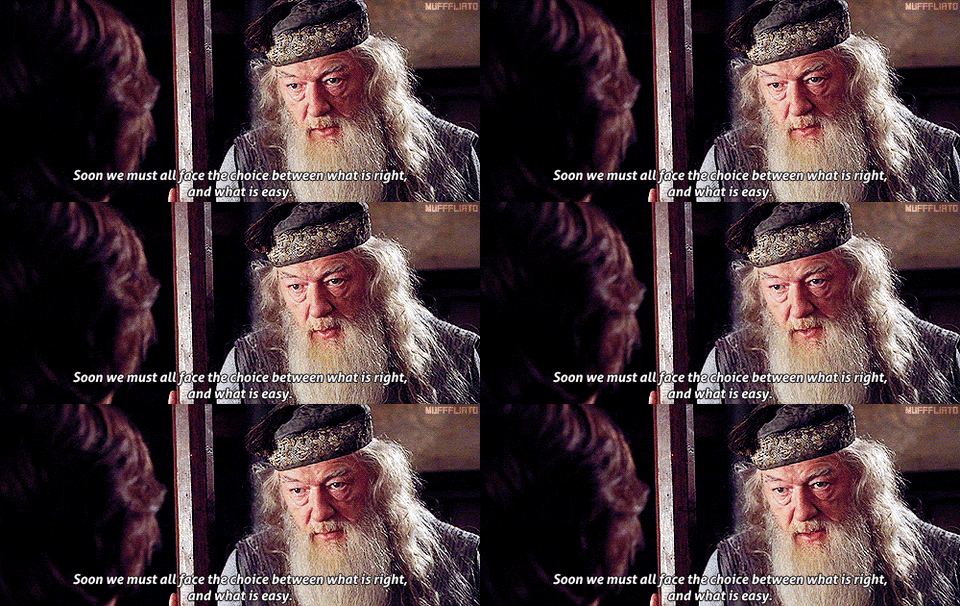
I wondered what Dumbledore would say...


This is a feeble light.


Post Script

I received an unexpected sign of life from a student last night.


That made me happy that I had written this.

“Age is foolish and forgetful when it underestimates youth.”
J.K. Rowling, Harry Potter and the Half-Blood Prince 


Saturday, February 27, 2016

Target practice...

High up above a lark was singing joyfully.

I sat there in the bunker feeling rather smug, smoking.

Not only I had got out of games but I was being paid to do so.


We hardly noticed the 'tac, tac, tac' above our heads.

Suddenly a flag was raised and we raced up the butts to reposition the targets.

The ammunition was live.

The target practice goes on...

In 2001, in the UK,  40,509 kids were receiving military training, including weapons training while at school.

The Ministry of Defence funds a 'youth organisation' whose aim is to:

 "provide a disciplined organisation in a school so that pupils may develop powers of leadership by means of training to promote the qualities of responsibility, self reliance, resourcefulness, endurance and perseverance". 

but it acknowledges that one of its objectives is:

"to encourage those who have an interest in the services to become Officers of the Regular or Reserve Forces"

Source http://military.wikia.com/wiki/Combined_Cadet_Force

I remember going to see Peter Brook's film version of Lord of the Flies at school.


How relieved we were to be saved from our own savagery...


Whose targets?

In whose interests are 'our' 'educational targets' set?

EDUCATION-INDUSTRIAL-MILITARY-COMPLEX

Is education preparation for war?

Who are we fighting for?

Whose targets?

In whose interests are 'our' 'education targets' set?

WHY EDUCATION PUBLISHING IS BIG BUSINESS

REPORT: BIG EDUCATION FIRMS SPEND MILLIONS LOBBYING FOR PRO-TESTING POLICIES

NO PROFIT LEFT BEHIND

HIGHER ED's OBSCENE PROFIT SCHEME: SCHOOLS, BANKS, AND THE GOVERNMENT WIN - YOU DROWN IN DEBT.

HERE'S A BIG REASON WHY AMERICANS HAVE $1.16 TRILLION IN STUDENT DEBT.

Is education a market for companies to profit from our children?

Who are we endebted to?

Whose targets?

In whose interests are 'our' 'education targets' set?

PISA 2012: HAPPINESS OR PERFORMANCE?

Is education preparation for performance?

Who are we performing for?

Resetting targets.

What if we were to reset 'our education targets'?

What if we were better informed as to how these 'our education targets' are currently set?

What if we were to do some research...

  • Who actually is in favour of war?
  • Who actually is in favour of standardised testing?
  • Who actually is in favour of massive student debt?
  • Who actually is in favour of massive inequality?


What if we hypothesise that more people are in favour of peace than war?

What if we spent more money on research into solutions for peace rather than on preparations for war?

What if we spent more time encouraging cooperation rather than competition?

What if we looked to improve happiness more than to develop performance?

I thought about the United Nations Conference COP 21.

I looked at the list of ongoing conflicts on Wikipedia.

I thought of the massive demonstrations in the streets of Paris

I thought of the work of Daniel Bassill in Chicago.

I thought of Terry Elliott blogging on budget cuts in education in Kentucky.

Targeting Peace.

"Establishing lasting peace is the work of education; all politics can do is keep us out of war."
Maria Montessori

It so happens that I fell upon a report on French TV late last night into the concept of Altruism.

It highlighted an educational program which sought to reduce violence between kids at school through mindfulness training.

It featured an American academic Richard Davidson from Wisconsin.


It featured a French academic-become-buddhist-monk Matthieu Ricard.


If education is 'the most powerful weapon which you can use to change the world' (Nelson Mandela) it is also a battlefield.

There are forces who have massive financial interests in maintaining education in its present state.

There are forces who have massive financial interests in maintaining violent conflict between people.

How can we counter greed?

How can we strive for peace?

Economists are not all convinced in the sustainability or desirability of current exchange systems.

“To put it bluntly, the discipline of economics has yet to get over its childish passion for mathematics and for purely theoretical and often highly ideological speculation, at the expense of historical research and collaboration with the other social sciences.” 
― Thomas PikettyCapital in the Twenty-First Century


I am convinced that we can not remain indifferent to the use of weapons in our societies...


I hear much talk about 'accountability' in education.

I am not against some form of accountability.

There is 'numeric accountability'.

There is 'moral accountability.'


Thursday, April 16, 2015

Doodling in Latin...

Any scrap of paper will do.

(The scrap on the left, on which the image of an old man is drawn, is an example.)

This class has got nothing to do with me.

I shall be elsewhere.

I escape the clutches of Latin grammar and let my mind wander.

I am the archetypal distracted student.

I am the one at the back that the teacher gives stern looks to.

All those bad school reports now make me realise that the teachers were less concerned about my learning and more concerned about my playing their game.

I just couldn't be bothered.

I watched Dave Cormier's video presenting the theme for week 1 and it left me feeling a little frustrated. I didn't like the sound of 'learning subjectives'; I mean that literally I didn't like the sonority of the word subjectives.

Apart from the obvious objective subjective (false) dichotomy there was little, I felt I could dig into, to explore.

It felt to me like I was already with a spade and wheelbarrow to unearth rhizomes and all I got was a lump of concrete just under the surface.

After an initial exploration of what other diggers had come up with, I found a few rich roots to unearth and to contemplate.

They had clearly found more inspiration.

They were not bothering so much to dig downwards into the Dave Cormier prompt, they were working laterally, letting their gaze wander more widely.

I chose three posts which marked me from the first days of rhizo15:

Firstly there was Keith Hamon's wonderful swarming post:  "Ethics in MOOCS: the Two Four Ten or so Commandments of #rhizo15"  . Each of Keith's posts are a MOOC in themselves.  I have great admiration for the sobriety, the precision, the intellectual depth of Keith's writing.

Then there was Susan Watson's "Subjective Learning Subjugated-Objectives Subversive-Subjunctives." I love how Susan uses language, how she exudes energy in her writing. I love her word play, she set me off on one of the games that I prefer.

After there was Mary Ann Reilly's beautifully written, heart-breaking piece on the death of her mother "What it was I was listening for." It made me think back on how rhizo14 had been for me in part a process of grieving.

I immediately went back and read two posts that I wrote at the beginning of that course: Suspend disbelief and Life beyond the meme. Learning is often recursive. Learning is indeed grief engraved.

I came back to Dave Cormier's 'learning subjectives' what on earth could I do with it?

Prompted by Susan Watson's word play, I decided to cut up the word 'subjective'.

How many words could I find with 'ject'?

Trajectory  - that was a good start. It connected with mapping and rhizomes. Rhizomes map laterally.

Adjective
Objective
Subjective
Reject
Deject
Abject

Hmm.  Prefixes and Suffixes I thought that could be worth exploring.

In fact what did 'ject' mean?

Latin classes were actually proving pretty useful so many years after.

I googled 'ject' - I had never done that before.

All of that thanks to Dave Cormier!

'Ject' is a 'root' word - marvellous for rhizomes!

I found a resource for English students.

There was something in the introduction which immediately struck me:

'An oddity about this ROOT is that it never stands alone, as other ROOTS do. 
Standing alone it has no meaning.'

These ROOT-WORDS are JAC, JEC & JECT meaning THROW & LIE. An oddity about this ROOT is that it never stands alone, as other ROOTS do. Standing alone, it has no meaning. It is entirely dependent on prefixes and suffixes to be meaningful. 

1. Dejected : de JECT ed (de jekt’ ed) adj. 

Low in spirits; cast down 


2. Dejection : de JECT ion (de jek’ shun) n. 

A condition of despair; depression 


3. Adjacent : ad JAC ent (ad jas’ ent) adj. 

Next to; as, the adjacent house 


4. Adject : ad JECT (a jekt’) v. 

To add to; to annex 


5. Adjective : ad JECT ive (aj’ ek tiv) n. 

Not standing alone; a word which modifies a noun 


6. Adjectival : ad JECT ival (aj ek tie’ val) adj. 

Using many adjectives; as, an adjectival style 


7. Conject : conJECT (kon jekt’) v. 

To plan; to surmise 


8. Conjecture : con JECT ure (kon jek’ chur) v. 

To form an opinion; to surmise 


9. Ejaculate : e JAC ulate (e jak’ yu late) v. 

To throw out; cry out 


10. Eject : e JECT (e jekt) v. 

To throw out; as, eject him from the hall 


So, those Latin classes were not only useful for practising my doodling, they also enabled me to recognise how words are constructed.

I take back all that I have said about Latin.

Rhizomatic learning in rhizo15 is about making connections.

Dave Cormier you are a genius.

What a wonderful week 1 video!

We are at ROOT social  animals we are JECTS.

We are thrown out and there we lie, helpless.

Little by little we try to make sense of our lot.

I think we all come to the same conclusion: Alone we are meaningless.


Wednesday, April 15, 2015

No more package tours...


I knew that I was hungry.

It was recognisably a restaurant.

There were tables and chairs on the terrace. It looked picturesque.

I imagined a number of tasty meals that I might like to eat.

When I looked at the menu I suddenly had absolutely no idea what I should choose.

Even my friend's descriptions didn't really help much.

I would have to taste the food for myself.

In the end, I closed my eyes, circled my finger over the menu and chose a dish by random.

When it appeared (see photo above) it resembled nothing that I might have pictured.

I can't remember what it was called.  I would have struggled (understatement) to pronounce its name.

I knew that Poland was to the east.  I had no picture of what the country might look like.

I had no idea of its beauty. I had no idea of the friendliness and openness of the people.

I had no idea of its customs, its costumes, its music, its landscape.

I was heading out into the unknown.


I had never learnt very much about Poland at school. Why should I have done?


There were enormous photos boarding up windows of imposing buildings in some of the streets.

They marked houses where some people had lived before the war.

Walking here, under this sun, feeling this warmth, I imagined those people doing the same.

There were not many people about.

It was extraordinarily peaceful.

We drove out of the town, my Polish friend and I.

We hadn't even left the suburbs of Lublin when suddenly I was confronted by a sight that I had told myself I didn't want to see.

It was standing there, in a convenient location just after a Carrefour hypermarket.

I had never heard of Majdanek.

Dealing with uncertainty...

How does one deal with the unexpected?

If I am writing this now, it is because I am starting Dave Cormier's course 'Rhizomatic learning: A Practical view.'

He starts the course this week with the theme of 'learning subjectives'

"How do we design our own or others learning when we don’t know where we are going? 
How does that free us up? What can we get done with subjectives that can’t be done with objectives?"

Package tours...

I think back to my teaching of English to students a few years ago. 


We were using a course book, with clear 'teaching objectives'.  


When I think about this word 'objective' now it makes me laugh.


It was one vision of what might have been 'the objectives', carefully explained in the teacher book.


The procedure was easy to teach. 

The exercises were easy to mark. 
It was easy for students to understand 'course requirements'. (that perhaps was 'the objective.')

What did this really have to do with learning a language?

There were postcard pictures in the course books of red buses,  Big Ben, and the Houses of Parliament.


Kids would go to visit monuments on package tours.

What they got to see would of course depend on the number on their bus or the choice of tour guide.

You can imagine them excitedly chattering away in French in Trafalgar Square.

What did they really understand about these monuments?

Why were they looking at these buildings and not doing other things?

Why were they reading those texts and not doing other things?

Who decided that this was educational?

What did this really have to do with learning a language?

I asked myself a few questions...

How could I learn to teach differently if I was not connected differently?

How could you learn a language if you were not connected to people who you might want to communicate with?

I resolved myself to maximise possible connections for myself as a learner.

I resolved myself to maximise possible connections for the students as learners.

A few years later...

I found myself in Poland with my English teacher friend discussing how to connect trainee English teachers with French English learners.

None of that had been planned. It was not in any teacher's book. It grew out of connecting widely.

A group of Polish students came to stay with my students in France.
A group of French students are going to stay with their new friends in Poland.

They chose to do the trip. It wouldn't necessarily benefit everybody.

I don't believe in universal recipes for success.

It is not clear what they will learn.

I am sure that they will learn much more English than the kids on the package tour to London.

I think that is how I see my learning job:

asking critical questions.
enabling diverse activities in diverse spaces
enabling diverse connections in diverse spaces
enabling diverse engagement in diverse spaces
helping out when people are totally lost.

(I might add to this list...)

Back in France...

I am happy going out into the unknown, towards the unknowable again 'with' Dave Cormier.

I do believe that we have to reimagine what education means today in this world which has been technologically connected 'for us'.

Discourses are there to be deconstructed...

I ask myself questions...

Whose objectives do discourses of 'learning subjectives' benefit?

Might we be paralysed or consumed by 'abundance'?

How do we encourage or enable students to thrive in this world of what is termed 'abundance'?

Might informational abundance become educational poverty?

What do we mean by learning?

What do we mean by education?

What do we mean by success?

How can we assess success?

Who should assess success?

What sort of community do we want to live in?