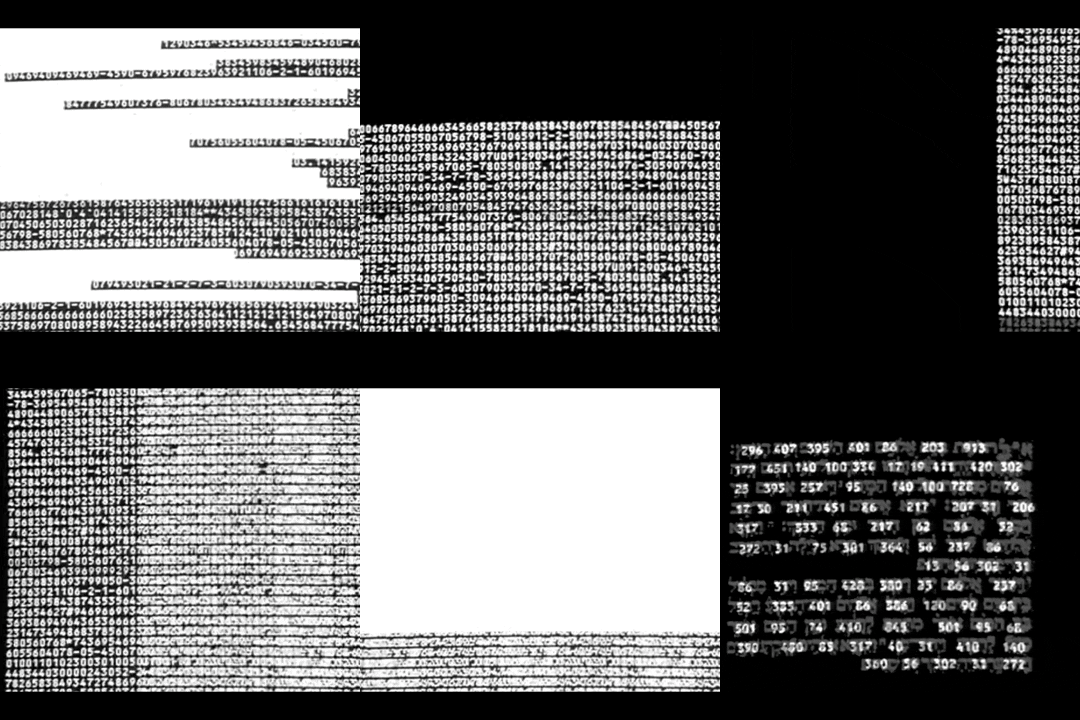
Sticks and stones may break my bones...
Numbers will surely kill me.
Collected number stories.
I) A prelude of Bach.
(I never learnt to play his preludes, it's a pity)
Suddenly, playing the cello took on a new importance.
This time it was for money.
I was eleven maybe twelve years old.
I felt pressure rising in my head.
I didn't really know why.
By the end of the week, it had become unbearable.
I tried screaming.
It changed nothing.
As the days counted down, so the pressure rose.
Playing now was punishing.
I hated the cello from that day on.
It had become an instrument of torture.
I didn't tell anybody.
I kept it to myself...
I gave up music shortly after.
II) Weeping is not a counting noun.
Their eyes well up with tears.
Their eyes are veiled out of pain.
So many years of not counting up to many.
So many years of not counting up to much.
I can feel the anger rising in me.
I think of the wasted human resources and of the hours of alienation.
It makes me want to weep.
Everybody speaks a language of some sort.
Not everybody speaks at school.
Classroom language, that's what they call it.
"Can you repeat please?"
"I don't understand"
After years of not understanding, no amount of repetition will change anything.
Silence hurts less than ridicule.
III) Lies, damned lies...
(The following refers specifically to my French University context)
"At the Baccalaureat students will have a B2 level in a foreign language."
No they will not.
No 90% of the students we teach do not.
"At the teacher training school pre-service teachers will have a B2 level in a foreign language."
No they will not.
No 98% of the students we teach do not.
Faced with their own lies, what do they do?
They pretend that they (the lies or the students) don't exist.
Faced with their lies, what do we do?
a) Pretend that these students don't exist
(good idea - pretend that the exam is at a B2 level, the numbers will lie)
b) Fail 90% of the students
(bad idea - failure is the teacher's fault and the students are not happy, the numbers don't lie)
c) Ignore their lies and use grades to help the students make some sort of meaningful progress.
(maybe the best idea - even if the numbers don't add up immediately, they will...with a little practice)
IV) Outnumbered
The mathematics are pretty clear (even for me):
There are more students than teachers.
There are more students who speak French than English.
There are not enough hours of class to hope for them to make the grade.
The students, even those who like English, will only play along in class for a grade.
We have no choice but to count, to measure the (potential) impact of our teacherly actions...
GRADES = MONEY.
MONEY = YOUR WORTH
As we are obliged to have a single grading system for all the students regardless of their level, if we grade them purely on their linguistic level, we might as well just give them a grade at the start of their university cursus and cut the classes. The grade will not significantly change.
Sudden evolutions (not linearly managed progress) are possible given the right learning conditions.
Such evolutions are impossible with classical teaching methods.
The grade may significantly change if there is a sudden surge of motivation, an integration into a community where the language is used, a major increase in the time spent engaging in the language.
As we are not obliged to slavishly follow a particular program, we can make courses as adaptable as possible by concentrating on the following:
- Diversifying learning spaces
- Caring for the students as individuals
- Regular mentoring of individuals or small groups
- Encouragement of peer mentoring inside and outside of institution
- Student selected formal collaborative of individual project based learning
- Student selected individual or formal makes from formal make bank
- Encouragement of all forms of informal learning
- The development of digital literacies
- The development of online/offline personal learning networks
V) Negotiating contracts
As we are able to adapt grading schemes to our courses we are able to concentrate on increasingly negotiated criteria for evaluation.
We put the emphasis on evaluating:
1) Engagement of learners to make some sort of meaningful progress in an area which they choose.
This progress (not necessarily linguistic) may be a result of formal or informal learning.
2) The autonomy and reflection of learners in their learning.
We are attempting to enable them to take control of their own learning in the spaces that they choose and within the networks which we try to help them to develop.
3) The mastery in certain tasks which are defined in relation to their academic or professional objectives or by the learner personally.
4) The linguistic competence within the particular tasks and during interviews.
VI) Numbers talk
If we really want people to learn a language (or other) then we really need to enable them to connect with communities or networks within which they will be able to develop outside the classroom.
I never learnt French before I was introduced into communities within which I could find people and cultural artefacts with which I could identify.
Learners who are really engaged in their learning do not count the hours.
If a learner is self-directed, autonomous, connected with a group of stimulating co-learners, accompanied by respected master learners, learning is more effective and more cost effective...
VII) Measuring individuals
If measuring individuals with numbers results in a loss of self-worth and learner motivation, it is not only not cost-effective it may be ultimately abusive.
If measuring individuals learning only concentrates on short term learning of easily measurable items or skills it does not take into account the complexity and unpredictability of life-time learning.
If measuring individuals denies the influence of their social context and the networks with which they are connected it is a denial of social reality.
If measuring individuals denies them the possibility to freely explore their talents, give useful feedback to learning mentors, connect widely with people outside the classroom with whom they can identify with, we are doing less than we can conceivably do.
VIII) Body counts
Some people's bodies speak louder than words.
"On a scale of 1-10 - where 10 is really painful - how much does this hurt?"
That's what the nurse asked my daughter when she was having stitches.
Those numbers made sense to my daughter.
The nurse was trying to help her through a learning episode.
I don't think that numbers are not useful.
I think that numbers like other symbolic systems may enable us to communicate pleasure, pain, proficiency...all manner of stuff.
I think that we have much progress to make in measuring the impact of teachers on learning...
I think this is where Dave Cormier's work on rhizomatic learning is so valuable.
Foot note and Note to Self.
I am not happy with this article.
It changed direction after reading Nick Kearney's post
It is not a reply to his post.
It has become part of a process of ordering my thinking about counting and measuring...
I am going to come back to this and his post at a later date, when I have thought things through more clearly.
Much to ponder...