Showing posts with label mentoring. Show all posts

Tuesday, November 8, 2016

First steps.

A year ago I was writing my first post for a "wolweek", I entitled it "La Vie Active" .

It speaks of my work as a English language teacher in higher education in France and my attempts to open up the classroom and to connect learners to people with whom they can share an affinity.

This year again, a few of the students are taking up the challenge and making first steps in blogging in a foreign language.  For some of them this requires considerable courage. Writing in English, blogging, connecting over social networks with people they have never met in countries they have never visited, is not easy.

So this is my purpose during this week, to see if I can help students like Mael, Antoine and Maxime to engage in a process of learning out loud, of working out loud.

They are already doing this here in Clermont Ferrand in their associative work with Manastaps, creating events in the community - The Bougnat Street Festival for urban sports/music, a Salon to connect students with professionals working in the Sports field in companies like Modugames, Oxytis, in banks, in shops like IKEA, in humanitarian action, in education, in high level sport, with people in disability.  I have taken great pleasure seeing how ex-students adapt, create, innovate, manage, care in their communities.

I collect their stories in interviews and share them on Youtube for future generations:

#CLAVSTORIES

I develop networks of people who can help students with their English, with their professional development.

This is my purpose again  this year for the #wolweek to give encouragement and to attempt to connect students to communities of practice, to a way of working openly, to be generous, to network widely, to realise that if they think their ideas are obvious to them, they perhaps underestimate how amazing they can be to others.


I have myself benefited amazingly from learning, working outloud.

I would like to share with the #wol community here the work of Alan Levine @cogdog who has constituted a truly amazing collection of stories of connection.

TRUE STORIES OF OPEN SHARING 

So let me introduce one or two of my amazing students:

Maxime  Otmani
@MaximeOtmani 
who is blogging here http://maxmyfourseasons.blogspot.fr/

Mael Troutouin
@maelitoT 
who is blogging for the first time here http://maeltrotouin.blogspot.fr

Antoine Ratinier
@Ratinier_A
who is blogging for the first time here http://antoinesblogger.blogspot.fr/


I will add to this list as they open up to this community...

Charlène Duquet

who is blogging here: http://charlenestrategy.blogspot.com/

Gregoire Billouet

who is blogging for the first time here: http://gb423006.wixsite.com/gregoire-billouet/blog-1

Nicolas Souques
@RahjinSioux 

who blogs here: https://rahjinswarriorspath.wordpress.com

Here is a bundle of RSS feeds from their blogs:

http://www.inoreader.com/bundle/0014cd6387e5

I think back to my first steps in this blog, entitled "To boldy go."

"I was 19, I was happy,  wasn't sure where I was going.  Not much has changed in thirty years!


This is the first and perhaps the last entry in this log."

I have greatly benefited from meeting people along the way who have helped me out.

We are never quite sure where our paths will lead. 

I am convinced that the more we give the more we may receive. That is my interest in the #wol movement.

Have a thought for those who are just stepping out and offer them a friendly sign, a comment of encouragement, a piece of advice, an article they might find of interest.

You never know how being attentive to another person may change that person's day, year, life.


Sunday, February 7, 2016

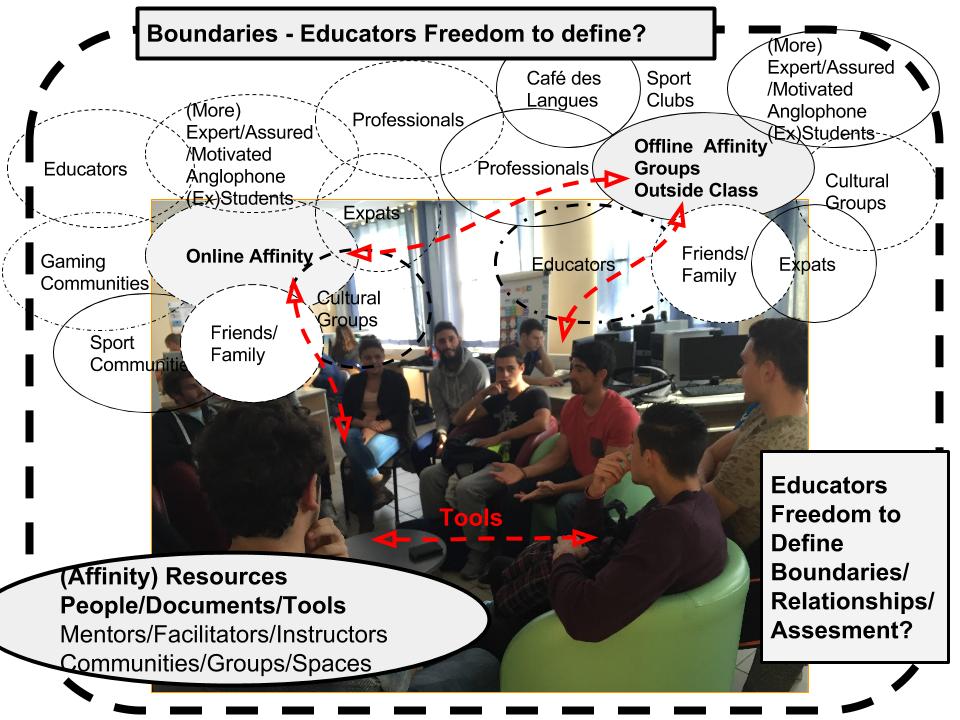
Mapping strategy.

Boundaries and Affinities.jpg
In my last post here, I was reflecting on the place of story in maps.

Our maps unfold as desire moves us...

The routes taken by others may be a help, an inspiration or an obstacle to our freedom.

I have been browsing Daniel Bassill's Tutor Mentor Site while reflecting on strategy.

I think of strategy as a means to enable adaptive action rather than a template which limits action.

There has been a clear strategy to maximise the possibility for spontaneous connection/play/dialogue.

There is an underlying desire to change relationships to nurture learner leadership.

Thanks to Terry Elliott and his leadership in annotation, I have been picking up on aspects of Daniel Bassill's site.

https://via.hypothes.is/http://www.tutormentorconnection.org/

I am just getting used to Hypothes.is having played with Diigo but am yet to really master it.

I note down annotations from Daniel's site here:

Enabling learner voice

https://hypothes.is/a/AVK79YdgvTW_3w8Lyx5U

I immediately see a connection to what I was doing earlier.

I was thinking of how I have been using learner/teacher/mentor narrative to modify the narrative space in which we work.

I note that this blog is my own narrative space. I suspect that as a narrative space it is also my map.

I think back to Narrative Essence...


It is perhaps atypical but enables me the freedom necessary to be really me.


I take a quick look some of the different resources that I have assembled over a period of five years.

I take a look at how CLAVIER is emerging and try to map the movement this year.


There is a clear movement away from trying to establish a horizontal multiplicity of institutional partners to a core group of partners and then making deeper connections with existing online or offline communities.


I note that students' narratives are evolving. 

The introduction of blogging enables such stories to be more easily shared.

These articles are typical:
They are more aware of the inequity of access to language learning communities and their motivation to learn is increased or at least their realisation that the classroom system has failed them means that they are less hard on themselves.

The education system not only fails them in languages, lack access to professional networks also limits their future life choices.

I realise aloud here, (up to now I was focussed on language learning) this is a much deeper problem. 

I think back to Daniel Bassill's tutor mentor work...

I resolve to widen my communication...

I resolve to widen mentor development.

I resolve to organise more meetings to work on this intra-institution at first.


Mentor stories such as these have had an effect on changing narrative space of students and teachers.

A student remarks on how a mentor has enabled him to widen his horizons as to future employment.


The same student talks of learning of the importance of networking thanks to another mentor.

Networks have been key to my own learning and efforts to build up an effective network of ex-students has proven again and again time well spent.  The institution unlike elite higher education institutions has no effective alumuni association. Students pass through, pass exams, and pass out of view. 

I note with pleasure a conversation with a current student who was able to use my contacts to help him quickly develop an event.


Mapping stories:  

https://hypothes.is/a/AVK8AhAXvTW_3w8Lyx55

The importance of connecting and visualising space and connecting story is remarkably present in Daniel Bassill's site.

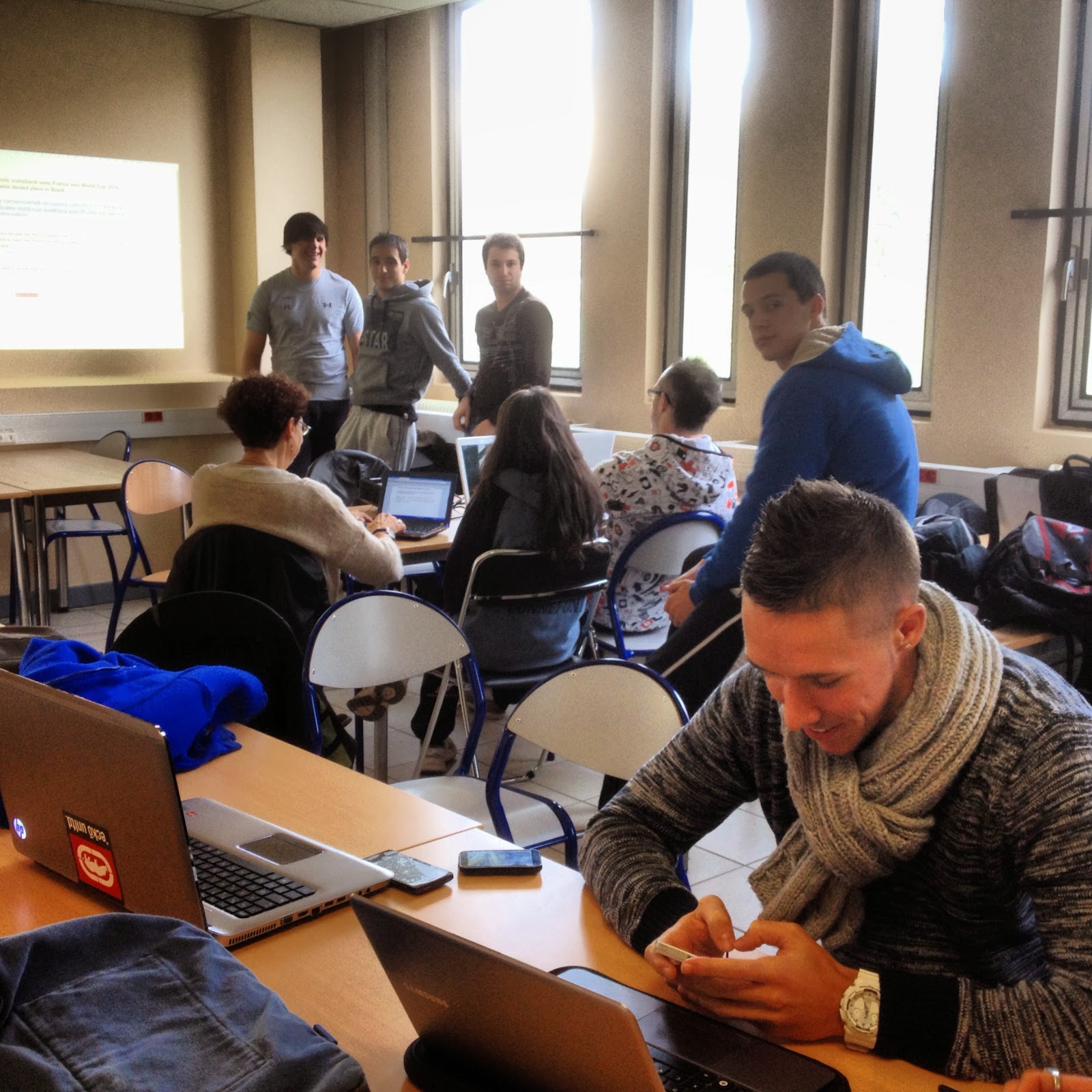
I have been obsessed with learning space and its effect on learning. I have collected images of how our learning space has changed from an isolated classroom. A few years ago the learners were anonymous students.


With traditional interaction orders.


To a fluidly connected learning hub.


Where individual learners are reflecting and sharing their reflection on educational roles.


Modifying learning spaces to include diverse personal/professional spaces and reimagining existing learning spaces.


And contributing to local communities while learning English and developing their literacies.


Keeping images of learning spaces has enabled active participation in a wider institutional projects.
Communicating more widely has enabled participation in projects to develop local communities.

Identifying Leaders/Partners

Thanks to student recommendation I have been put in contact with a teacher who is enabling learners to participate in meaningful associative work as part of their course. I have arranged a futher meeting. I am building up cross generational mentoring between year groups and between ex-students and current students and between other diverse mentors.

If I consider meetings over the past couple of weeks:

  • Establishing Connection between Finnish educators and local secondary school
  • Meeting with passionate young educator in the UK with motivated trainee teacher in France to participate in conference via hangout
  • Meeting with research colleagues in France, UK and Poland
  • Meeting with Polish employees of local multi-national and making connection with Polish colleagues
  • Communicating with Polish preservice teachers mentoring and researching local learners
  • Meeting at student-organised salon with key teachers

Redefining communication channels

I need to redefine boundaries of online spaces that I have set up.

Personal Web-Site: Tâches de Sens

CLAVIER Web-Site: clavedu.org

I need to spend a good deal of time to organise and put online the resources - like some of those here.

I need to work on and share my adaptive map of changing educational space.

Such a space is open to local and international communities and builds on narrative and learning which is generated not by a group of 'experts' but by wider community/ies.

This is education for the benefit of wider communities and not for a select number of lobbies who seek to generalise their dominant narrative and profit from the dependence of globally interchangeable, standardised, operatives.

PISA needs to be challenged...


I find myself quoting Abraham Lincoln:

"The best way to predict your future is to create it."


Sunday, January 24, 2016

Lines of flight...

These are early days...

1995 I bought my first computer and connected it to the internet.

1999 I got a fixed post at the university.


2000 I was working on an internet conected resource centre in France and building a web site.

These are early days...

2005 I was coordinating a team of local teachers in France to develop online learning resources for 2000 students. Most students are still using a text book in their classes at the university. At home they have workbooks. The books cost them 30 euros. They don't bring computers to class. Smartphones have not yet been invented. I am working alone in a classroom with a blackboard and chalk. Wifi doesn't exist yet in the classrooms. They are still doing exams in ampthitheatres.

These are early days...

2008 I am using Facebook with all my students as a means of extending the classroom.

2009 I have never written a blog post.

2010 I wrote one blog post. I didn't know what Twitter was.

These are early days...

2012 I no longer have a classroom, I am working with a colleague in and open connected space.

2015 I wrote 120 blog posts. I am working with teachers and mentors in France, UK, Italy, Poland, USA, Australia, Egypt, Singapore, Haiti. I am doing research with people in France and Poland.

A group of students have largely self-organised a four-day learning program in the UK with their peers.

I spend a good deal of time learning and working with groups of  peers in cMOOCS and communicate via Twitter, Google Plus, Facebook, Scoop It, Instagram, Blogs, Websites.

Students are working online and offline with other students and teachers from different countries.

They are learning to develop search literacies with a team of librarians, they are curating their research using a a web application Scoop It. Librarians are responsible for part of their English grade which is based on their explanation and reflection of their personal research approach.

I now have a database of 180 student curated collections made for their assessments. 


They are making videos posted on Youtube from their smartphones for their evaluations.
https://www.youtube.com/playlist?list=PLOnKtuBFJfkBITr38M0xpA1e25mOkPbXa

They are using collaborative Google Documents to complete self-directed reflective learning portfolios.  20% of their assessment is now dependent on the quality of their reflection. 20% of their assessment is based on work which they have chosen to do. 30% of their grade depends on their individual work - projects, videos, presentations, discussions.

Only 30% of their grade is directly dependent on their level in English.

No text books are used, no documents are assigned, all documents and projects are selected by the students. There is a box full of text books which the students can take home if they want (none of them do).

80% at least of students have a smartphone.

200 second year students have been evaluated on their networking activities with students in the UK.

40 students will be mentored by student teachers in Poland.

20 masters students have been working with students in Italy.

All students in one masters' program accepted to blog every day for a week in English and shared their posts with business people met around a hashtag.
http://www.inoreader.com/bundle/0014cd6371fb

Five years ago, I didn't know what a hashtag was.

These are early days...

2014-15 CLAVIER extended - the possibilities for more and more students and teachers to connect.


I started to question my role.

How did I want my learning activities, research activities, teaching activities, teaching and development activities to continue.

Some of the people that I work with are predominantly researchers.

Most of the people that I work with are teachers with varying contracts and varying motivations.

Did I want to be responsible for stretching out the possibilities to connect with students in other institutions?

Did I want to concentrate my energy on really developing a connected model of language learning in the classes that I am directly responsible for?

Did I want to spend much more time on research?

How best to connect to online and offline affinity groups?

Via institutions? Via existing informal or professional communities?

I am constantly (re)adapting my attention and energy depending on what connections open up effective learning possibilities for the students.

I have worked horizontally after a period of working alone vertically on my own digital literacies.

Now I am going to work on attempting to embed certain approaches not across language teaching networks but with colleagues in other disciplines to see if it possible to consolidate and deepen critical thinking, self-directed reflective learning, digital literacies, and in particular networking literacies...

Safe to fail

There is an expression that I gleaned from Dave Snowden and it is the concept of safe to fail.  I, we are working within what might be described as complex adaptive systems. Things are changing rapidly around us. There is no uninventing the internet possible, there is no uninventing the desire to fly.

Working on the edge of what is possible is potentially risky for those who want to stretch out.

The rewards are not necessarily obvious. Many will prefer to wait until there are viable means to fly as passengers...

I am constantly reassessing risk to myself and demanding what is sustainable.

We can get ahead of ourselves. We can be sucked into areas of turbulence or experience engine failure.

I strive for sustainable real talk with my fellow explorers, I really don't want to crash.

I rather prefer to take time to appreciate the view...

As someone once said, we are attempting to rebuild an aeroplane while flying it.

These are early days...