Showing posts with label digital literacy. Show all posts

Sunday, October 2, 2016

An indian summer.

"Do you want to stay here, or would you prefer to go outside over there?" I asked them.

"I'll follow you." I heard myself saying.


It was a beautiful afternoon of an "Indian Summer" on a grassy plateau in the Massif Central.

The people (students) sat down together in groups of various sizes and configurations and started to exchange.

A pair of them had come with food that they had prepared for the occasion, they shared their offerings with the newcomers.

I (an English teacher) moved from group to group stopping to listen and to speak with some of the people I knew (students) and with the newcomers who were from Nigeria, Columbia, Senegal, Finland, the USA, Ghana, China.

Dancing in the wild.

The newcomers, I had learnt the week before, had come from all around the world to study dance and anthropology together. I thought that the opportunity for an informal meeting of the minds would be mutually beneficial to everybody.

English would be the lingua franca for the occasion...dance might also be a useful means of communication and reflection, I thought to myself.

The people were all engaged in different conversations, some sitting, some standing, some speaking, some listening, some kneeling, some lying down.

None of the conversations were scripted, programmed or determined by myself (the teacher).

I pointed out that they might find some things in common...

As the afternoon went on the people moved changing the group compositions, changing the conversations.

Stories of resilience.

I spoke to a guy from Ghana and another from Senegal or Nigeria (I am not sure now) about their learning stories. They spoke to me of the difficulties they had had navigating classical expectations of parents or institutions to focus their attention on what some might consider a marginal activity - dance choreography and anthropology.

They spoke of the thousands of students in amphitheatres...

One spoke to me of trying to take law classes to dissimulate what he was really doing which was to follow dance anthropology classes at the university.

They had showed remarkable resilience in their desire to follow paths which they felt were essential to them.  I made a mental note of their stories for future reflection.

Emergent learning.

After a little while, the interaction in one group had mutated from conversation to a break dance battle.

On hearing the music, which was coming from someone's portable wireless speaker connected to a smartphone, all the other groups stopped conversing and stood up on the slopes to become an audience within an emergent, natural auditorium.

The dance had changed the nature of the space, the nature of the ritual.

There were whoops of delight, expressions of encouragement, cheers and clapping as the pair of dancers showed their moves.

After what seemed a good few minutes, the dancers stopped, some people grouped in pairs and started taking contact information, others were attracted by drumming coming from across the plateau, others went off to retrieve their belongings.


Massively Open Offline Class.

I moved with some of the people over to the other side of the plateau, passing a couple of girls with hijab attempting to walk across a slack line, a boy that I knew from one of my classes hanging upside down from a trapeze, a group of jugglers.

I stopped to speak with them and was greeted with a smile.

The activities had been organised as part of a festival to welcome new students to the university.

I overheard one student say to another:

"Why don't you tell your friends to tell the teacher that you had to miss class, this is much more interesting."

I looked back at concrete boxed classrooms and thought of those that they contained.

Once at the other side of the plateau, I was met with a group of African dancers in traditional dress who were acting as a magnet, attracting others to dance with them.

I recognised one or two of the dancers as those who had been with the class of students in the "English" class just before.

I spoke with the students watching the now active dancers of their meeting.

"Had that been a valuable learning experience?" I asked them.

The expression on their faces was eloquent, they all noted that it had indeed been both memorable and of interest to them.

I noted that some of them had been taking contact information from their new friends, had started organising times to meet.

They had at first oriented themselves.

They had shared declarations.

They had networked with these strangers.

Weak ties were being strengthened.

Now, they were clustering.

There had been clear focus on the spontaneous break-dance battle.

I shall remember this class as one with many connections from which to learn, an open space within which to roam. I thought of how this connected to my own experiences of (rhizomatic) learning online and offline.

Education for community

I thought of the street festival that had been organised by students I teach the weekend before.

I thought of the connections being made between them and the local community.

I thought of the wealth of the learning ecosystem within which they had been the actors.

I am fortunate working with people whose sporting, academic and professional activity takes them into so many diverse spaces.


Learner Resilience

I am wondering now about learner resilience.

Not all the students that I meet demonstrate the same determination as those African dancers.

Many need time to orient themselves.

Many have been so institutionalised that they are looking only to go through the minimal motions to get a grade.

Many classes, many spaces, many rituals, relations, reinforce such minimal transactions.


Strategies of school and deschooling.

Opening them up to imagining different relations, different activities or means to learn within the institution or outside of the institution is not straightforward - particularly when the institutional culture itself is the major obstacle.

I am now faced with two quandaries,which in effect are similar:

How do I go about facilitating the development of resilient learning networks and communites from within an institution in the most effective way?

How do I go about enabling learners to view the people around them - classmates, people in the street, in the town, on the internet as potential members of their learning networks?

How do I go about enabling learners to benefit from paths trodden and links made (online or offline)without overwhelming them with my own paths, links, conclusions, beliefs, culture?

One problem for me concerns digital literacies, the need (or not) to develop the desire/skills/competences necessary to be able to learn effectively. In order to do this, it is essential that I build alliances and find convergences with my colleagues who may not necessarily see the interest themselves in developing those digital literacies which I would consider essential for some if not all of the students that I work with. I am thinking of the work of Ken Bauer, Gardner Campbell, Alan Levine and Jim Groom here...

I shall follow my curiosity...
Another problem concerns the visual organisation of existing learning opportunities, activities offline and online.  It is essential to use learner generated 'slug trails' to point to new possibilities within those over familiar boxes.

Photos, videos, personal testimonies, stories, demonstrations, all must play their part, I have been curating those over the past few years.

I have been teaching students how to create digitally, to research critically, to curate, and share, to network offline and online with CLAVIER.

I suppose what is essential now is to make those connections with other colleagues to enable that ecosystem to really weave deeper and wider. I am seeing more and more convergences in ways of thinking, and ways of teaching.

I must invest time on key nodes.

I must map, I think of Daniel Bassill.

I suppose that is what I have been doing with my research.

(idiot - you have been mapping continuously for bloody years - he says to himself).

I am collecting the bits, now I need to find the most effective ways to enable learners to access them.

I must find time, I must find time.

I think of Daniel Bassill.

It's not that I must.

It's that I want to.

I want to.

I have for some time been working towards setting up some sort of "learning bank/make bank".

I must develop connections further. I must map.  I must map.

Priorities, priorities.

Time is precious, my resources and influence are limited, the pressure to fit students, teachers and learning into 'managed paths' and standardised outcomes, in predictable rectangular boxes, with interchangeable teacher operatives is considerable.

I have already seen promising projects killed this year through lack of support...

It is no time to be a nobody.

Fuck that.

I shall enjoy my time as this nobody.

I am heartened by the idea that for the moment at least, in France, university is seen as a public service where students are not to be endebted for years thereafter.

How long will this last?

Fuck that.

We can only do what we can do, with our feeble means...

Learning in an age of abundance?

I think for a -moment of the term: "learning in an age of abundance".

I think we need to reassess what we mean by abundance.

I think of the term 'Indian Summer'.

I make a few mental notes to address

  • the idea of learning, the idea of colonisation in "the wild" and the notion of "wilderness"
  • conflicting notions of enlightenment and transcendence. (Note to self: Les Maux Des Mots.)
  • conflict between capitalism and sustainable ecosystems.

What is it that Dave Cormier says?

Content is people?

I can never remember.

An age of abundance can surely not be reduced to people, even less to bloody information, or data.

I rather hope now that he is thinking of inviting people to reflect on learning/learner resilience now.

I rather suspect that I am ready for that now.

He probably isn't.

Whatever...

Looking back, looking around, looking forward, looking around.

I look at the presentations that I was doing earlier in the year when I was in Poland.

Suddenly, they take on renewed importance.

I shall study them again.


I shall reorient.


Well that was an  unexpected flurry of typing.


Footnote.

Special note: Terry Elliott's recent posts sparked enthusiasm to review this post and to extend it.

Fuck knows why.


Footnote to self.

Note Cynefin Framework and Dave Snowden's Party Organisation. 

How not to manage complexity.


Tuesday, March 1, 2016

Better read then dead.


"They don't bloody read anything these days."

We are clearly not alone in Clermont Ferrand. 

Here is some throwaway data:

Reading for Pleasure

Teacher guided question to students: 

"What do you read?"

Student guarded answers to teacher: 

"I don't read. I don't like reading."

"I read l'Equipe (sports newspaper.)"

"I don't really like reading much."

"I never read."

"I never read."

"Ad infinitum."

Weird Student answer to teacher [2% of class]:

"I like Science Fiction."
"I love Harry Potter."
"I like Manga."

Outlandishly weird student answer to teacher [probably an Alien]:

"I like Wittgenstein."

Reading for Academic Purposes.

Student remark to teacher:

"I don't understand why I got a bad grade."

Teacher response to student:

"Did you read the instructions?"

Student answer to teacher:

"But it's all in English."

Teacher retort to student:

"But this IS an ENGLISH class."

Student reply:

"....mgrammggrrr........[mumbles something.]" 

Student goes off.
Teacher sighs.

Student writing for Academic Purposes.

Teacher question to student: 

"Did you write this yourself?"

Student response to teacher:

"Yes of course. I used Google translate."

Teacher comment to student:

"Ah, yes that is why you translated 'collant' with 'sticky'....
 The girl is not wearing stickies. They are tights."

Student response to teacher:

"Oh! But it took me a lot of time to type that."

Teacher response to student:

"....mmggrmmgrrr[mumbles something]"

Teacher goes off.
Student goes off.

Student writing for pleasure.

[No data.]

Remarks on data.

OK, so this data is clearly not representative of all groups of students everywhere and all that.

These are French undergraduate sport science students (except the Alien who was a maths student)in Clermont Ferrand [in France not very near Paris].

I am sure that we can find small pockets of geek participatory fan fiction fanatics somewhere hidden in the campus. 

I haven't come across this rare species to date.

It could be a research project.

Atlantic Data

I thought I had better go and find some more data. 

I thought the Pew Research Centre might provide me with some cool data.

I found an article in the Atlantic entitled "The Decline of the American Book Lover."

I recommend it. 

It is a cool read.

It has cool data.

Transatlantic Data

I thought about this with my colleague after reading or should I say listening to Terry Elliott in Kentucky raging.

Here is a link to his rage:


I love repetitive RAGE.

You can rage with him on hypothes.is

I added some David Bowie rage.

He is all the rage again now he is dead. (note cool graphic effect - very The Next Day):

"People are so fucking dumb. Nobody reads anymore, nobody goes out and looks and explores the society and culture they were brought up in. People have attention spans of five seconds and as much depth as a glass of water." David Bowie

I recommend you go and rage with David and Terry. 

They do it so well.

Books. Who needs them?

We were doing video projects the other day. 

One of the girls came in to show me a couple of videos that she had made to publicise a night-club.

She was really proud of her work. 

She had done both of them following the practice she had had in English class in video making.

Maybe we should give up crying over books or at least books with writing.

Do people cry about scrolls?

Do people cry about parchment?

I suppose they might.

It is sad.

I must not lack empathy for their predicament.

They might beat me with their scroll [and hidden truncheon].

That would hurt.

Better read then dead.

I thought of all the books that I had read.
I thought of all the books that I cherish.
I thought of all the books we took to the second hand shop.

I found another David Bowie raging quote (note cool graphic effect - which makes it illegible):

"I'm a real self-educated kind of guy. I read voraciously. Every book I ever bought, I have. I can't throw it away. It's physically impossible to leave my hand! Some of them are in warehouses. I've got a library that I keep the ones I really really like. I look around my library some nights and I do these terrible things to myself--I count up the books and think, how long I might have to live and think, 'F@#%k, I can't read two-thirds of these books.' It overwhelms me with sadness." --David Bowie, quoted in the Daily Beast in a 2002 interview with Bob Guccione, Jr. David Bowie


Not having a large library like David Bowie makes me less overwhelmed with sadness.

I am sad that David Bowie died.

I shall not need a warehouse.

That is my fate.

God Bless the Kindle.

What they eye doesn't see...


Tuesday, November 17, 2015

Meadow

You never quite know what will pop up.

Wild flowers scatter seeds around the meadow.

Some are carried by animals others by the wind...

A little while later, you discover that some of them have fallen in fertile ground.

As you study the different species and take soil samples, note the season, the humidity, you start to see patterns.

What is apparently chaotic, haphazard, is not.

Chaos has order...of sorts.

If learning is a mechanism (a word which I think is inapplicable to the natural world) then this is how it can be observed.


I have witnessed some examples over the past few days.

I asked my students to create tutorial videos last year.

One of the students, Maxence http://cordomac.blogspot.fr made a rock-climbing video with his friend Romain.

It suddenly and quite unexpectedly popped up in a Twitter conversation between somebody in Australia and someone in France.


That work which had been done a year before suddenly had popped up.


A conversation with an ex-student the year before had led to him coming to participate in class. I have learnt to capture instants so that others may benefit from them at another moment.

I videoed a conversation in French.


As I had the video, I posted it into a a document for students in the Sports Management class.  Now most people would say that if you want people to make progress in English you only have documents in English. Counterintuitively the French video sparked English writing.

Here, in Sylvain's blog http://sylvainben.blogspot.fr/2015/11/the-diversity-of-job-opportunities-in.html, he responds to the video which captured his attention his reflection written in English.

I comment on the blog, giving him the link to the video, now on Youtube, to enable him to reflect on using diversified media in his blog. His blog added to the video, enriched by comments by myself and Bruno Winck now becomes a powerful tool to demonstrate a simple principle.

What counts for me, is not 'content' per se, but people who share personal or personally sourced resources with others

A book as Dave Cormier would say is a stupid person who can no longer interact. 

Appropriately, unexpectedly the concept of rhizomatic learning pops up here.


Learning in open networks is messy and challenging.

Learners need to develop 'crap detection' skills


Learners need to understand the importance of networking with people to find mentors and experts and friends.

Learners need to learn the importance of sharing their work.

Learners need to learn how to curate.

I found a student, Huseyin who blogged on the question of information overload.
https://huseyinaydinblog.wordpress.com/2015/11/16/day-1-wolweekchallenge/


I can see now what the next classes will include...


Monday, April 6, 2015

A birthday party.

That birthday party in the pub was probably a bad idea from the start...


First the choice of that pub was not to the taste of the wine bar crowd.

Then the animal-rights crew were complaining about the choice of pub food.

Then the bloody rock-climbers found nothing better to do than to start climbing around the pub lounge walls, having decided to attempt the first un-aided traverse from the bar to the toilets.

The landlord had to wipe the guys off the wall when he came to pick up the empty glasses.

Things were going from bad to worse.

Then they went pear-shaped.

John-Jo turned up half-drunk.

He started trying to chat up Samantha's girl-friend.

The inevitable argument broke out.

I had to act quickly.

I managed to get him out of the door without him actually hitting anybody.

Phew...

What on earth had I been thinking?

It was absolutely bloody obvious.

I was a complete idiot!

All these people had only one thing in common: they were my friends.

They all represented quite separate parts of my life.

They weren't supposed to meet.

They all (except John-Jo) stayed long enough to sing Happy Birthday.

I was touched.

A few years later...

I was reminded of this occasion, while reading a blog which spoke of on-line tension during #rhizo14.

I was thinking about how difficult it is for there not to be conflict in on-line interaction, even if it is not explicit.

There are the very different people who turn up to a course.

Then there are the varying levels of digital literacies which enable different levels of  participation.

Then there are the varying levels of competence in the languages used during the course.

Then there are the vastly different cultural backgrounds of the people.

Then there are the very different expectations of these very different people who turn up.

Then there are the very different life experiences of the participants who are attempting to interact with people who may be complete strangers.

Then there are the multiple interpretations possible of what is said, written, done, by the others.

Then there are the multiple interpretations possible of what is unsaid, unwritten, undone, by the others.

Then there are the pre-existing relations, tensions, between the participants.

Then there is the over-stretched course-host, trying to jolly everybody along, trying to put out fires...


Last orders..

Looking back now, it was a shame that John-Jo got himself drunk.

Maybe he would have liked Samantha on another day,  given time.

Perhaps, Samantha would have realised (given a long time) that he wasn't just an idiot?

I could have told her that he wasn't always as scary as he had appeared...when he had been drinking.

If he drank, it was because things scared him less...when he had been drinking...

There was no time to explain.

Thinking about it now, I view things very differently.

Those same people, those same events, have a very different message for me today.

Time changes things...

Maybe the guys climbing those pub walls were opening up a window to a different world for us?

Maybe those times of tension, of conflict were our most precious moments?

Maybe what was memorable, wasn't such plain-sailing?

Maybe it takes time to appreciate what we learn from idiots?

I don't regret that birthday party now.

One lives and learns...


Wednesday, October 29, 2014

Planet of the apes?

Planet of the apes, is surely one of my top three movies featuring Charlton Heston.

It is a wonderful morality tale for our DOT (com) age.


Man's savagery is out-savaged by the apes.
Ape culture is to the fore.

That icon to the age of enlightenment, the Statue of Liberty herself, is found derelict on a beach by an agonising Charlton.

God! Nobody does agonising better than Charlton.


My top three Charlton Heston movies are, in no particular order:


  • Planet of the Apes (for the Statue of Liberty scene)
  • Ben Hur (for the chariot race)
  • Bowling for Columbine (for Maryline Manson).


Return to Planet of the Apes

Actually, it was Howard Rheingold who got me reminiscing about Charlton's agony.

I was watching one of my favourite hangouts from the Connected Courses Studios featuring John Udell, Howard Rheingold, and Gardner Campbell entitled "Thinking Like the Web" and there were some remarks of Howard's which caught my imagination;

"You know the irony of this issue, of people saying, 'I'm really not a technical person, why should I use the web?' is that the web was such a wonderful step that enabled people who weren't technical people to use the internet. You don't have to go through any kind of technical depths in order to move from one internet site to another, you click on a link. 

You don't have to go through some kind of command line arcana to do things on the web, there are forms for that. 

I think it is a little like saying, 'Well I don't intend to be a published author why should I learn to read and write?' We're living in a literate world, if you don't read and write, you are disempowering yourself. 

You are not necessarily going to choose a career in literature, you are participating in the power that the literate community conveys on anybody who goes through the quite a bit of trouble to learn to read and write."

I am struck by the irony of the mass of research funding which has gone into enabling humans to communicate with our cousins the apes.

Latest developments in ape-education include (no kidding) iPads!!


Despite our best efforts, and millions of dollars in research funding, literary critics are sadly disappointed at ape efforts to produce great works of art.

Complete works

Apes - 0
Shakespeare - Quite a lot.

Just think of the quality of post-renaissance literature embodied by William Shakespeare.

Thank goodness that he had  forward looking parents!

Thank goodness for Will's remix artfulness!

Learning to read and write must have been seen my some as new-fangled in those days.

School wasn't even compulsory at the time!!

Measure for measure.

Back in the lab...
(you know the one responsible for ape-mutations leading to our downfall and Charlton's agony)

Wise scientists are pessimistic that apes will ever be able to, to... ape Will's best efforts:

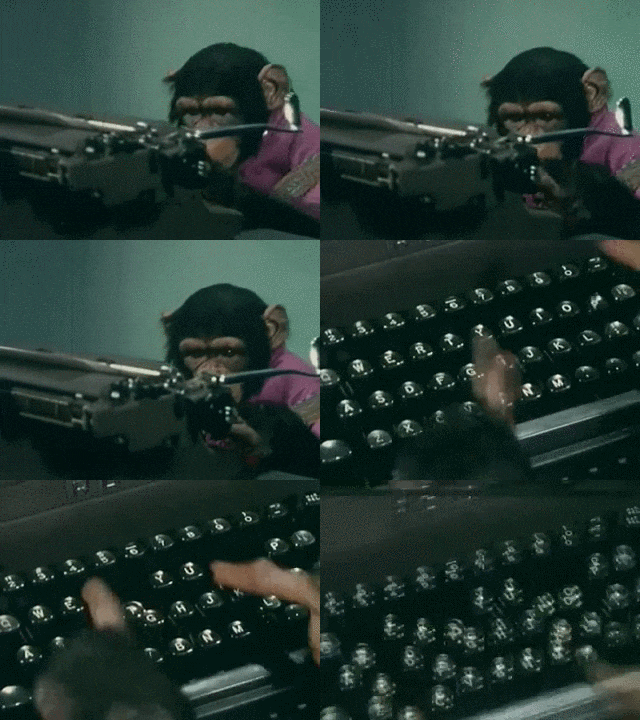
"Is it really feasible that a chimpanzee with a typewriter and an infinite amount of time will be able to produce the complete works of Shakespeare?"


Dumb and Dumber

So we are giving apes, iPads to undumb them.

So we are giving kids iPhones and worrying that such technology is dumbing them down.

We are arousing moral panic about:

in the same way that our elders and bettters did in the 18th century about novels .

Protect our vulnerable ladies and children.

Oh the irony!

Such trashy, morally suspect stuff as is now studied in length at school.

Moll Flanders anyone?

We complain that kids waste their time on the most sophisticated communication tools ever devised playing Candy Crush, taking Selfies, and ban them from classrooms, so that we can concentrate on studying 18th century novels and writing essays.

Do most kids know how to write essays with a pen before we teach them?
Do most kids know how to use the web and social media to learn before we teach them?
Do most kids need to learn how to learn about living in their present and their future?

It is unlikely that either apes or kids will be writing many 18th century novels now...sniff.

What the hell is the point of education?

Is it a) clicking for cheap bananas?
Is it b) clicking for freedom of expression?
Is it c) clicking away the clicker?

Declaration of independence anyone?

It is certain that our  current vision of freedom has much to do with a revolution of thinking and of communication which has its roots in the 18th century.

Maybe we are forgetting the long struggle for people's hearts and minds which enabled such freedom?

Maybe we are forgetting the connection between the introduction of new technology and new ideas, new forms of art?

Manifesto anyone?

I would suggest that digital technology does not dumb down apes any more than it dumbs us down.

I would suggest that we need to learn with our kids how to use digital technology like smartphones to communicate widely and create new forms of art.

I would suggest that our masters are no longer nationally or geographically dependent.

I would suggest that Amazon is no longer simply the brave young girl accompanying Charlton.

I would suggest that our own species and other more vulnerable species are in danger.

I would suggest that we need to learn how to use the web to participate in discussions on what constitutes Liberty in a net-age, unless of course in our DOT-age we want to become captive signing-apes in a zoo.


Thank you Howard, Gardner and John for your inspiration.