Showing posts with label rhizomatic learning. Show all posts

Sunday, August 26, 2018

New jazz perspectives.

Simon Ensor
Susan Watson

What's the connection?

At first sight there appears little in common between the two images shown above.  

To understand the connection between the two you will need some back-story. 

Back story to the connection.

As mentionned before, I have been tagging along with Connected Learning MOOC, and their daily doodling prompts,  

Susan Watson, the artist of the second image above is one of the leading co-learners and facilitators. 

Without her and other key people (who and what is key fluctuates), who participate in different online spaces at different rhythms, with different objectives, and different perspectives, I wouldn't be learning what I am learning at the moment.  

There are moments of distance from what others are doing, of apparent disconnection, of fatigue, demoralisation, boredom and then quite unpredictably moments of rapid progress.

I have found the same in learning languages, you can imagine that you will never ever understand a thing, that you will never be able to speak.

Given sufficient motivation, drive, urgency, given people around you to learn with, to support and encourage, given sufficient time invested in failing, failing, failing better, you suddenly realise that you are in a different place altogether. 

Learning ain't linear.

So here's the connection:

Over the past few days, I have gradually been discovering new perspectives. 

Indeed, it is this key concept which connects the two afore-mentionned images.

I had noticed a post of Susan's on Facebook which mentionned the word "perspective."

"Am not sure what part me seeing your work with Perspective has inspired me to go back to basics which I never worked at ðŸ™‚ Thank you"

I had also started following artists on Instagram to alter my attention feed.

Some of the artists' work appears formulaic and soul-less, they appear to weaponise technique.

I feel myself impressed by their photorealistic productions but left cold.

Where is the emotion? 
Where is the human? 

I find myself coming back to a conversation with Susan on Facebook.

Both of us are at a point where we are looking to go beyond what comes easily.

In my case, I can doodle and scribble and app smash to effect but I feel myself disatisfied with my technical limits. Susan was working on a big project and found herself limited technically. We found ourselves brought together. 

this is how connected learning works ðŸ™‚ Started looking at online resources. Find this guy very clear https://www.youtube.com/user/LighterNoteProd

I had always looked to safeguard my childish soul and independence.

I note here a conversation with my daughter.

She came to draw a lantern with me. 

She looked at her rapidly drawn lantern and then mine and said:

"Your's is really good."


Her frustration at not doing a "good drawing" damped her enthusiasm there and then.

She wasn't ready to give up her child's perspective, her independence.

She would much rather have drawn a unicorn with rainbow colours...

I remember getting bored at the still lives we had been asked to draw at school.

Bloody still life...more like dead life...

I had been unready to work on repetitive practice of perspective at school. 

Art had little by little become another school subject.

Furthermore, any joy of artful expression had been quelled by their insistence on "sensible" career choices and time tables.

No, you would do better to work on more "academic subjects" they said.

I felt, over the years, a dull thudding of regret. 

It had only been in Mr Edwards (if I remember his name) classes where we were left to our devices, and nurtured by Led Zeppelin.

He understood where it was at.

(I note a resonance of Howard Rheingold's story of school and the art classes taught by his mother.)

The rest of school was often times: do the exercise, do the test, do the exam...for marks.

FUCK MARKS...

Another riff: escaping echo chambers, halls of mirrors....

Academic feeds on Twitter have felt to me more and more about  reputation economy management and less and less about learning these days, more and more about Western perspective economics...

But, what's the connection?

I find myself noting: 

"Do we need to bow down to peer reviewed and anointed experts, or search...for personal perspectives...for recognisable wisdom?"

I think of our social media environment...our galleries...

From Twitter's, Instagram's/Facebook's/Google's business perspective model the quality of the content is secondary to the capture of attention...and the cash that comes from it.

If shit captures attention and shit is cheap then shit it will be....

If sufficient numbers of people like, share, buy into shit then shit it will be.

If sufficient numbers of academics cite your shit then shit it will be.

If sufficient numbers of key academics cite your shit then your shit is recognised.

If sufficient numbers of art collectors buy into your shit then your shit is recognised and your market value goes up.

Quantity of tweets, that is to say the frequency with which tweets are made is key.

Quantity of articles published, that is to say the frequency with which articles are published is key.

Quantity of pictures on the market with a high market value is key.

It's academic my dear AK.

A conversation with my friend Apostolos the other day about PHD's confirmed to me..again...the sterility of much of that world. 

Repetitive technique...no soul.

Produce what sells...

AK was talking about a conversation with a supervisor who had noted a lack of "recognised references" to "key academics". It all seems more about paying tribute in some sort of feudal kingdom. 

A conversation with my friend Sarah about academic voice led to a call to Nick Sousanis for support.


The fact that Nick's wonderful, ground-breaking thesis, "Unflattering" was drawn connects here...

A look at Nick's technical brilliance in "Unflattering" is a tribute to time, attention, talent, independent research and personal inspiration.

No slavish, soulless academic pandering there.

The human shines out.

All that jazz...

So the prompt from the daily doodle was "jazz". 

Jazz is the name of our dog.

I didn't feel any inspiration to start drawing a dog...again.
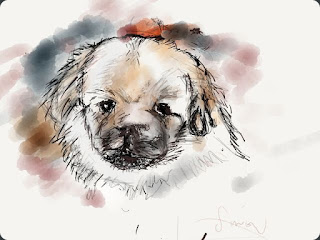

I didn't feel any inspiration to start drawing a saxophist either. 

I was much too much taken up with failing to draw rectangles - boxes, cupboards, trunks, boxes, televisions, tables, boxes, et al in perspective.

BOXES, BOXES, BOXES...!

I found an artist's grid app to put on my phone.

I worked and worked at finding the right angles, the right lines.

I went and found a couple of Youtube tutorials to learn to get my boxes drawn with perspective.


I worked and worked repetitively at drawing and redrawing boxes, cupboards, books.

One might even say that the work and the research was academic...

I think back to my child self...

He would have found it all terribly boring.

Jazz, Prog Rock, and Punk

The thought of jazz made me curious about the music.

For many listeners jazz can sound strange, improvisations, dischords may challenge.

For other listeners, jazz can sound academic, intellectual, opaque.

Being of that generation in the late seventies, I remember Emerson Lake and Palmer.

I have to admit to having bought records of "prog-rock" - hours of twiddling, pomp, and pretention.

Camel, Yes (oh no), Genesis, (at its worst), Rick Wakemen and his seven wives...and seventy keyboards.

I thought about the extraordinary technique behind the best playing of jazz, progressive rock.

Hour upon hour of practice.

THEN THERE WAS PUNK and TWO TONE.

In an instant, the twiddling and twaddling, hobbits and fairies gave way to ...

ANARCHY and GHOST TOWN.

BUT THEN THERE HAD BEEN JAZZ.

I went and found some information about the history of jazz and found an article:

You will be shot: Five ways jazz can be punk.

"Jazz is a sponge for outside sounds. Add another idea to it — say, European classical or gospel-inflected R&B music — and it absorbs, assimilating the sound into a new subgenre: like "third stream" or "soul jazz," respectively. Wring it out, and its own improvisatory essence remains in the mix.
It's hard to imagine something that could be further in sound and structure from jazz than punk rock, but punk and jazz do have elements in common — the most important being attitude. Whether it came from the boundary-pushing free jazz of the late '50s or the experimental electronic sounds of the late '60s and '70s, the spirit of adventure, creativity and thumbing one's nose at "the rules" has always been a part of jazz's historical trajectory."
Jazz and Basquiat...

I find myself thinking back to my Facebook conversation with Susan.

Jazz impro without technique very limited ðŸ™‚ Contrasting Punk and Classical/Academic. Basquiat and Rembrandt ðŸ™‚

I went and did a bit of research into Basquiat.

At first sight, there doesn't seem too much connection between his work and jazz.

I would have thought about hip hop, street influences...

But...

Bowie, Bach and Bebop: How Music Powered Basquiat

If ever there were sponges it would be Bowie and ...Basquiat.


"When Basquiat was around, she recalled, “music was playing all the time.”

On Thursday, the exhibition “Basquiat: Boom for Real” opened at the Barbican Center in London. The show focuses on the artist’s relationship to music, text, film and television. But it is jazz — the musical style that made up the bulk of Basquiat’s huge record collection — that looms largest as a source of personal inspiration to him and as a subject matter."


"Basquiat’s tastes were eclectic: Curtis Mayfield, Donna Summer, Bach, Beethoven, David Byrne, Charlie Parker, Miles Davis, Aretha Franklin, Public Image Ltd.’s “Metal Box” album."


"Basquiat was especially devoted to bebop, the restlessly inventive genre typified by the likes of Parker, Davis, Ornette Coleman and Thelonious Monk. Basquiat’s love of bebop fueled his art, said Eleanor Nairne, co-curator of “Boom for Real.”


“Bebop was quite an intellectual movement,” she said. “It was also quite iconoclastic in wanting to break away from these older jazz harmonies. That idea of a kind of rupture, and of these musicians who were very young, vibrant powerful forces; there were lots of parallels he found with his own work and life.”


"The multifaceted nature of the scene gave Basquiat license to crisscross artistic forms on the way to developing his own style."


What is the connection?

"Connected learning combines personal interests, supportive relationships, and opportunties. It is learning in an age of abundant access to information and social connection that embraces the diverse backgrounds and interests of all young people."


"The research is clear: Learning is irresistable and life-changing when it connects personal interests to meaningful relationships and realworld opportunity."


"Learning is motivating when it grows out of personal interest. A growing body of research indicates that interest helps us pay attention, make connections, persist and engage in deeper learning."

Footnotes.

Like the succession of boxes, I will come back and study my scribbling here with new eyes.

I have already come back and cut and edited a bit.

We are constantly redrawing our lines.

I won't try to hide it.

I always preferred annotated artist's sketch books to uncontextualised finished "masterpieces" floating on a gallery wall.






Sunday, February 11, 2018

Defining CLAVIER.


"I am by nature uncomfortable with definitions: I tend to prefer contextual conversations with permeable "working" definitions and shades of gray. I think openness has many shades of gray."

Bonnie Stewart.

https://elearnmag.acm.org/archive.cfm?aid=3185174

"This time of walls and travel bans demands conviction and ingenuity from critical digital educators concerned with gestures of openness and hospitality. To change the landscape on both sides of the walls that are being built to keep us apart, we need to show up and collaborate wherever we can."

Maha Bali and Kate Bowles.


http://www.digitalpedagogylab.com/sides-networked-learning-world-walls/

CLAVIER. WTF?

was the working title for our conference submission for the Unicollab conference in Krakow.

In an attempt to define this acronym from my perspective I brought together blog-posts, photos, presentations, quotes et al.

It is a challenge to make sense of it.  

DEFINITIONS

One has to start somewhere so I started with the acronym's constitutive words:

CLAVIER: Clermont and Warwick Virtual Intercultural Exchange Research.

CLAVIER: Connected Learning and Virtual Intercultural Exchange Research Network.

CLAVIER: "a Moodle course." I found this in a document and smiled.

CLAVIER Network: "a large-scale exchange that puts emphasis on informal interaction with minimal intervention from instructors. In this network, students can determine the nature of the activities that they would like to be engaged in and choose communication channels to blur the boundaries between formal and informal learning."
https://scholarspace.manoa.hawaii.edu/bitstream/10125/44578/1/22_01_review%201_luogui.pdf

This attempt is already much more explicit and closer to what I would consider the truth, maybe it was written by my friend Teresa Mackinnon :-).

One cannot disassociate intercultural online/offline practice from research in CLAVIER.

ONLINE OFFLINE FORMAL INFORMAL 

"blur the boundaries between formal and informal learning."

One might add: "blur the boundaries between online and offline."

One might add: "blur the boundaries between institional partnerships and online communities and affinity groups"

One might add: "blur the boundaries between disciplines."

One might add: "blur the boundaries between practice and research."


MULTIPLE SPACES/TOOLS ONLINE/OFFLINE

One might emphasise pragmatic and critical use of technology: if formal platforms were the initial starting point for the Warwick and Clermont exchange, they were not used at all for other partnerships or exchanges.

Tools used have depended on the types of exchange and its objectives and on the personal choice of the participants. A suggested Facebook group creation, for example, was rejected by students this year who preferred to rely on Facebook group messaging. One or two students have refused to use internet and have preferred to exchange letters. Student or teacher choices are discussed and respected.


fig3.jpg


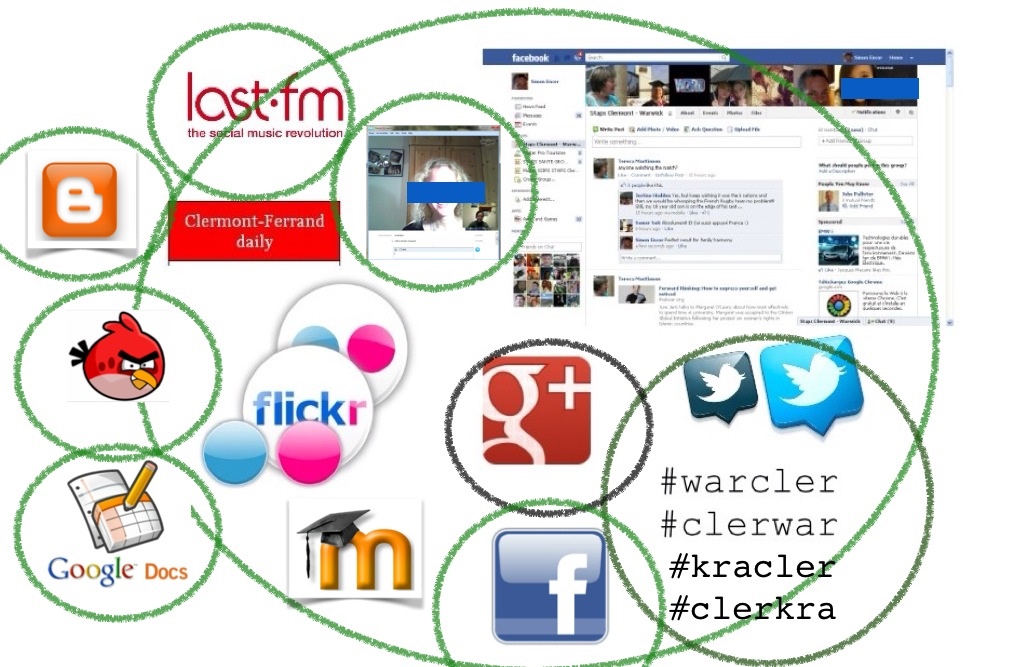
CLAVIER: Moodle, Blackboard IM, Blackboard Collaborate, Skype, Google Documents, Google Hang-outs,Google Plus Communities, Youtube, Blogger, Storify, Wordpress, Twitter, Instagram, Facebook, What's App, email, snailmail.

CLAVIER: "A Moodle Course" er not really.

MULTIPLE ACTIVITIES

Over seven years,a diverse range of activities has been used, depending on the exchange, on the moment.

Activities can be long-term or pop-up, teacher or student led.

CLAVIER: Information exchange, intercultural exchange, Cultura questionaires, surveys, collaborative story-telling, collaborative project development, video creation, blogging, tweeting, pod-casting, chat, email, video-conferencing, visit organisation, visit coordination, travel, professional interview simulation, gifting, conferences, teaching practice, teaching observation, research, teacher training.


MULTIPLE PARTERSHIPS/COMMUNITIES

The multiple partnerships and communities which have constituted CLAVIER have been identified with acronyms, some of which have become used as searchable hashtags on social media.

CLAVIER:  #CLAVIER#WARCLER/#CLERWAR CLERKRA/KRACLER MOLCLER/OUCLER/DAKCLER/KANCLER/SANCLER/LINCLER/#CLAVEDU/CLAVBUS
#CLAVMED/WARKRA


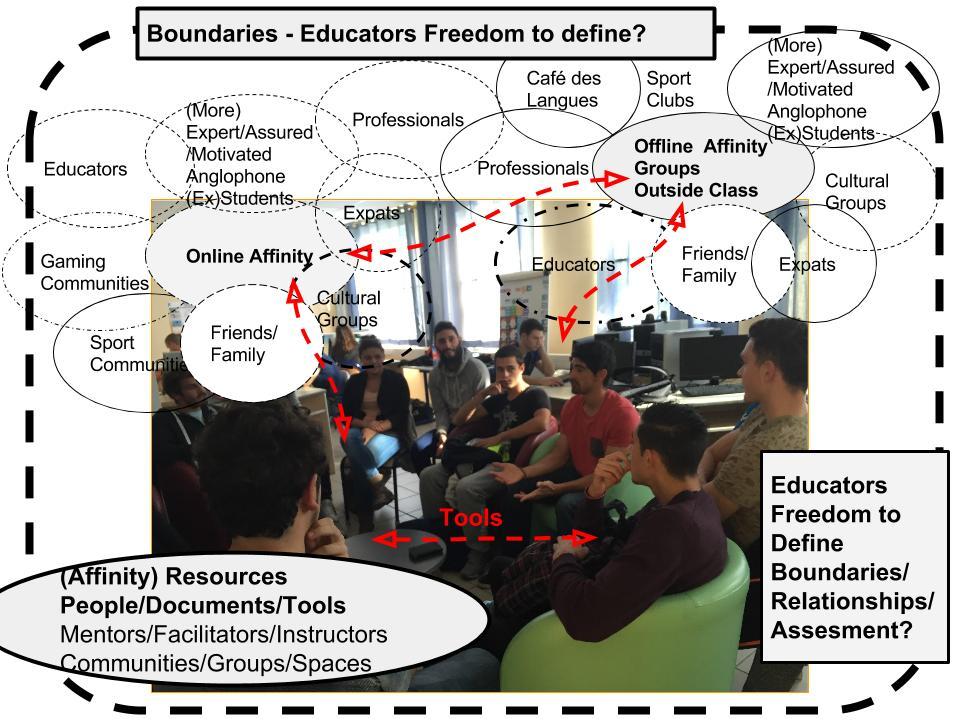
A key term for CLAVIER is affinity

Networks have developed via academic, professional or personal affinity.

Such personal affinity networks have also been identified with hashtags. These are some examples:

#CLAVFOOT/#CLAVROCK/#CLAVSKI/#CLAVMUSO/#CLAVSCIENCE/#CLAVSTORIES

CONNECTING, CRISS-CROSSING, DEEPENING 

"Learning is the formation of connections in a network." 
Stephen Downes

I take a look at the top tags on Touches of Sense...

CONNECTION is first, then C(onnnected)Courses, then #rhizo14 (Rhizomatic Learning), Education, Learning, Freedom, then, #rhizo15 (Rhizomatic Learning), then C(onnected)L(earning)MOOC, then Creativity, Meaning, and Complexity.

CLAVIER: Connected Learning and Virtual Intercultural Exchange Research.

Blog post titles tagged CLAVIER express connection...repetitively:


Connecting Desire(s)
Pinball Machine
(Dis)connections.

A closer look at these posts' associated tags, and the multiple connections are evident.

CLAVIER & RHIZO14
CLAVIER & CLMOOC
CLAVIER & DIGIWRIMO

Ad infinitum.

Criss-crossing...


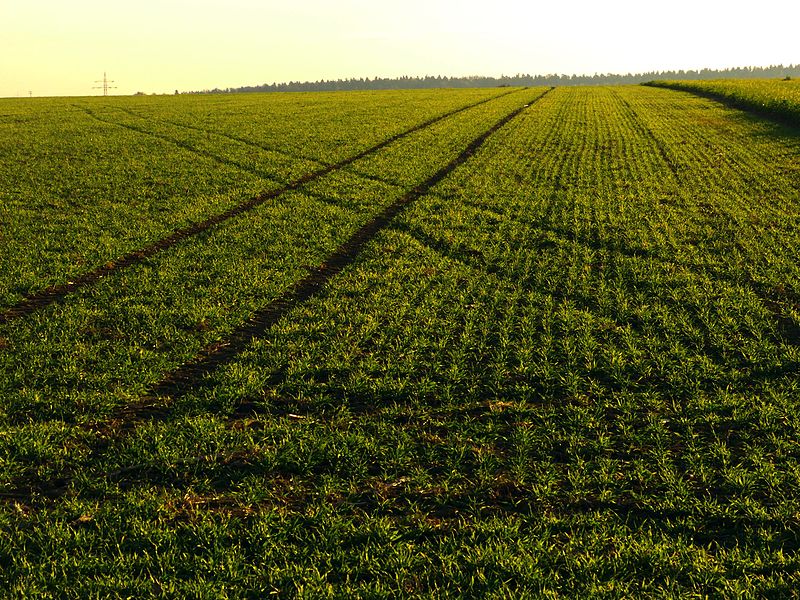
"criss-crossing verb gerund or present participle: criss-crossing.

form a pattern of intersecting lines or paths on (a place).

"the green hill was criss-crossed with a network of sheep tracks"

Move around or travel around (a place) by going back and forth repeatedly."

"It was the third and fourth time that we had physical exchanges with students from Poland and the UK. It is these criss-crossing of paths with enable us to learn deeply and gradually to change together. It is a slow at times pain-staking process."


Over a period of seven years, I have connected and reconnected with people in different contexts online, people in #rhizo14 pop up and connect in #clmooc, in @vconnecting, in #digiwrimo, in #digped.  Inevitably highly connected educators like myself or Teresa act as bridging nodes between vast numbers of people who may be offline or online.

I am constantly meeting people who I have only known online in offline contexts.

My personal/professional/academic learning networks inevitably blur boundaries of what constitutes CLAVIER. 

My personal/professional/academic interests are already blurred

One or two photos, one or two activities can help demonstrate this.


"It is when those distant voices come to people our little boxes an instant and change them for ever that we realise that we do indeed share common and for ever shifting ground."
http://tachesdesens.blogspot.fr/2017/03/criss-crossing.html

This photo is from what I have decided is a "CLAVIER" album. 

CLAVIER connects people - teachers, learners, professionals, singers, dancers...whoever.

We have a class which I am teaching in Clermont Ferrand on the campus. Terry over in Kentucky is speaking about education (he took the decision not to school his kids) in a hangout with the teachers in a classroom via a smartphone which is being passed around a huddle of teachers. 

I met Terry online, during the rhizo14 MOOC. We have become very good friends, working together on poetry, meeting for intermittent pop-up hangouts called "CLAVPICNICS". On the bottom left is Marcin, my colleague and friend in Poland, next to him is Maritta, my colleague and friend in Finland, then we have a teacher in the classroom, and on the far right we have Teresa, my colleague and friend in the UK.  

You can see a similar scene in this photo, with students and my laptop.


“Happy Birthday
Then it was Maha's Birthday, why don't we sing 'Happy Birthday' I thought, - well why not?


In thirty seconds, their singing was on the internet winging its way to Egypt, and the USA, and Brazil, and Australia...well wherever.


Pretty quickly, Kevin had remixed their song, Terry had Zeega'ed the birthday meme in Arabic, Maha had blogged on it and sent back a sung response to my students (they are unaware of that for the moment unless the one Tweep has done his job for the masses and sent it viral in Clermont Ferrand STAPS)”

http://tachesdesens.blogspot.fr/2014/09/the-spaceman-episode.html

"Road Trip

...they had actually written a song in English - entitled...Road Trip. I took a photo of their manuscipt:


I then got another student to capture their performance to post to Youtube.
At 12:00 I tweeted the following message:


Three hours later, a tweet arrived from Egypt...

This regular and insistant and long-term criss-crossing of boundaries, and ties between people for me is what really constitutes INTERCULTURAL learning. 

One can not learn to know (people) without this constant, long-term criss-crossing and  deliberate reflective questioning.

"The only way to make borders meaningless is to keep insisting on crossing them: like a refugee, without papers, without waiting to be given permission, without regard for what might be waiting on the other side. For when you cross a border, you are not only affirming its permeability, but also changing the landscape on both sides. You cross carrying what you can carry, you cross bearing witness, you cross knowing that you are damageable, that you are mortal and finite, but that language is memory, and memory lives on."

Lina Mounzer

It is the moments when we experience discomfort, dissonance, conflict even, that we learn the most.

Little by little I note a change in the landscape of the environment in which I am working.

Little by litle I note a change in my own perceptions as to what "open" is limited by, as to what freedom might be, as to the limits of empathy in understanding the lives of others, as to what my own privilege blinds me to, as to what my own criss-crossing identities are.


COMPLEXITY INFORMED TEACHING

One cannot disconnect CLAVIER from a context of long-term pedagogical research which seeks to discover how to teach in a digitally connected environment.

CLAVIER, from my perspective is an integral part of this, my personal development as a teacher. 

It is also why,I have sought to extend connections across my institution not only with language teachers but with those in other disciplines.

I make no distinction between distant and local digitally-enabled connections.


If an offline context/event/action might benefit other people then I document it and teach/encourage students to do so and share with appropriate people or communities.

A video of a meeting enables others to watch it at a later date.

A photo of an activity enables others to see it and experiment.

Affinity groups have popped up from student desires.

This year we have had a Facebook messenger enabled local rock-climbing group and a Facebook group enabled "run in English group". The students have expressed a desire to combine their passions with English practice and meeting new people and I have facilitated their development by acting as a bridging node between them and existing local communities online. 

I have also been working with distant humanitarian associations, for example, in Nepal to enable students to engage their energies in such actions.


A quick look at my Facebook messenger account and I have numerous ongoing conversations which vary from students from Krakow and Clermont Ferrand discussing an upcoming visit to France to a multi-national group talking about Humanitarian missions.

OPEN, DIGITALLY ENHANCED, PEDAGOGY


I suppose this  behaviour of connecting and sharing is at the heart of "Open education" or open practices in business like the "Working Out Loud" movement.

I look at other CLAVIER tagged posts on Touches of Sense....

Reaching out.
Out of the box.
Lines of flight.

[For myself, I am driven by wanting to know what lies on the other side, on the outside. 

The thought of going through the motions in a closed box defined by others is an anathema. 

Education, conceived as the following of pre-conceived, closely monitored, continuously measured and institutionally badged "learning paths" is some sort of vision of hell.

I will fight to open the door. 

Maybe I have been fighting to open the door to Corporate America?

I am constantly troubled by this "digital" "freedom", this opening of our lives our education systems to corporate surveillance and profit.

I sign up to "engagemooc" via Twitter.

It is not much resistance to this dystopian "future".  

I wonder to what extent I am designing my own echoing digital prison. 

Out of an institutional box into a corporate box. 

Deleuze and Guattari reference: 

Capitalism and Schizoprenia. 

I am uncomfortably aware of my own schizoprenia...]

Digital literacies: critical media literacy, video creation, collaborative writing, graphic creation, is embedded into our pedagogy in Clermont.

Active, collaborative project-based pedagogy is a major part of how we work. 

Portfolio assessment developed in both Clermont and Warwick reflects a common desire to bring together formal and informal learning, online and offline communication.

One cannot disassociate easily personal/professional/academic spheres.

Academics or professionals are often at ease with formal tasks and language but insist on the importance of "small talk" and general conversation.

Our multiple identities demand that our complexity be taken into account by teachers. 

This recent research presentation from a conference in Corsica seeks to map complexity informed practices and identify bridges or barriers to future development.


It was accompanied with a Virtually Connecting hangout facilitated by Teresa to enable distant particpants to access the conference and to contribute to discussions.  Unfortunately lack of reliable wifi disconnected us but didn't prevent a valuable discussion to be recorded between Teresa and Martina Emke of the Open University.


Our work with CLAVIER demands transcultural, transmedia, and transdisciplinary connection and collaboration.

Our work on open learning spaces and our documenting of our experiences has also influenced and led to Clermont language teachers being associated with the development of a transdisciplinary open learning space (later aborted).


ORGANIC, NATURAL, RHIZOMATIC, COMPLEX

In conversations with Teresa in particular, we have always associated CLAVIER with unpredictable rhizomatic development. Depending on who you speak with, it has different forms, and for some people they wouldn't associate CLAVIER with their exchange activity at all. 


  • Le « principe de connexion et d'hétérogénéité » implique que le rhizome se forme par liaisons d'éléments hétérogènes sans qu'un ordre préalable assigne des places à chaque élément : « [...] n'importe quel point d'un rhizome peut être connecté à un autre, et doit l'être »6.

Marcin tells me he is going to be in Warwick in February with a group of students.

A student asks me if he can include his ongoing video-conferencing with a Warwick correspondent he met the year before in this year's portfolios.

A student tweets me a photo of his weekend with a Warwick student he met two years before.

I am witness to a Facebook conversation concerning a reunion between students who have met in Krakow three years before.

  • Le « principe de multiplicité » : la multiplicité est « [...] l'organisation propre du multiple en tant que tel, qui n'a nullement besoin de l'unité pour former un système »7, c'est-à-dire que la multiplicité ne peut être artificiellement unifiée et totalisée par une forme surplombante. la multiplicité est une forme de prolifération immanente et autonome.

CLAVIER undoubtedly demonstrates multiplicity in its organisation, it has no unity, there is no central organisation. Its development is unhierarchical and non-centralised. I can see a fair amount of its emerging features but nobody would be able to have a reliable overview of any outline.

  • Le « principe de rupture assignifiante » qui caractérise l'absence d'ordre, de hiérarchie entre les éléments et surtout l'absence positive d'articulations prédéfinies, contrairement aux arborescences ou systèmes organiques qui prévoient et localisent leurs faiblesses afin d'organiser les ruptures possibles : « un rhizome peut être rompu, brisé en un endroit quelconque »8.

CLAVIER as exemplified by stories of student exchanges popping up after years of dormancy can be ruptured and then reconnect in different forms.

I am contacted by Marcin to meet up with a group of Polish students for the New Year, two of them are with Marcin in Krakow a third is in Canada. They have left the university. I met up with them the last time I was in Krakow for and Erasmus trip. They have become friends.

  • Le « principe de cartographie et de décalcomanie », c'est-à-dire que la carte s'oppose ici au calque, en ce que le calque est reproduction d'un état de chose bien identifié qu'il suffit de représenter. Au contraire, la carte est un tracé original qui rend un aspect du réel que nous ne connaissions pas encore (une carte peut présenter des entrées multiples et un même espace peut être symbolisé par un grand nombre de cartes différentes).

You couldn't reproduce CLAVIER it has no unified plan, it is for ever changing.

It may/must/can only be represented by multiple maps.

Maps fixed like this blog post are only ever incomplete and related to a particular moment.

I am writing to map meaning.

A search of blog post titles here on Touches of Sense and Teresa's conference presentations express the organic and rhizomatic nature of this network.

A search of images which illustrate the blog posts reinforce this insistance on complex perspectives.

CLAVIERFlower Vases and IrisesGrowing like Topsy, Sowing seeds, Little seeds little signs,

“Things are going haywire”
“As another term starts, after only one week, things are going haywire. First day in class, we had students chatting with a friend of mine working on a Ski Resort in Australia, during the week we had students reading my blog, seeing their snow hat from last winter being commented on by people all around the world and retweeted by Rihanna (a robot - I kept that quiet not to spoil the effect) on Twitter.”


NATURE, NETWORK, NURTURE

I find a presentation given to a group of Marcin's students in Krakow about rhizomatic learning for an Erasmus Teaching Staff Mission.

Is this CLAVIER
Is this Rhizo14?

It is connected learning in a digitally networked environment.


TOUCHES OF SENSE...


CLAVIERBuilding Bridges...

We are forever building bridges...making connections.

I find another CLAVIER tagged post here:

"Vectors of virus." 

"I'm a rat."

I said to the teacher between classes.

It had suddenly occurred to me that I had identified my role.

It is an image that has crossed my mind over the past few days.

I get into places where I shouldn't.

I am a carrier of  viruses.

There are positive viruses, there are negative viruses.

Those judgements depend on your values.

http://tachesdesens.blogspot.fr/2017/03/vectors-of-virus.html

CLAVIER -  RESEARCH and/or MAPPING

It is becoming increasingly apparent that both 

Touches of sense...

CLAVIER 
are:

RESEARCH or MAPPING adventures.

“Writing has nothing to do with meaning. It has to do with landsurveying and cartography, including the mapping of countries yet to come.” 
Gilles Deleuze

Mapping strategy

Mapping Touches of Sense...

CLAVIER is some sort of attempt to map countries yet to come.

"It is because modern education is so seldom inspired by a great hope that it so seldom achieves great results. The wish to preserve the past rather than the hope of creating the future dominates the minds of those who control the teaching of the young"

Bertand Russell