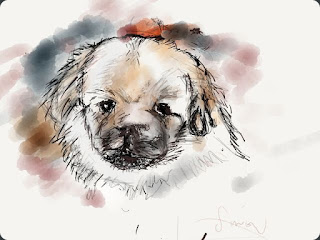
I had spent a little less than a month working on portraits, drawn or painted from photos, and then, unannounced, this face emerged.
He stares out of the page, an unsettling presence.
There are stories to imagine, none to tell.
Well as far as I am concerned he was a piece of recreation.
I simply played with colours and forms until it said stop.
I stopped to contemplate what he or it might mean for future acts.
I find working purposefully, in a concentrated manner on study , on technique, tiring but valuable. I realise that this will be a constant source of frustration but also a challenge and a potential source of satisfaction.
I am not really sure how the idea of completing 30 portraits came about, it just did.
It is this path which arouses my curiosity, which begs me to retrace my steps.
Taking bearings.
Why, I ask myself, does one image attract at a particular moment?
There are people who have an eye that I treasure.
There are people who have a way with words that inspire.
There are those photos that come back to me that I go to search for years after.
What determines this toing and froing from, repetitive technical exercise to recreation?
Instinctively, intrinscially motivated moments of studied effort, concentration, intermingle with instintively motivated moments of freely formed, instinctive creativity.
The monster can't appear without the work on portraiture, the monster can't appear without the freedom to create.
Mapping not tracing.
Mapping most often involves taking knowledge of the lines of others inorder to trace one's own steps....
I suppose what I find so wrong about much of classical education is that teachers don't wait for students to naturally and instinctively search for answers, for mastery, to their own personal questions, to map out their own personal paths.
Most of the time creativity is not called for, only unthinking tracing.
I find myself taking screen shots of the artwork of others, as reference, as inspiration.
I find myself watching documentaries retracing the artistic paths of others.
Moments of serenity, moments of despair....
I think again how objects, images, memories become markers on our maps, moorings for our lives.
I think again how motifs model meaning.
I think about the challenges to accepted motifs and the creation of new forms of art.
I think of how loss of attachment, mooring, meaning, leads us to fearful despair, confusion or outrage.
Tides, waves, lunar movements...
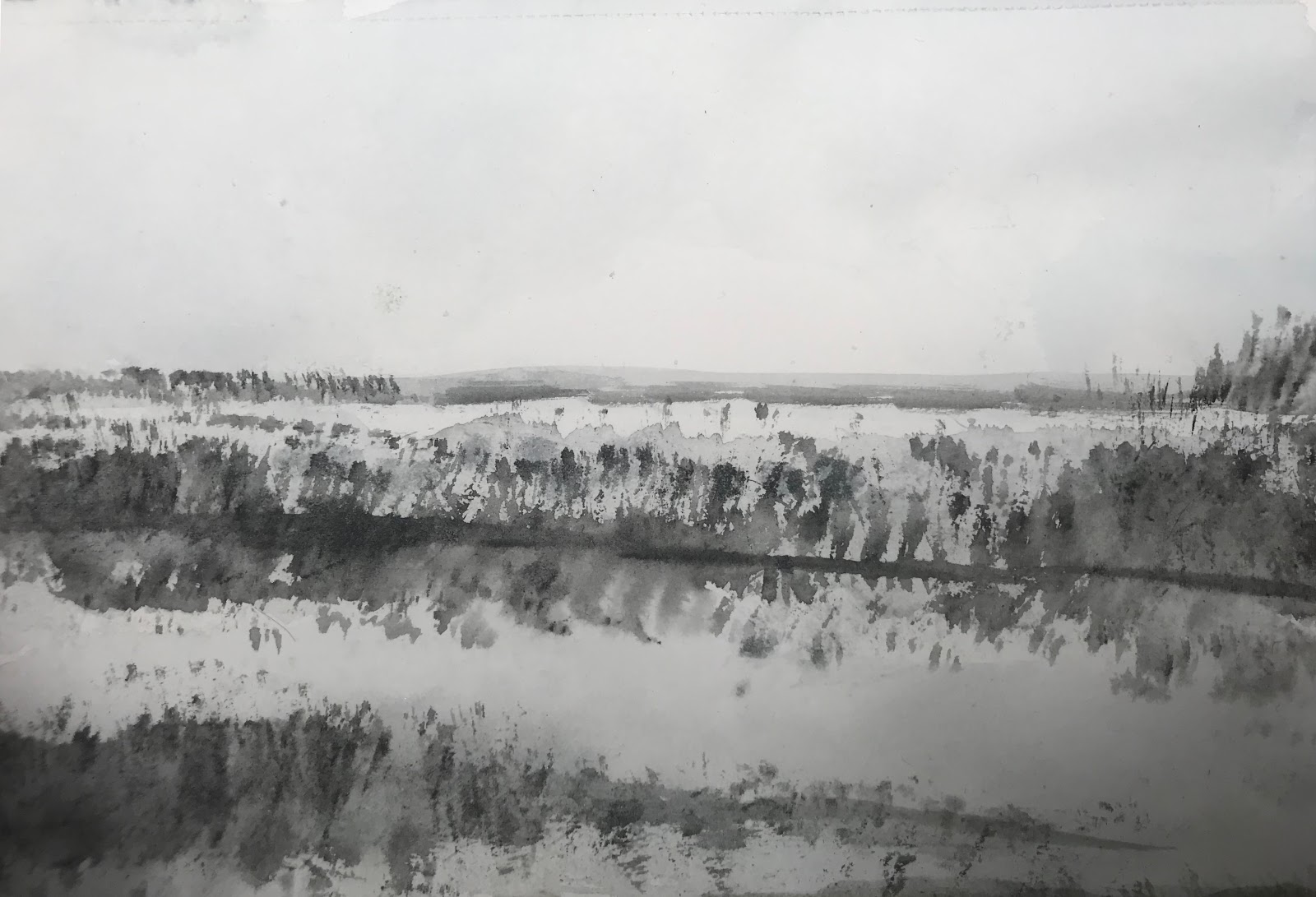
I leave people and portraits and find refuge in landscape.
As I draw, I branch off, my eye drawn around the room.
I glance over at my bookcase and see the mountaineering section, the aikido section, the Stanislavski and Chekov books on acting, the various tomes concerning educational research from the past ten years. Each section represents moments, hours, years of attention, enthusiasm, passion, and its waning.
There are seasons, tides, reverberations, which somehow connect in my thoughts, memories, writing, drawing, painting....
Living for many years on the coast, moving backwards and forwards between two countries separated by the sea, looking at photos from series of annual trips across the channel, the sea is a constant motif in my existence.
“There were profound reasons for his attachment to the sea: he loved it because as a hardworking artist he needed rest, needed to escape from the demanding complexity of phenomena and lie hidden on the bosom of the simple and tremendous; because of a forbidden longing deep within him that ran quite contrary to his life's task and was for that very reason seductive, a longing for the unarticulated and immeasurable, for eternity, for nothingness. To rest in the arms of perfection is the desire of any man intent upon creating excellence; and is not nothingness a form of perfection?” ― Thomas Mann, Death in Venice and Other Tales
Casting off moorings.
Strangely, time appears for this work, when time before appeared absent.
How is it that after so many years, I find this time to paint?
Maybe, I have cast off those moorings that were holding me back.
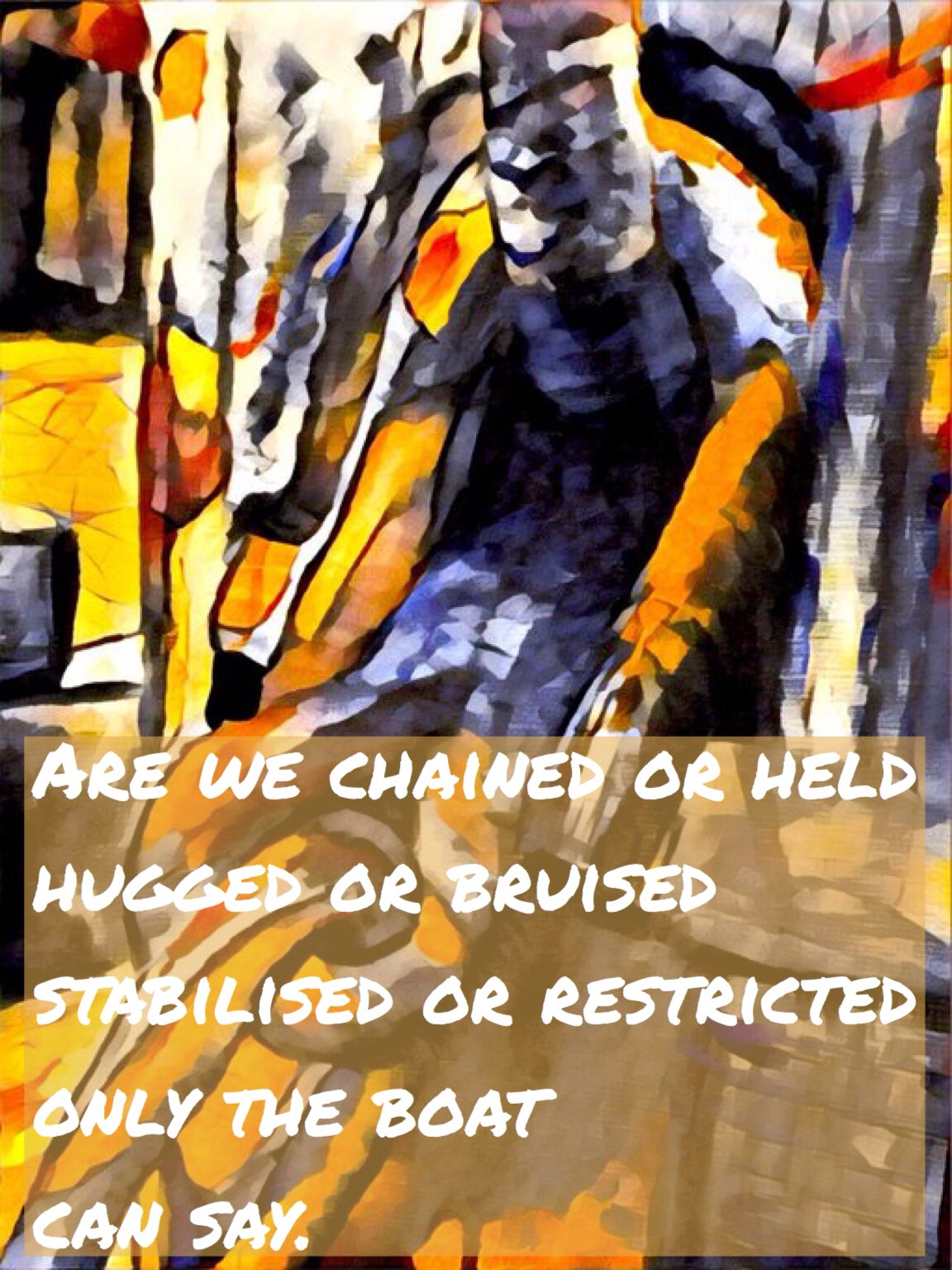
I find a poem on the Mooring image from Wendy Taleo. It finds its place somehow here.
I don't really know why it is that I am pausing here to write a few notes in this "ship's log".
At first sight there appears little in common between the two images shown above.
To understand the connection between the two you will need some back-story.
Back story to the connection.
As mentionned before, I have been tagging along with Connected Learning MOOC, and their daily doodling prompts,
Susan Watson, the artist of the second image above is one of the leading co-learners and facilitators.
Without her and other key people (who and what is key fluctuates), who participate in different online spaces at different rhythms, with different objectives, and different perspectives, I wouldn't be learning what I am learning at the moment.
There are moments of distance from what others are doing, of apparent disconnection, of fatigue, demoralisation, boredom and then quite unpredictably moments of rapid progress.
I have found the same in learning languages, you can imagine that you will never ever understand a thing, that you will never be able to speak.
Given sufficient motivation, drive, urgency, given people around you to learn with, to support and encourage, given sufficient time invested in failing, failing, failing better, you suddenly realise that you are in a different place altogether.
Learning ain't linear.
So here's the connection:
Over the past few days, I have gradually been discovering new perspectives.
Indeed, it is this key concept which connects the two afore-mentionned images.
I had noticed a post of Susan's on Facebook which mentionned the word "perspective."
"Am not sure what part me seeing your work with Perspective has inspired me to go back to basics which I never worked at 🙂 Thank you"
I had also started following artists on Instagram to alter my attention feed.
Some of the artists' work appears formulaic and soul-less, they appear to weaponise technique.
I feel myself impressed by their photorealistic productions but left cold.
Where is the emotion?
Where is the human?
I find myself coming back to a conversation with Susan on Facebook.
Both of us are at a point where we are looking to go beyond what comes easily.
In my case, I can doodle and scribble and app smash to effect but I feel myself disatisfied with my technical limits. Susan was working on a big project and found herself limited technically. We found ourselves brought together.
I had always looked to safeguard my childish soul and independence.
I note here a conversation with my daughter.
She came to draw a lantern with me.
She looked at her rapidly drawn lantern and then mine and said:
"Your's is really good."
Her frustration at not doing a "good drawing" damped her enthusiasm there and then.
She wasn't ready to give up her child's perspective, her independence.
She would much rather have drawn a unicorn with rainbow colours...
I remember getting bored at the still lives we had been asked to draw at school.
Bloody still life...more like dead life...
I had been unready to work on repetitive practice of perspective at school.
Art had little by little become another school subject.
Furthermore, any joy of artful expression had been quelled by their insistence on "sensible" career choices and time tables.
No, you would do better to work on more "academic subjects" they said.
I felt, over the years, a dull thudding of regret.
It had only been in Mr Edwards (if I remember his name) classes where we were left to our devices, and nurtured by Led Zeppelin.
He understood where it was at.
(I note a resonance of Howard Rheingold's story of school and the art classes taught by his mother.)
The rest of school was often times: do the exercise, do the test, do the exam...for marks.
FUCK MARKS...
Another riff: escaping echo chambers, halls of mirrors....
Academic feeds on Twitter have felt to me more and more about reputation economy management and less and less about learning these days, more and more about Western perspective economics...
But, what's the connection?
I find myself noting:
"Do we need to bow down to peer reviewed and anointed experts, or search...for personal perspectives...for recognisable wisdom?"
I think of our social media environment...our galleries...
From Twitter's, Instagram's/Facebook's/Google's business perspective model the quality of the content is secondary to the capture of attention...and the cash that comes from it.
If shit captures attention and shit is cheap then shit it will be....
If sufficient numbers of people like, share, buy into shit then shit it will be.
If sufficient numbers of academics cite your shit then shit it will be.
If sufficient numbers of key academics cite your shit then your shit is recognised.
If sufficient numbers of art collectors buy into your shit then your shit is recognised and your market value goes up.
Quantity of tweets, that is to say the frequency with which tweets are made is key.
Quantity of articles published, that is to say the frequency with which articles are published is key.
Quantity of pictures on the market with a high market value is key.
It's academic my dear AK.
A conversation with my friend Apostolos the other day about PHD's confirmed to me..again...the sterility of much of that world.
Repetitive technique...no soul.
Produce what sells...
AK was talking about a conversation with a supervisor who had noted a lack of "recognised references" to "key academics". It all seems more about paying tribute in some sort of feudal kingdom.
A conversation with my friend Sarah about academic voice led to a call to Nick Sousanis for support.
Quite! Stick to your guns. Use their voices as data to analyse, as part of process. This is exactly how I would write thesis. If you don’t challenge « objective » « academic voice » you may as well accept you are just another brick in their bloody wall...
Alternatively accept it’s (also) a bureaucratic passport to an academic status and do what they tell you. Your story reminds me of my friend and colleague Rosemary who did thesis on paganism.
I was thinking about Nick as I was writing. Coz, you know, I don't think what I am wanting to do is as big a step as his was, but apparently others see it as a digression
"Jazz is a sponge for outside sounds. Add another idea to it — say, European classical or gospel-inflected R&B music — and it absorbs, assimilating the sound into a new subgenre: like "third stream" or "soul jazz," respectively. Wring it out, and its own improvisatory essence remains in the mix.
It's hard to imagine something that could be further in sound and structure from jazz than punk rock, but punk and jazz do have elements in common — the most important being attitude. Whether it came from the boundary-pushing free jazz of the late '50s or the experimental electronic sounds of the late '60s and '70s, the spirit of adventure, creativity and thumbing one's nose at "the rules" has always been a part of jazz's historical trajectory."
Jazz and Basquiat... I find myself thinking back to my Facebook conversation with Susan.
Jazz impro without technique very limited 🙂 Contrasting Punk and Classical/Academic. Basquiat and Rembrandt 🙂
I went and did a bit of research into Basquiat.
At first sight, there doesn't seem too much connection between his work and jazz.
I would have thought about hip hop, street influences...
If ever there were sponges it would be Bowie and ...Basquiat.
"When Basquiat was around, she recalled, “music was playing all the time.”
On Thursday, the exhibition “Basquiat: Boom for Real” opened at the Barbican Center in London. The show focuses on the artist’s relationship to music, text, film and television. But it is jazz — the musical style that made up the bulk of Basquiat’s huge record collection — that looms largest as a source of personal inspiration to him and as a subject matter."
"Basquiat’s tastes were eclectic: Curtis Mayfield, Donna Summer, Bach, Beethoven, David Byrne, Charlie Parker, Miles Davis, Aretha Franklin, Public Image Ltd.’s “Metal Box” album."
"Basquiat was especially devoted to bebop, the restlessly inventive genre typified by the likes of Parker, Davis, Ornette Coleman and Thelonious Monk. Basquiat’s love of bebop fueled his art, said Eleanor Nairne, co-curator of “Boom for Real.”
“Bebop was quite an intellectual movement,” she said. “It was also quite iconoclastic in wanting to break away from these older jazz harmonies. That idea of a kind of rupture, and of these musicians who were very young, vibrant powerful forces; there were lots of parallels he found with his own work and life.”
"The multifaceted nature of the scene gave Basquiat license to crisscross artistic forms on the way to developing his own style."
What is the connection?
"Connected learning combines personal interests, supportive relationships, and opportunties. It is learning in an age of abundant access to information and social connection that embraces the diverse backgrounds and interests of all young people."
"The research is clear: Learning is irresistable and life-changing when it connects personal interests to meaningful relationships and realworld opportunity."
"Learning is motivating when it grows out of personal interest. A growing body of research indicates that interest helps us pay attention, make connections, persist and engage in deeper learning."
Footnotes.
Like the succession of boxes, I will come back and study my scribbling here with new eyes.
I have already come back and cut and edited a bit.
We are constantly redrawing our lines.
I won't try to hide it.
I always preferred annotated artist's sketch books to uncontextualised finished "masterpieces" floating on a gallery wall.
Halfway through scene one, I realised that I had been wildly optimistic....
My mind was a horrific blank.
I would never get to see Birnam wood for the trees.
It was perhaps the curse of the Scottish Play.
So proud had I been to be given the starring role, so confident was I that I would be able to pull it off with a minimum effort, I usurped my position, I didn't respect the author who had given us custody of his work.
I grabbed a copy of the book, nobody seemed much to care, the other kids didn't know their lines either.
That didn't make any difference to how I felt.
I felt that I was cheating.
As the play advanced, fragments of the key monologues came back to me, I was able to pocket the book.
"Is this a dagger that I see before me, the handle toward my hand?"
"Out out brief candle."
"It is a tale told by an idiot...signifying nothing."
Apart from breaking a glass just before the appearance of Banquo's ghost, things went pretty well.
The audience seemed generally enthralled by our performance.
We even got a laugh when the ghost screeched out in agony (he walked on the broken glass).
"Ow, ouch, ow..."
"Blood hath been shed ere now..."
Thrilled by the applause, I decided that I would have to take things a bit more seriously and learn my lines.
With mastery of the text, I would really be able to appreciate the play, immerse myself in the action.
I decided that I loved Shakespeare.
I was very fortunate that I had teachers who let us play, and one in particular who let us discover the blood, the terror, the laugther, the beauty of the text which might have seemed so disconnected from us.
We went to Stratford, we marvelled at the Tempest, he shared with us his passion. He made the content of the class come alive.
We were the content.
I have thinking recently about the apparent separation between 'content' and 'conversation' between 'transmission' and 'dialogue', I am coming to the conclusion that there is a false dichotomy being made.
As an actor, I learnt how to memorise text, how to leave myself behind, how to reach out to my memories embodied to create not illusion but theatrical reality.
As an aikidoka, I learnt how to repeat movements, to mirror my partners movements, to experience the energy in the connection between us.
As a learner, I learnt which authors would excite me, would arouse my curiosity, would teach me what I needed to know.
Lecture.
I have been thinking about the teachers who really performed, who really educated, and those who made no connection with us. Even their texts were poor, not even a brilliant performer could have brought them to life.
Content is nothing without connection.
Learning is nothing without dialogue.
Education is nothing without morality.
Connection for connection is pretty vacant.
Eye-candy, junk food, common core
I think of the time that young kids spend on junk, on the net, in the canteen, at school.
There is no beauty, no risk, no care, no feeling, just numbers, numbers, numbers.
I also think he is right to change his choice of collocation from 'submit to authority' to 'respect authority' as he has done in the comment stream.
I don't think that 'content' disconnected from a respectful relationship between co-learners is a vision of education to which I adhere to. I am pretty sure that Bill would agree with me on that.
When an actor performs on stage, there is respect for the authority of the author but there is also respect for the essential role of the audience in bringing the story to life.
When a teacher attempts/learns to transmit knowledge, there must be a respect for the dialogue between himself and the learners - they are sharing in an educational performance. It is for this that I would use the term 'co-learner'.
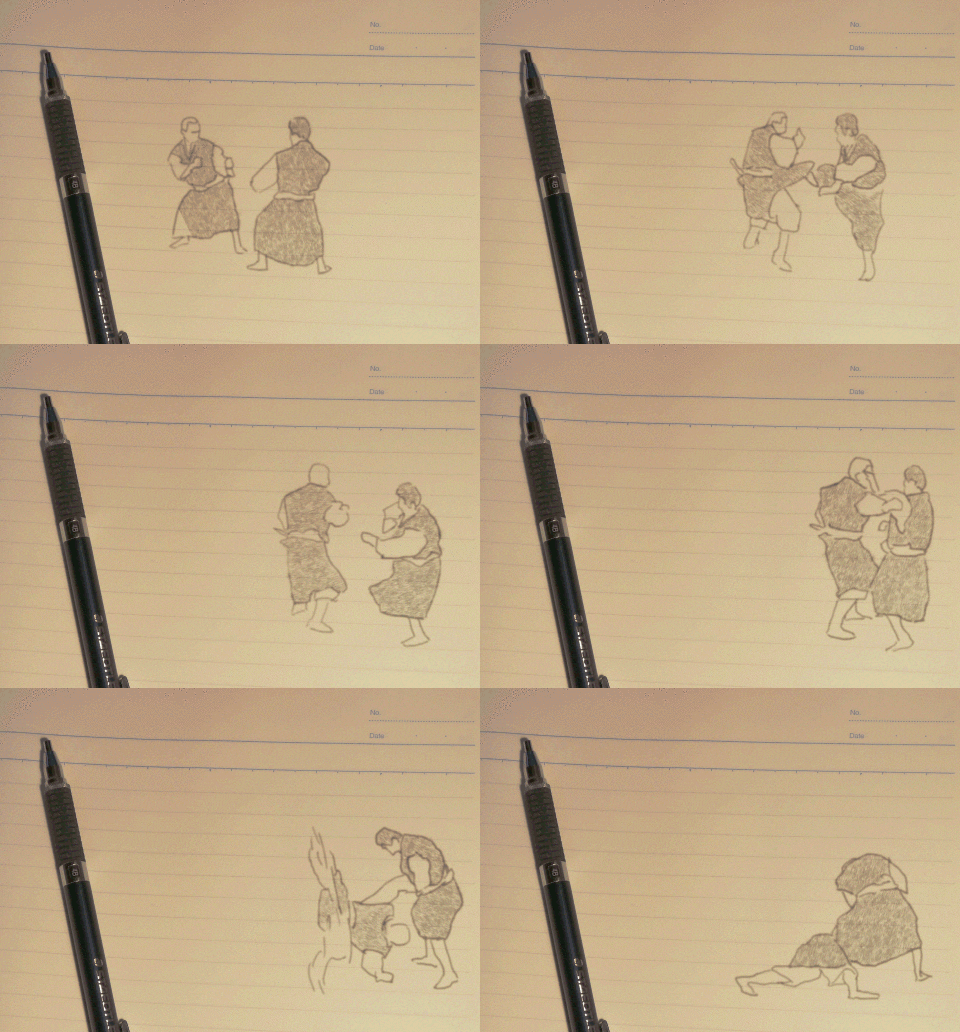
Aikido for me is an educational model, the master transmits humility to his student in the pursuit of a common journey towards deeper understanding, through a series of learnt movements which only have meaning when enacted together.
It appears to resonate for me as a metaphor for connected learning.
There was an audible crack as his sabre movement ripped my muscle.
One of my hands was still attached to his collar.
I had learnt a painful lesson:
"Don't lark around with an aspiring 4th Dan the week before the assessment."
No amount of enthusiasm or adrenaline-spurred determination, could make up for my lack of technique or for my lack of respect for his mastery.
"Sorry about that", he offered, "I shouldn't really have done that...to hurt you..."
Sometimes one learns the hard way. No, one always learns the hard way.
Hours of practice, hours of not getting it right, hours of dreaming it's right.
So many dreams we have... to whose ends?
Ticket inspectors and their kin, the train enthusiasts, would have us working on their scales. Schools are their train-sets.
They organise their tracks, they play with the points, they privatise the carriages. They publicise the fancy rolling stock. They use the truth that talent is not enough to standardise the timetables, to drill the kids to their predestined tracks.
They celebrate the share-holders' profits.
“If you board the wrong train, it is no use running along the corridor in the other direction.”
Dietrich Bonhoeffer
Play-school proponents, on the other hand, put the accent on the innocence, the creative imagination of the child, the idea that they only need to be left to their own devices to make a marvellous new Play-world.
"Kid's have you finished Playoutopia yet?"
We dream our worlds on Youtube, on Second life (not many of us now), on cable-tv. We identify our dolls, our icons. We consume our life-analysing apps...an iPad anyone?
"I lost 200 grams."
They celebrate the share-holders' profits.
When I was a kid, I played at being a grown-up.
We were commandos, I was an actor, a journalist, a musician, a social worker.
I was a "Jack of all Trades and a Master of none.".. A happy Joker.
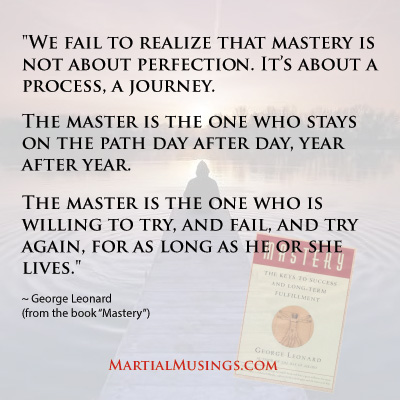
Learning mastery may enable self-respect.
I lurked, I played, I came to realise that learning around is not enough.
Drilling without reflecting deeper as to the choice of our master is blind subservience.
You must work hard to see.
There is no alternative, we must learn to handle their arms to neutralise them, if we must.
Education is not training?
No, training is what one does best with education.
Education enables us to make considered choices about the form of our training and our relationships to masters.