Naturaliser (Fr) Il s’est fait naturaliser français. Importer d’une autre langue un mot ou une expression Empailler un animalmort ou conserver une plante, de façon que cet animal ou cette plante gardent leur aspect naturel. L’Afrique renferme plusieurs espèces d’animaux qu’on ne pourrait naturaliser en Europe. Is it safe?
"We will burn the old grass and the new will grow." Pol Pot.
Initiation.
The newbies must experience the same confusion as their forebears.
Is this initiation to a sect?
Yes this is...a new term...year zero. The term begins...
What do your students see of the activities of others?
Do they get to build on the learning of others?
What traces do they leave for those who follow?
Graffiti on the desk?
Scribbles in the borrowed text book?
A broken chair? Low-life learning.
Of course, we can never wipe the slate clean. not even Pol Pot managed that...
In the corridors of (informal?) learning students sketch schemes, caricatures, myths, share short-cuts through the maze.
They become (perhaps) thereby empowered by their peers.
Dumb and dumber.
I spoke to a student last week.
She smiled.
She feigned understanding or to avoid embarassment by busying herself statically on her chair.
She understood nothing.
She was Moldavian.
She spoke Roumanian and had only ever learnt French and Russian at school.
I felt ridiculous.
Dense and denser.
I remember the lectures at university.
Either I was dense or the lecture was...to the extent that it may as well have been in a foreign language.
There was no pause for breath, there was no time to take legible notes. The graffiti was no help.
We feigned participation by scribbling on a page of A4.
I gave up going to those lectures.
Nobody had ever stopped the teacher to suggest that his lectures were, to us mere mortals, gibberish.
What means did the teacher have of knowing, before the end of year, that nobody understood?
Nobody had ever stopped the teacher to ask a question; they wouldn't have known where to start.
Logic and logical
It reminds me of a story of my father who was asked to teach logic at theological college.
He knew nothing of logic so he borrowed the notes of the departed logic teacher.
He read the notes religiously, praying that nobody would stop him to ask a question....
He recounted his story with a gleam in his eye. He had an acute sense of ridicule...he found the story hilarious.
Learning and culture.
Teachers group together by affinity, they cross each other in corridors sometimes with only a nod. From time to time, they disappear to their clubs...er conferences. They go to meet those with whom they will discuss the progress of the research and advance learning.
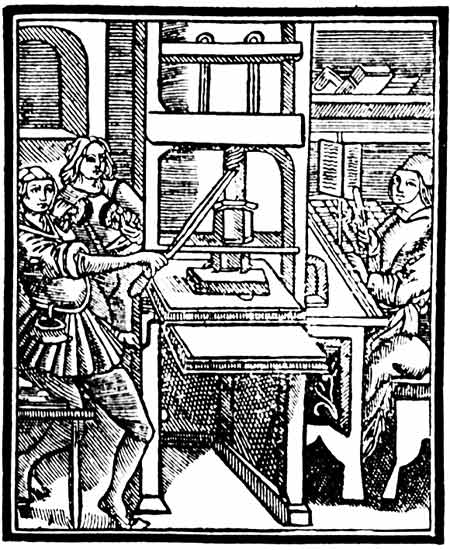
Fortunately for their careers, a few years back...some guys introduced the printing press.
The act of reading and writing became something less esoteric, wider literacy became something desirable to the wider community.
It empowered a new guild: The Academic.
New ideas might be spread and discussed right around the continent...even further afield.
These were modern times.
I sometimes have the impression that we don't give enough thought to literacy.
I sometimes have the impression that we don't give enough thought to FAQ's.
I sometimes have the impression that we don't give enough thought to Market Research.
I sometimes have the impression that we don't give enough thought to Smart Portable Devices.
I sometimes just want to laugh.
I remember my father. He makes me smile...still.
It is important to maintain a sense of humour. It is perhaps this the most important lesson to learn.
INTERMISSION
An Italian Class...
And now...
And now a few questions.
What traces of your students do you keep and cherish?
Do you maintain relationships that you work so hard to establish with your students? Why?
What students frequently asked questions do you keep? What do you do with them?
What student suggestions, student advice, student stories do you keep? What do you do with them?
What connections do you enable between generations of students and other interesting people?
What do you do to enable learners find interesting documents, ideas, people?
What people do you invite to help you enable your students to learn?
What do you do to enable progress from year to year?
How do you evaluate progress from year to year? With standardised tests?
What literacies are appropriate to develop today? Why?
What sort of learning environment do you thrive in?
a) A blank cell
b) In a place with a group of people with whom you feel you can identify
c) In a country in which they speak an alien language.
d) In a classroom in which one teacher speaks about things which don't interest you.
e) Other..
That work which had been done a year before suddenly had popped up.
A conversation with an ex-student the year before had led to him coming to participate in class. I have learnt to capture instants so that others may benefit from them at another moment.
I videoed a conversation in French.
As I had the video, I posted it into a a document for students in the Sports Management class. Now most people would say that if you want people to make progress in English you only have documents in English. Counterintuitively the French video sparked English writing.
I comment on the blog, giving him the link to the video, now on Youtube, to enable him to reflect on using diversified media in his blog. His blog added to the video, enriched by comments by myself and Bruno Winck now becomes a powerful tool to demonstrate a simple principle.
What counts for me, is not 'content' per se, but people who share personal or personally sourced resources with others
A book as Dave Cormier would say is a stupid person who can no longer interact.
Appropriately, unexpectedly the concept of rhizomatic learning pops up here.
Learning in open networks is messy and challenging.
Learners need to develop 'crap detection' skills
Learners need to understand the importance of networking with people to find mentors and experts and friends.
Learners need to learn the importance of sharing their work.
Before the beginning of the 20th century, the only means of obtaining pearls was by manually gathering very large numbers of pearl oysters from the ocean floor, (or lake or river bottom). Thebivalves were then brought to the surface, opened, and their tissues searched. More than a ton were searched in order to find at least 3-4 quality pearls..
Bored yet? Not to your fancy? I give up! No, I didn't write that introduction, I know nothing about all of this; I cribbed it off Wikipedia, and here's the photo to prove it:
Now I don't know about you, but I hate wasting my time reinventing the wheel, searching for that link...(yawn) somewhere on page 46 of a Google search. After all that effort, when you have found that rare pearl, there is a temptation to hide it away, with your precious favourites, or to show it off proudly at meetings to less well endowed colleagues.
- Look what I know, aren't I a clever clogs me?
- No actually, he found it on the internet...on his phone.
Another tempting lure for us learners is to copy and paste the content from the oyster which is our world (wide web) and to pretend it's our work. Never done that? Of course not; we are pearly whiter than white (unlike those poaching students).
So in this age of collaboratively cultured pearls (thank you Wikipedia!) it is getting easier and easier to find stuff to learn and to copy, to make us seem really bright. Yes, it does help if you know the right type of mollusc which interests you, something about its natural habitat, and even where the other expert pearl divers or farmers hang out....
All these points I will return to, but for now, let us just cast our gaze across the ocean which is the internet and reflect........
All done? OK let's go on.
No question, our apprentice fishers will need to learn how to search effectively, how to work together and where to find friendly experts to save their precious time. Joyous with a successful trawl, they will need to know how and where to share their find(ings) and/or how to transform it/them into culturally valuable individual works of art/science/cuisine etc.In this way, they themselves might become recognised one day as unique...
Knowledge, it is safe to say, does grow on trees.
I have a particular fishing tool that I would like to share with you today. It works in net browsers, in and out of Twitter, it enables you to organise your links with tags in organic coral-like structures, and makes your diving or culturing work available to all by embed, by mail or by inviting others to join in the fun. Want a shift of paradigm? You are not alone in our ecosystem! By clicking on the little pearl,you can even fish as a team, err, as a school...of fish, together, in the high seas.
Here it is, take it all, take a single pearl... my colleague did this afternoon. Here is my priceless tree just below. I confess that it is not all my own work.
I shall be teaching my students how to fish the net together very soon. It will save my breath. Why should I dive so often at my age? The kids can do it.
Original Photo Credit for pearl diver :Kuwaitsoccer http://tinyurl.com/639kz4f