Showing posts with label network. Show all posts

Sunday, October 2, 2016

An indian summer.

"Do you want to stay here, or would you prefer to go outside over there?" I asked them.

"I'll follow you." I heard myself saying.


It was a beautiful afternoon of an "Indian Summer" on a grassy plateau in the Massif Central.

The people (students) sat down together in groups of various sizes and configurations and started to exchange.

A pair of them had come with food that they had prepared for the occasion, they shared their offerings with the newcomers.

I (an English teacher) moved from group to group stopping to listen and to speak with some of the people I knew (students) and with the newcomers who were from Nigeria, Columbia, Senegal, Finland, the USA, Ghana, China.

Dancing in the wild.

The newcomers, I had learnt the week before, had come from all around the world to study dance and anthropology together. I thought that the opportunity for an informal meeting of the minds would be mutually beneficial to everybody.

English would be the lingua franca for the occasion...dance might also be a useful means of communication and reflection, I thought to myself.

The people were all engaged in different conversations, some sitting, some standing, some speaking, some listening, some kneeling, some lying down.

None of the conversations were scripted, programmed or determined by myself (the teacher).

I pointed out that they might find some things in common...

As the afternoon went on the people moved changing the group compositions, changing the conversations.

Stories of resilience.

I spoke to a guy from Ghana and another from Senegal or Nigeria (I am not sure now) about their learning stories. They spoke to me of the difficulties they had had navigating classical expectations of parents or institutions to focus their attention on what some might consider a marginal activity - dance choreography and anthropology.

They spoke of the thousands of students in amphitheatres...

One spoke to me of trying to take law classes to dissimulate what he was really doing which was to follow dance anthropology classes at the university.

They had showed remarkable resilience in their desire to follow paths which they felt were essential to them.  I made a mental note of their stories for future reflection.

Emergent learning.

After a little while, the interaction in one group had mutated from conversation to a break dance battle.

On hearing the music, which was coming from someone's portable wireless speaker connected to a smartphone, all the other groups stopped conversing and stood up on the slopes to become an audience within an emergent, natural auditorium.

The dance had changed the nature of the space, the nature of the ritual.

There were whoops of delight, expressions of encouragement, cheers and clapping as the pair of dancers showed their moves.

After what seemed a good few minutes, the dancers stopped, some people grouped in pairs and started taking contact information, others were attracted by drumming coming from across the plateau, others went off to retrieve their belongings.


Massively Open Offline Class.

I moved with some of the people over to the other side of the plateau, passing a couple of girls with hijab attempting to walk across a slack line, a boy that I knew from one of my classes hanging upside down from a trapeze, a group of jugglers.

I stopped to speak with them and was greeted with a smile.

The activities had been organised as part of a festival to welcome new students to the university.

I overheard one student say to another:

"Why don't you tell your friends to tell the teacher that you had to miss class, this is much more interesting."

I looked back at concrete boxed classrooms and thought of those that they contained.

Once at the other side of the plateau, I was met with a group of African dancers in traditional dress who were acting as a magnet, attracting others to dance with them.

I recognised one or two of the dancers as those who had been with the class of students in the "English" class just before.

I spoke with the students watching the now active dancers of their meeting.

"Had that been a valuable learning experience?" I asked them.

The expression on their faces was eloquent, they all noted that it had indeed been both memorable and of interest to them.

I noted that some of them had been taking contact information from their new friends, had started organising times to meet.

They had at first oriented themselves.

They had shared declarations.

They had networked with these strangers.

Weak ties were being strengthened.

Now, they were clustering.

There had been clear focus on the spontaneous break-dance battle.

I shall remember this class as one with many connections from which to learn, an open space within which to roam. I thought of how this connected to my own experiences of (rhizomatic) learning online and offline.

Education for community

I thought of the street festival that had been organised by students I teach the weekend before.

I thought of the connections being made between them and the local community.

I thought of the wealth of the learning ecosystem within which they had been the actors.

I am fortunate working with people whose sporting, academic and professional activity takes them into so many diverse spaces.


Learner Resilience

I am wondering now about learner resilience.

Not all the students that I meet demonstrate the same determination as those African dancers.

Many need time to orient themselves.

Many have been so institutionalised that they are looking only to go through the minimal motions to get a grade.

Many classes, many spaces, many rituals, relations, reinforce such minimal transactions.


Strategies of school and deschooling.

Opening them up to imagining different relations, different activities or means to learn within the institution or outside of the institution is not straightforward - particularly when the institutional culture itself is the major obstacle.

I am now faced with two quandaries,which in effect are similar:

How do I go about facilitating the development of resilient learning networks and communites from within an institution in the most effective way?

How do I go about enabling learners to view the people around them - classmates, people in the street, in the town, on the internet as potential members of their learning networks?

How do I go about enabling learners to benefit from paths trodden and links made (online or offline)without overwhelming them with my own paths, links, conclusions, beliefs, culture?

One problem for me concerns digital literacies, the need (or not) to develop the desire/skills/competences necessary to be able to learn effectively. In order to do this, it is essential that I build alliances and find convergences with my colleagues who may not necessarily see the interest themselves in developing those digital literacies which I would consider essential for some if not all of the students that I work with. I am thinking of the work of Ken Bauer, Gardner Campbell, Alan Levine and Jim Groom here...

I shall follow my curiosity...
Another problem concerns the visual organisation of existing learning opportunities, activities offline and online.  It is essential to use learner generated 'slug trails' to point to new possibilities within those over familiar boxes.

Photos, videos, personal testimonies, stories, demonstrations, all must play their part, I have been curating those over the past few years.

I have been teaching students how to create digitally, to research critically, to curate, and share, to network offline and online with CLAVIER.

I suppose what is essential now is to make those connections with other colleagues to enable that ecosystem to really weave deeper and wider. I am seeing more and more convergences in ways of thinking, and ways of teaching.

I must invest time on key nodes.

I must map, I think of Daniel Bassill.

I suppose that is what I have been doing with my research.

(idiot - you have been mapping continuously for bloody years - he says to himself).

I am collecting the bits, now I need to find the most effective ways to enable learners to access them.

I must find time, I must find time.

I think of Daniel Bassill.

It's not that I must.

It's that I want to.

I want to.

I have for some time been working towards setting up some sort of "learning bank/make bank".

I must develop connections further. I must map.  I must map.

Priorities, priorities.

Time is precious, my resources and influence are limited, the pressure to fit students, teachers and learning into 'managed paths' and standardised outcomes, in predictable rectangular boxes, with interchangeable teacher operatives is considerable.

I have already seen promising projects killed this year through lack of support...

It is no time to be a nobody.

Fuck that.

I shall enjoy my time as this nobody.

I am heartened by the idea that for the moment at least, in France, university is seen as a public service where students are not to be endebted for years thereafter.

How long will this last?

Fuck that.

We can only do what we can do, with our feeble means...

Learning in an age of abundance?

I think for a -moment of the term: "learning in an age of abundance".

I think we need to reassess what we mean by abundance.

I think of the term 'Indian Summer'.

I make a few mental notes to address

  • the idea of learning, the idea of colonisation in "the wild" and the notion of "wilderness"
  • conflicting notions of enlightenment and transcendence. (Note to self: Les Maux Des Mots.)
  • conflict between capitalism and sustainable ecosystems.

What is it that Dave Cormier says?

Content is people?

I can never remember.

An age of abundance can surely not be reduced to people, even less to bloody information, or data.

I rather hope now that he is thinking of inviting people to reflect on learning/learner resilience now.

I rather suspect that I am ready for that now.

He probably isn't.

Whatever...

Looking back, looking around, looking forward, looking around.

I look at the presentations that I was doing earlier in the year when I was in Poland.

Suddenly, they take on renewed importance.

I shall study them again.


I shall reorient.


Well that was an  unexpected flurry of typing.


Footnote.

Special note: Terry Elliott's recent posts sparked enthusiasm to review this post and to extend it.

Fuck knows why.


Footnote to self.

Note Cynefin Framework and Dave Snowden's Party Organisation. 

How not to manage complexity.


Friday, November 13, 2015

La Vie Active


Nothing would have changed if I hadn't opened the door to my classroom.  

I might have satisfied 'my students' in 'my classroom' and nothing would have changed. 

It is only by working/learning out loud and understanding that the classroom walls are virtual that things have changed.

The majority of the students that we work with have English language skills which are limited by their limited access to English speaking communities. 

If you have family who is connected to English speakers or who has the means to send you on a language exchange your privileges guarantee less limited skills. 

It is a question of access. 

As there is a 'digital divide' so there is a 'linguistic divide'.

If learners already have a network of English language speakers (not especially) natives then this is reflected in their social media networks and also their digital literacies. 

Research carried out for the CLAVIER project demonstrates that the challenge which faces us is to build the bridges between learners and (language) learning communities via afffinities.


The practices of language teachers (as other teachers) in the public sector here in France are largely protected and linked to the interests of institutional deciders, publishers, testers, and education equipment suppliers. 

There are many good reasons for teachers to continue practices which have hardly evolved and where 'new' technology has largely reinforced existing practices of teacher controlled/centred closed classrooms.

Learners are a captive audience for a captive educator, behind 'closed doors.'

Learners may well also be a captive audience for 'individualised learning paths' behind the closed doors of the walled garden of a 'Learning Management System.'

What a teacher does (once the door is closed) may be largely unknown.


Younger teachers (good students) largely reproduce teaching that resulted in them becoming good students encouraged by traditional peer teachers.

Bridging the connection between digital practices in informal learning and in formal learning may well be considered as largely incompatible.

Research into inservice and preservice teachers perceptions of Online Intercultural Exchanges reflect stories of informal learning/formal learning in business and individual experiences of education. 

Learners with innovative teachers remember them.

Teacher centred teaching produces teacher centred teachers.

It is a question of  first "educational culture" and second access to innovative networks.


"Teaching space" architecture often encourages 'closed door policies'.

Research into alternative spaces, research into alternative teaching/learning organisations has resulted in open learning spaces and ,networked enhanced team teaching.

Research into meaningful networked enhanced active learning, have resulted in making global connections which are reflected in transformation of the learning space. 

How do we transform pockets of innovation into wider uptake of innovation?

What can be learnt from studying the 'learning spaces' and practices of the most innovative companies?

Working out loud, sharing photos of new spaces inspire others...has succeeded in opening a little more than space.


"Networked market-led/PISA innovation"

What a teacher does in some institutions (once the door is closed) is largely his problem until standardised testing of some sort is introduced and a compulsory course book imposed. 

What a teacher does increasingly in many institutions is fill in forms for data retrieval and centralised analysis and control.

American language testing services impose technology specifications to become a recognised tester.

Out go the French keyboards in comes Qwerty.

The language training market is enormous.

A quick Google search brings up astronomical figures: the market is projected to rise $193 billion by 2017.


The students that we work with are not necessarily the most connected in terms of network.

The students that we work with are not necessarily going to benefit from foreign language certifications - even if obliged to study for them (unless they become passports to advancement).

Education or protection racket?

The question I ask myself at times is do we want education for our children or a corporate protection racket?

Note references to the research publishing mafia.

"Academic publishers the most profitable obsolete technology in history"
http://sasconfidential.com/2015/11/06/obsolete/

Note response of Steve Wheeler:

"Inspire to learn." 
http://steve-wheeler.blogspot.co.uk/2015/11/inspire-to-learn.html

Meanwhile there appears for many of them to be a yawning gap between their 'education' and what they call in France 'La Vie Active' (the rest of their lives).


La vie inactive

I am never quite sure what one might term education - 'La Vie Inactive'?

Work is done largely for a grade. No grade. No work. No grade. No degree. No degree? Anxiety.

Anxiety: what am I going to do next?

Networks are everything.

The challenge is enormous.

The importance of meaningful networked learning can hardly be understated.

As Steve Wheeler says: "Networks are everything."
http://steve-wheeler.blogspot.fr/2015/11/networks-are-everything.html

The unattractiveness of unmeaningful commercial networked teaching and testing can hardly be understated.

Peer support.

A recent interview of an ex-student underlines the challenge.

What students need he says is meaning, and dialogue with their peers and elders.

As, I connect with Working Out Loud via Bruno Winck, as I attempt to connect students struggling with English with Working Out Loud Week #wolweek, I wonder if we face an impossible task to really open up public education.

Will these students take an opportunity to share their learning with a wider network seriously?

Will these students think of it as a reason to pander to the whims of an unrealistic teacher?

Will the other learners be patient with their faltering attempts to communicate their learning?

Will we be able to go a little further to bridge the divide between active more expert learners and those who need their advice, their encouragement, their ideas most - these young students who waiting to enter into what they term 'La Vie Active.'

As I see the classroom open up, as I see more and more students connecting with their peers around the world, I see reasons for hope.

These are our children.

Please help.


Wednesday, September 16, 2015

Joke candles.

I was at the parent teachers meeting this week.

The teacher was talking about birthdays.


There was a long, terribly serious, debate about the pros and cons of homemade cakes.

There are no allergies in the class this year.

DARN!!

It is so much easier when there are allergies.

The kids get off the shelf supermarket cake.

No washing up...

Joke candles

Then she told the story of a mother who last year had had the great idea of putting joke candles on her kid's birthday cake.

He was six.

At first it was a great joke.

The more the poor child tried to blow out the candles the more they relit.

In the end the candles became a fire hazard, the teacher panicked and threw a fire-blanket over them.

The cake was ruined.

The kid cried.

Maybe he should have cried a bit sooner?

They might have avoided calling the fire brigade then.

Blazing candles.

I was reminded of this story while thinking of what to do for Maha's birthday.

I am quite sure that I am not alone in thinking of what to do for Maha's birthday.

She has friends everywhere dreaming up plans to celebrate her birthday.

This has no doubt something to do with her extraordinarily networked radical kindness.

I had this great idea of doing a search on my blog to see how many of my posts were connected to her.

I typed Maha in the search box.

What a dumb idea...

I ended up spending hours scrolling, searching on my smartphone, copying and pasting links into Pinterest.

I tried adding links from a couple of hangouts and then gave up.

I didn't dare Storify Twitter.

We might have been here until Christmas.

I then decided that Pinterest wasn't really up to the job.


I tried doing a Flipboard magazine instead.


View my Flipboard Magazine.


I thought of doing a Thinglink but decided that that would be more than hopeless - you wouldn't be able to see the picture for pins.

I ended up with 32 links.

I reckon that Maha must be around 32.

Joke candles.

Even if there aren't too many candles now, they keep relighting, inspiring other people, other blog posts, conference papers, massive Twitter chats even.

Oh no, you see the problem, that's typical.

I had my 32 candles ready.

I start trying to blow them out, just to try, and then I realise not only will they not go out but I now have 33 candles lit and shining.

What on earth am I to do?

Any more attempts and I will be up to 40 and that will be way too many.

In any case it is indelicate to count the candles after a certain number.

She'll never notice if I just say there's 32.

Happy Birthday Maha!!

Next year, I resolve not to count candles.

I shall definitely not use joke candles again, the ones that you can't blow out.


Abonnez-vous au tableau Maha de Simon sur Pinterest.


Sunday, September 13, 2015

Permutations

The community observer noted down my position and my role and the way that I connected to my fellow community members.


It appeared that clearly identifiable apprentices were grouped around my work position taking notes.

From time to time one of the apprentices took on my role and I gave them what appeared to be encouragement.

The observer wouldn't have been able to note the subtexts...

The observer wouldn't have been able to note the chemistry.

That would have been lost on him.

He didn't bat an eyelid.

He had quite enough data for his purposes.

We didn't bother to wonder what they observer was up to, we were too busy working to ask.

We ambled off to lunch.

I have been thinking about permutations in rhizo14 (as one does).

There has been a certain amount of discussion as to whether WEs constituted networks, swarms, communities, groups etc.

Is there not a case for suggesting that one must use a series of terms which are necessarily interconnected and permeable to talk of activity at a nexus of discourses?

I am simultaneously operating within networks, family, friendship affiliations, professional affiliations, time zones, operating systems, applications, languages, gender affiliation and so on..

Combinations of these attachments are constantly being weighed up consciously or unconsciously and constitute an ever changing and mutating ecosystem.

I have the impression that there has not been enough analysis of the varying and often competing attachment patterns between nodes at microlevels in the #rhizo14 netverse.

Tensions in competing attachment potentials are both inevitable and no doubt desirable.

Grouping of 'individuals' in 'clubs', 'communities', collectives is both a operational necessity and an endless source of bickering.

How far are tensions embedded in the technology which is used?

Can I make the hangout?
Will I be alone in my hangout square or with others?
How can I find my footing in a Twitter torrent?
How can I feel part of a group which is active when I am asleep?
How far I am aware of the ripples from the secret DM conversation?


What might have been seen as "rhizo14" from certain perspectives (more or less conveniently) was often more perhaps a continuation of previous or parallel cMOOC affiliation, #ds106, #clmooc, #edmooc.  

At the heart of much of the activity is academic discourse: research, abstracts, papers, conferences, phds.

Rhizo14 has been a useful hive for extracting conference honey.

There was no hierarchy in Rhizo14?
I fear that this is far from the truth.
A Keynote is not key for nout.

Rhizo14 has been a useful tree (he chokes) which might also hide the deeper forest ecosystem.

I suppose this is what I was evoking when I wrote Submission.

Rather than looking wider, at MOOC level we need to scratch around in the undergrowth, we need to timelapse what emerges, how we ourselves are caught between flow and critical ebb...

There is also the importance of wonder at what patterns emerge from nature.

Such patterns go beyond what is human and such feelings are inevitably uncomfortable.

Oh marvellous I am a bee...

Is it perverse to look at the microcosmos of a MOOC?

As I am writing this, I am at a nexus of competing discourses:

It is morning, breakfast time, Monday is the start of class, CLAVIER web site needs working on, the pleasure of writing here, the desire to put my thoughts out in some sort of form drives this on, I have been reflecting on the complexity of what brings us together and what takes us apart.

I feel somehow part of a wider discussion.

There are those clouds of competing memories, sensations,desires, thoughts, instincts which come together at a point HERE to result in this being written.

I don't really know why, but it's fun.

Image credits

Composition of permutations corresponds to multiplication of permutation matrices.
https://en.wikipedia.org/wiki/Permutation#/media/File:Symmetric_group_3;_Cayley_table;_matrices.svg


Tuesday, December 16, 2014

Pinball machine.


Ten, nine, eight, seven, six, five, four, three, two, one, we have lift off...

We launch ourselves with a high initial velocity, to be thrust into space.

Our trajectory is unpredictable...

Not all of the players will enjoy the ride.

Not all of the players get anywhere.

We strike lucky.

We get past the initial obstacles, we fly around the play space.

We touch unexpected energy sources which send us off in unimaginable directions.

As we rebound off key accelerators, we are dazed by unforeseen illuminations.

We ourselves become accelerators of the machine, driving it, driving others, driving ourselves.

At first, the experience is both destabilising and exhilarating. 

Woah, hang on, help!!

Multimodality of expression: 
  • music, 
  • text
  • poetry
  • comics
  • academic articles
  • sound 
  • video
  • dance
  • electric paper
[the list is long]

reveal unfamiliar juxtapositions of meaning.

Remixing, repurposing, reordering, rebooting, revolution.

Multicultural participants met randomly from across continents reveal unfamiliar interpretations of meaning.

The colour, sound, and whoops of excitement attracts others who gather around. 

They point out new means to play, new ways of seeing things,  they show us expert hacks...

A neon cloud lights up.

Pinball is an image which came to me yesterday.

I was thinking about my experience of connected learning in 2014.

  • Rhizomatic Learning. #rhizo14
  • Digital Storytelling #ds106
  • Connected Learning MOOC #clmooc
  • Connected Courses #ccourses
  • Digital Writing Month #digiwrimo
  • Rhizomatic Learning #rhizo15

So many hashtags, so many people, so many ideas...

I started playing around with a new version of one of my favourite apps #Picplaypost which I use for collages. 

I discovered new features which enabled me to add music, to create slideshows within the collage frame.  

I discovered new integration of Giphy for animated gifs, and Soundcloud.  

I played around with Strip Design to add text layers over the image. 

With each step of the process, a new tool came to the fore.  

With each new tool, a new way of expressing emotion, ideas became possible.

Maybe I should Zeega the pinball idea, I thought. 

I switched to the PC, I generally use it for blogging but not images or sound. 

I put together a Zeega and tweeted it out to friends in #ccourses, #rhizo14 and #clmooc.  


None of this activity would have happened in 2013 before I started #rhizo14. 

I had no idea how to make an animated gif. 
I had never heard of Giphy. 
I had never seen Zeega. 
I had never met a large number of friends that now enrich my life.  
I had no idea about Wordpress. 
I had never played around with Martin Hawksey's Tag Explorer.
I had never organised a Google Hangout on Air. 
I had never studied Deleuze and Guattari.
I had never spent much time studying learning theory. 
I had never written a haiku.
I had never had any feedback for my artwork.
I had never seen a make bank.
I had virtually never spent any time blogging...

I could go on...

Yes of course, you need to have the courage, and desire to launch yourself. 
Yes of course, you need to to choose the type of connected course you are starting with.
Yes of course, you need to have some start up competences to get yourself connected.
Yes of course, it takes time, openness and luck to hit the right combinations.

If somebody were to ask me about the learning outcomes of connected learning, I could provide them with some hard data. 

I could show them quantitative and qualitative data demonstrating an exponential increase in my knowledge and competences, and introduce them to valued members of my personal learning network.  

I could show them traces of this development over a long period. 

I could show them the knock-on effects on my professional work.

  • on the CLAVIER project  
  • on my colleagues
  • on my students
  • on my institution. 

I could also explain in quite a lot of detail, how I learn, how learning is unpredictable, how learning is unlinear, how learning is exponential when we are placed in an environment where we are valued for our difference, encouraged in our experiments, and challenged in our analysis. 

Does connected learning work?

Yes, my conclusions are clear, it works.

Does connected learning work in the same way without the internet without digital tools?

No, my conclusions are clear, learning is accelerated and transformed by the internet and digital tools.

I suppose this will underline what Alan Levine or @cogdog was going on about yesterday on this blog in his comments.  

Learning on and off the web, learning in the company of a network of widely distributed caring, creative, co-learners is learning pinball. 

One, two, three, four...hit it.


Where will I be in a year from now?


Monday, November 24, 2014

Volatile.


Wings pulse, wings pulse, wings pulse, imperceptibly...

breathless,
silent,
emphemera,
revealer.

Wings pulse imperceptibly...

Wings beat, Wings beat, Wings beat, Wings beat, Wings beat...


boundless carnival.
vibrating vortex.
volatile creatures,

all amplified

in
a
net.


for +Kevin Hodgson

 exploratory musing
inspired by our dialogues. 


Saturday, October 4, 2014

Zootopia?

I was rather looking forward to coming up eye to eye with the king of the jungle.

My mother had done the pre-lion build-up on the trip to Blackpool Tower Zoo.


"You'll see they even have a lion!"

I was, it had to be admitted, a little apprehensive about being in the same space as a real lion.

After all, he did have the means to  rip me to pieces with his bare paws.

A six-year-old human would be no match for a real lion.


Sensory deprivation

I was disappointed at the pitiful lethargy of the giant cat.

He was slumped in a cage.

He looked gloomily around, yawning with a glazed look of prolonged sensory deprivation.

All roaming was limited to uncomfortable shifting of cramped up limbs.

If he had been stuffed, with a roar on cassette loop, I might have been more impressed.

I was left with a sensation of intense sadness.

Zootopia.

Yes this was much better.

The owners of the progressive zoo had imagined animal heaven.

Lions were free to roam.

Trees, long grass, contoured, landscaped, enclosure gave a quasi-naturalistic impression of 'wild-life'. (or at least a quasi-naturalistic environment in the Warwickshire countryside.)

The animals seemed much better kept,  they could even stretch their legs, and bound around.

Hunting, of course, was unnecessary as the keepers kept all the animals healthy with carefully measured, scientifically designed diets.

Clever people, are scientists.

Breeding programs were a success. 

In some enclosures, animals of different species were even mixed.

We could see zebra with zebu, and the odd antelope.

Marvellous how animals of such diverse species could manage to live in harmony for the tourists' greater pleasure.

Perhaps the animals were happy to make new exotic friends.

I am not sure if animals make friends.

We were mightily impressed at the great efforts made to educate children.

We  learnt how the zoo was responsible for preserving endangered species.

Out in the wild in Africa, the locals were often inhumane poachers.

Thank God for the World Wild Life Fund!

The Panda was doing a marvellous job in the preservation of African biodiversity.

Educational program

I would like to imagine that in the future our children will look at the enclosures in which past generations were kept as absurd anachrosnism.

They will be shocked at the controlled diets.

Out of Africa 

I was brought up with stories of discovery, of adventurers.

There have been moments in my life when I have looked on at my peers with astonishment.

Whatever happened to grand narrative?

I was shocked that on finishing university, a large number of my fellow 'students' appeared to have their lives mapped out.

They had apparently been studying to get what was called 'a good job'.

What the hell was 'a good job'?

History degrees were apparently perfect preparation for young people to become accountants.

What the hell was an accountant?

I dreamt of adventure.

I met a 'successful' brand manager while working (playing) in Public Relations.

"I hate my job," he told me, "but it's too late now, with the mortgage and all."

He would never perhaps learn of his true nature.

He had become too dependent on his comfort.

He left me with a sensation of intense sadness.


Tuesday, September 30, 2014

Nature regains ground.

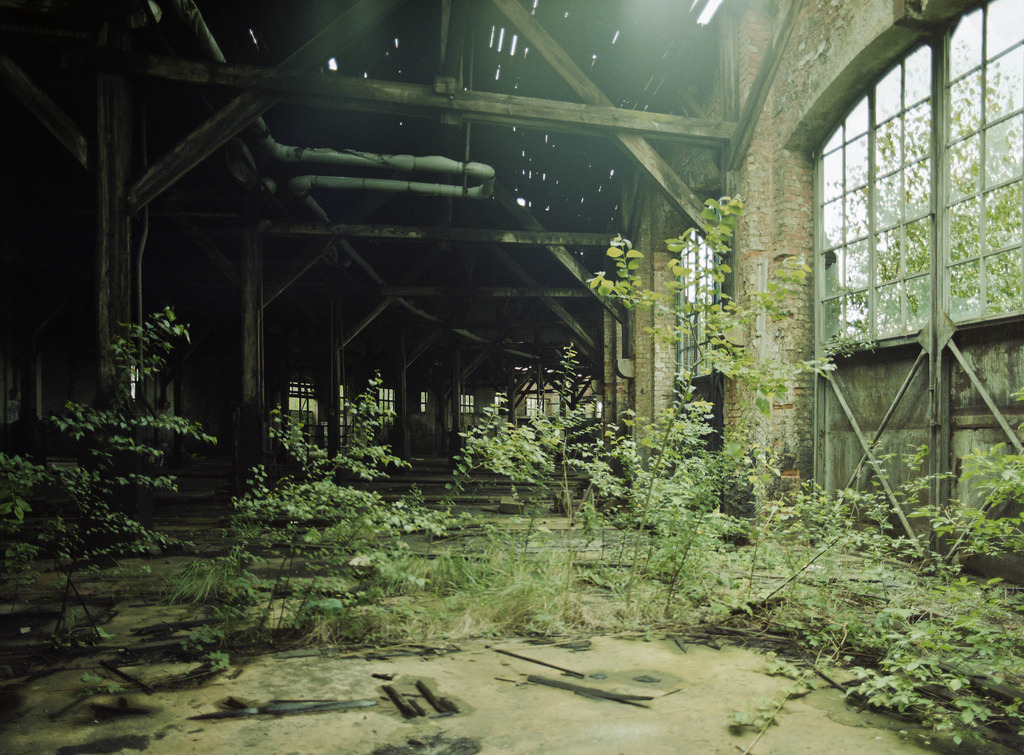
There is both loss and hope encapsulated in this image.

A factory gradually disintegrates.

Nature reclaims ground lost to industrialisation.

Setting our scene.

It is dark in the early morning, I couldn't sleep.

I am caught between night and mourning light.

Desolation and disorientation

There is a work-place that we have known with its reassuring certainty, clearly defined roles.

There is a ruin, that we are propping up, despite an uncontrollable erosion of its very foundations.

Nature regains ground.

There are faint signs of greenery pushing up between the cracks.

Loss and hope.

For some of us, there is only desolation in this scene.

For some of us, there is an impression of being at a loss.

For some of us, there is only a desire to return to order.

For some of us, there are grounds for hope.

Past-times

I can imagine the hustle and bustle in the workshop.

I can imagine the tea-lady doing her rounds.

I can hear the banter around the clocking on clock.

I can glimpse the neatly stacked ledgers each one in its place.

I can hear the voices of supervisors each one busying his work-team.


Worrying complexity of nature

Where there was order, well-oiled machine-like activity, there is absence.

Where there was production line, there is an eery void.

There is a ghost-like quality to the space.

Organic growth appears unbidden, unordered, chaotic.


Retraining our eyes.

We are so unused to nature.

We are so used to cutting it down.

We are so used to making it into manageable shapes.

We were skilled at enclosure.

We are so ill-equipped for openness.


Monday, September 29, 2014

Artful...as in Dodger.

A giant of a boy threw himself at what he considered to be the easiest route to the try-line.

The easiest route was...myself.

He took the wrong route.

He stopped short...

The bigger they are...the harder they fall and all.

I enjoyed tackling.

"Bravo that boy, very brave!"

I smirked, I admit to being not a little proud of that tackle.

Refereeing the match was a talent-scouting house-master who went by the name of Dracula.

A few months later, I was in Dracula's study.

"Tell me, Simon, what are your ambitions?"

"I would like to play rugby for England."

"Yes, yes... but what else?"

"Would you like to be head-boy for example?"

"No, I think it is ridiculous that older boys have power over younger ones, I think the idea that monitors are the only ones who are allowed to wear brown shoes is...ridiculous."

I liked the word ridiculous, particularly the stress on 'dic' and the  two last syllables, I liked the way the tongue moved to say it.


I embodied disdain. 

From that moment, I was marked as a nuisance, an annoyance, one not to be trusted.

Not even brown shoes would buy me, good heavens.

His final words when I finally escaped his clutches were:

"We shall miss Simon's way of... er making his position...er his disagreement...clear."

Prostitution Ring

"Are you prepared to prostitute yourself for this agency?"

I was a little surprised at the up-frontness of the interview question.

I figured that that was how they must speak in Public Relations.

"Of course."

I said it, convincingly enough for them to move onto the next question.

"Would you like to drive a BMW? All our executives get to drive BMW's."

I wasn't too sure about the BMW.

The serial car-incidents flashed before mine eyes.


  • My father's Austin - Gate post.
  • The vinyard's Citroen Van - Dangerously close to tumbling down a valley near Beziers.
  • The boss's Morris - Ran out of petrol in rush hour in Oxford Street.
  • The boss's Citroen - Break-down in Camden
  • The boss's Transit Van - Scratched before exiting car-dealers.
  • The boss's Taxi - Abandonned while driving itself in Drive.
  • The four driving tests - FAILED.


I reckoned that the BMW could probably wait.

Coffee-mourning

I was invited at the weekend for a coffee.

I thought that that was a little suspicious.

It appears one always gets offered a cup of bloody coffee when they give you the sack.

"Thank you for giving me the sack, that way I will not have to put up with any more of your stupid jokes and I will be entitled to unemployment benefit, as otherwise I would have had to have  resigned."

Those were the words that I remember spitting, or words to that effect.


Trust me. It's Official.

As we are talking about TRUST this week here in Connected Courses, I feel the need to come clean.

I love working in a team for a cause that I can embrace, fully.

I enjoy being in a band of imagined villains, pirates, outlaws.

I am terribly uncomfortable with badges, labels, official sort of stuff...

Unless of course it is part of a piratical plan.

If that's the deal, "Ahoy mates!"


The Academy won't save us. 

Oscar might come in handy.

I am brought back to a book of one of my favourite authors Joe Simpson - him of Touching the Void.
He never really comes to terms with the idea that one day he will not be a marginal climber on the dole.

I am, I suppose, like my friend Terry Elliott, an outsider.

I reread his article this evening: Iconoclasty 101: Outsiders in Academe for reassurance.


The Academy won't save us!

I want to enable us to have a space where it is difficult to distinguish facilitators from facilitators.

I want to us to have all sorts of biographies, all sorts of photos of unknown urchins with whom we may connect.

Artful then?

I am not sure how possible it is for me to be other than....

Dodger...

Pulling here, pulling there and giving a broad grin to a band of fellow urchins.

For Mia, Howard, Claudia et al.


Saturday, September 13, 2014

Rough field notes. Inklings of hope.

Field notes 

(I suppose this is part of what has been described as autoethnography - experts comments please)

Introduction
I shall attempt to change tack for this moment (perhaps this will continue? I don't know) in my writing in this space 'Touches of Sense".


It has served its purpose very well as a personal tool of research. I shall come back to this point.


I do not know in what forms this research will continue from now on. These are remains to be seen :-)

There is little doubt, however that I feel the need to take stock of my experience.

I would also here, like to share my questions and my lines of reflection with others.

I am beginning to question a number of concepts and limits to methodology of research, that I perceive as barriers to necessary transformation of education and I would venture societies.

I have been interacting with people spread out around the world (though that terminology itself is to be questionned) in a number of online and offline spaces. I shall attempt to identify and list those spaces.

1) Interior space. Historical Body/Space (note Scollon and Scollon)
Emotional/Spiritual/Cognitive/Body/Cultural/Narrative/Linguistic/Family/Friend/ ( I shall need to develop this further. at a later date). As a result of events and personal stories, it has been necessary for me to conduct psycho-analysis. This was clearly a turning point in my perception of my history and my relationship with 'myself' and others. I have also spent half of my life in a previously 'alien' culture and linguistic environment (France)

As a result of events in which I have been actor, it has been necessary to:

a) Go beyond comfortable emotional/moral/intellectual/experiential/physical limits.

b) Go beyond what I considered constituted my 'identity' - linguistic/cultural/philosphical/ (I shall need to develop this further at a later date)

c) Go beyond what I considered to be 'normality' 'sanity' (I shall need to develop this further at a later date)


2) Professional space (Note Bourdieu, Scollons, Habitus/Historical Spaces/Nexus of discourses/Interaction order)
My choice of 'professional activity' was (like for many) a combination of accident, design, and a response to economic/linguistic/competence constraint.

Coming from a family in which 'normality' was dealing with questions of 'life and death' (being child of generations of clergymen) and from a family in which there was 'vast inherited economic' wealth but no professional activity to mention, it was extremely difficult for me to make any sensible decisions as to how I wanted to 'earn my living' or that matter lead my life. My only sensible reaction to dissonance was to go towards a form of 'tabular rasa' - starting form scratch.(of course that in itself is a fiction).

I was rather marginalised in my proposed peer-groups being the 'youngest child' ,an unbeliever, a boy who lived in a big house in a mining town, or a boy coming from a relatively poor family and son of a clergyman in an expensive and distant private school. Identification with others was difficult. (I am aware that I share these difficulties with many others)

Academia, has been until very recently a mystery for me. I was able to float through university without a great deal of thought, I frankly had no idea what was going on.

I have in my life been witness to one thesis presentation (last year) which appeared to me to be fascinating but rather unattractive theatre.

I found little reason to engage with the form of 'learning' that I was presented with at school or at university.

I simply fulfilled minimum requirements until I managed to do what I was passionate about - research and story-telling et al. (to be detailed perhaps at some later date)

I was disappointed at the lack of 'adventure', the lack of 'ambition' of researchers that I met indeed it would be true to say they were not I felt an exception.

I did not find any university academic to identify with.

They appeared to me to be extraordinarily dull.

Coming from my social background, I was disconnected from any 'career' mapping, never have had any real ambition apart from to play, and pay the bills and to manage to do what I have seen of interest to finance - travel, children's education, clothes etc.

My relationship with money is one rather of boredom, I find the obsession with financial gain and acquisition of objects to mark 'social success' of little interest if entertaining at times. I can quite appreciate beautiful objects but I retain a mostly critical relationship with acquisition and accumulation.

Coming to English language teaching after miscelleaneous and diverse 'professional' experience, (note perhaps to be extended at later date) I discovered an environment in which for  a while I could play with satisfaction.

I enjoy experimenting and reflecting on my experience. I have always observed from a distance and played different roles to see how one or another role would have an effect on the environment in which I have found myself.

I have noted with interest the various 'given identities' that I have been tagged with.

'serious' 'fun' 'geek' 'dangerous maverick' 'difficult to work with' 'trouble-maker' 'insane (often that one' 'Cantonaesque (NB Eric Cantona see Wikipedia) 'elecron libre' 'fonctionnaire d'etat' (teacher employed permanently by state) 'associate member of research laboratory'.


I have noted how the introduction of particular technology has had a disruptive effect on the teaching environment. I have been fascinated by these evolutions. This curiosity has driven research and experiment.

As a result of diverse professional experience/personal experience I have been able to increase my resilience, and my distance from the professional environment in a way that some people appear unable, or unwilling. It is clear that I share neither the values, nor the competences, nor the fears, nor the perspective of many of the people with whom I have worked with. There have been a few notable exceptions. (references)

I have embarked on an experiment to transform education from within, from my own classroom.
(See references)

I have found great help in considering the environment in which I act through a number of lenses:

(Notes: note refs)
a) A Complex system
b) Ecologies
c) Narrative spaces
d) Nexus of discourses -(ref - Scollon and Scollon)
e) Through Social Network theory
f) Through rhizomatic metaphor - though I feel that this is reaching its limits (to be investigated)

Clearly such reflection is having a major effect on my action choice.

3) Onlining learning spaces 2014
(Notes - Downes/Siemens/Cormier/Stewart/et al to be continued Scollons again/Activity Theory Engstrom/Research areas to be defined and not yet done to my knowledge See all lenses above)
I shall fast forward to my recent online learning experience.(note intermediary online experiences have already been documented elsewhere). In January 2014 I signed up to participate in Dave Cormier's Rhizomatic Learning Course (see blog posts tagged #rhizo14, pinterest curation, twitter (archive - to constitute), various interactions - blog comments, twitter maps (cf Hawksey) - to be detailed at later date). I then played in CLMOOC (refs to add) and am currently participating in Connected Courses (refs to add).

I would like here to note a number of points to investigate:

1) There appears to be resistance of certain researchers to question their methodology, their role as researchers, the objectives of research and relationships with questions of
a) recognition
b) authorship
c) status
d) means of representing dynamic emergent complex systems
e) cultural domination in a globalised 'economy'
f) assumptions of supremacy of 'scientific method'
(to be extended/detailed at later date)

2) We appear to be reaching the limits of terms/concepts to describe and to imagine learning in a globally networked environment (notes to detail and review)
a) Spacial/temporal issues to conceive networked learning
b) Lack of distance from cultural frames of perception to make sense of globally networked learning. (Note I have been looking at Gestalt theory as a means to partly explain such problems)(points for reflection here)
c) Lack of distance as concerns 'technological framing' (this includes language/semiotic environments(see Mcluhan/Blommaert et al)
d) Problems of distributed and disassociated identity (to investigate and reflect on)
e) Concepts such as 'class' 'institution' 'course' seem more and more hazardous.
f) Learning 'management' appears absurd.

3) We appear to be stuck in an obsolete politico/economic system whose deficiencies are being amplified by globally connected technology. The results of this on an ecological level and human level are dramatic.
a) Relationships between man and machine to address urgently.
b) Relationships between corporations/governments/finance to address urgently
c) Relationships between ..(to be continued at later date)
d) Relationships between territory and national boudaries (to be continued)

4) We appear to have great difficulty in recognising healthy humans from unhealthy humans.

On a personal level, I have begun to understand why I have been marginalised and aggressed as my discourse/behaviour is for many intensely destabilising and threatening.

We appear to have great difficulty in recognising and dissociating 'manipulative' from 'reciprocal' relationships (Note discussion with KW Hamon and Terry Elliot - ref) which respect diversity and complexity.

5) I have cause for hope.

a) I have finally met individualswho appear to question assumptions of what constitutes the differences between:
  • religion and spirituality
  • freedom and freedom to exploit
  • education and manipulation 
  • learning and assimilation of models
  • dialogue and parallel monologue
  • research and academia
b) I am finally meeting individuals who appear to question assumptions of how to express 'knowledge' , its 'value', 'artificial separations between spheres of activity' notably the following:

  • Art and science
  • Text and other media of communication
  • Immediacy and reification
  • Individuals and communities and networks
  • (to be added at a later date)
  • Flow and distance
  • Emotion and reason
c) I am beginning to experience apparent transformations in:

  • My own perception of my identities
  • My own trust of my action, reflection, and means of expression
  • My level of competences (to detail)
  • My relationships with academia/research/education/other spheres
  • My lenses of analysis and vision of future transformation of education and social environments.
These 'field notes' are shared in the hope that their perspective will enable me and others to further advance in this process towards advancing critically within a chaotic environment for my own and others' benefit.'

I note that 'poetic' 'artistic' expressions as evidenced in this space are a means of research in what constitutes unknown spaces which would be for me impossible with other more traditional methodology.

It is extremely difficult when venturing beyond what one has been used to, to map new territorities.

This venture can only be done in association with my fellow adventurers and in no way can this current or previous pieces of expression/reflection be realistically limited to being the voice of an author by the given name:

Simon Ensor.

I have the strong impression that I am beginning to identify with unauthors who have gone by the given names of Deleuze and Guattari.

PS. Thank you for your patience. I feel that is quite enough neurone crunching for one evening.

Interestingly, 'Enso' pieces (of which I do not claim particular authorship - rather editing-rights) are both more enjoyable, and much less tiring.

My only hope from these field notes is that I shall take control of at least a part of this process of research. 

Frankly, this work/play at times is draining.

To be continued.


Note to self. attempt to define 6D learning.

Note to self.  I shall add bold, refs etc etc when I have had a break.


PS. To those doubting my sanity, please don't forget to include doubt as concerns your own frames of reference.  If there are any fears for me in this process.

Please allay your fears, I have very good friends who I trust. I am well armed for the journey.

I am fed up now. I shall publish.

Que sera, sera, whatever will be will be etc.
(Football song - note irritating change of genre)


PS Having just see Maha's post. It seems that there is a lot of what I have just done going on.
Am I English/French? etc etc.
Am I me?

Frankly I am fed up with absurd boxes which we put people in.
Yesterday somebody said - ah you must be a buddhist.
For years people grilled me - Are you a Christian?

This is really getting on my nerves this obsession of categorising.
Note I must study Gestalt.


PPS Maha I think we have an article brewing.

PPPS Having written a letter to Jim Groom, reading a comment of Susan Watson and a tweet from Maha, I am feeling more courage and have even edited bits of this.


Tuesday, September 9, 2014

Compagnie d'apprenants

Rounders, the ball comes my way, I give it a big wallop and then run round, sort of.

Here's a sort of wallop:

I was in Nancy in November 2010, for a conference which I blogged about in "What are you?".

That was one perspective on a process I have been living over a number of years. I was there to talk of  "company of learners" - "Compagnie d'apprenants" in the company of learners.

I felt, perhaps wrongly as a result of my own fear, that I wasn't in the company of learners.

My anger comes out in my blog post. I am not sorry for my anger.

I felt unable to connect.

I was in Clermont in 2008, a maverick, to talk about using social networks in teaching , my mother had just died, the internet didn't work, I felt unable to connect with many of the people there. I was over the edge.

The words of one of my students, one of my fellow learners helped me continue. Those words, some of them, are translated here in this post Nagasaki mon amour.


I was in Pau in 2010 to talk about how to find meaning in language learning with connecting learners via their passions, via affinity.

I attended the conference in secret. 

During the summer I wrote unexpectedly a sort of article in French while sitting next to a swimming pool, I didn't know I didn't have to write an article.

I was able to write an article, to come so far because of my colleague Marie Christine Rustan.

Without her, nothing would have happened. I would have remained isolated probably, unhappily in a disconnected classroom.

She helped me with my French, she helped me fight.

She trusted me. 

This is a tribute to her, to all the learners with whom I have been able to learn - sometimes despite them.

They put up with me

This is a tribute to my wife, my two sons, two daughters who help(ed) me with my French, miscellaneous cats, dog and fish and all my family spread out around the world and elsewhere.

I spent hours writing that article I didn't have to write. I am not sure what my family thought.

It would have been difficult to explain.

Aikido taught me to respect the other as myself.

Pau is a long way from our home. My family came with me, the internet didn't work, my family had made great sacrifice to accompany me, their anger helped me to complain to the organisers to find another slot.

I spoke, I was in tears at all the frustration I had felt, the people in the room were touched.

I was touched. 

That would be Taches de Sens dans les Nuages

The accompanying portfolio/website would be Taches de Sens

I started a blog.
This would be this  Touches of Sense
I didn't really know why or if I would ever write more than one post.
To boldy go represents the first.
It will also represent the last.


I came out in the open.

I started to find wider support in my institution.

I was able to go to Learning without frontiers in January 2011 in 2012.
I was able to spend special privileged time in the company of my uncle in his final two years.
I was able to see Steve Wheeler speak.
I learnt what Twitter was about.
I began to feel really connected.
I was no longer alone.
I might be a maverick, a one-off.
I was no longer weird.
I wasn't completely crazy.

In April 2012, I fulfilled my ambition to speak at the Plymouth Enhanced Learning Conference.

I felt able to experiment, to venture into Nomad's Land.

There were not many people present but the voices of Alec Couros and another person who spoke with me after, reassured me. I felt connected, I felt supported. I could take risks, safely.

I wrote about this experience here in Swings and Roundabouts.


I met Catherine Cronin, I think first in London and then again in Plymouth, I met Mary Anne Reilly, we spoke over dinner about Nomads, about Rhizomatic Learning. I felt connected. I felt that I could communicate, I felt nurtured. I was not alone.

In September 2011 a connection with my friend Teresa Mackinnon, met on Steve Wheeler's blog Learning with e's, opened up a path to connected learning via his blog via Twitter. It was thanks to his blog that I learnt that I could comment safely, the perhaps that I might even blog. I felt as many do I had nothing to say. I could never contribute anything. I still lived with the words of an ex-boss in PR,

 "and you can't bloody write".
(not like you Tony, not like you)

With only an hour face-to-face meeting with my friend Claude Tregoat we set up connections for 500 students in a project which would become to be known as CLAVIER.

They trusted me!  

In August 2012, with my colleague and research mentor Christine Rodrigues, she trusted me (I didn't know how some of you guys do research stuff) (I didn't know how to use the library) I was able to get a presentation, a study on social networks of language learners online, entitled Building Bridges, accepted at Eurocall in Sweden. We still have to find the time to write the article.

I met with my friend Marcin Kleban. After a twenty minute discussion we started a project of 40 language teachers and learners, he trusted me.. I met with my friend Blaise Ngandeu, I was able to learn about Nexus Analysis from my friend Maritta Riekki.

Suddenly people in my institution appeared to be taking what I had to say seriously..to almost trust me.

In August 2013, with my colleagues Christine Rodrigues and now Marcin Kleban we presented again at Eurocall in Portugal a study, Telecollaboration in Historical Spaces, looking at the barriers and openings  to widening connected learning among teachers and learners.

We are still looking for a place to publish the article. So if anybody has some bright ideas?

Meanwhile Teresa Mackinnon has been able to represent our rhizomatically evolving project in the UK and elsewhere got it accepted as a case study by a European Project.

In January 2014, I signed up and played along with Dave Cormier's Rhizomatic Learning Course, I started with no time, plenty of fear, and no expectations.  I found that not only I could write regularly when well connected but with ease.

I was able to really accelerate my reflection, my competences, my network connections, my vision of my place in this world.

I dabbled along with the #ds106 crew, that was fun.

That was a new sandbox.

In August 2014, I followed my friends Terry Elliot, Kevin Hodgson, Keith Hamon, into CLMOOC, I learnt to haiku, I rediscovered my love for art. I met a new friend Susan Watson. That playing around naturally led to Connected Courses.

There were names that were already familiar to me:

Howard Rheingold (yes he speaks)
Jim Groom (yes he speaks and speaks)
Alan Levine from #ds106 (he seems to have the biggest spanner),
Alec Couros, (he has lots and lots of great slides and talks and makes us laugh and think)
Mike Wesch - the guy who helped a bunch of students to make 'Visions of students today.
Mimi Ito, (I just read your report, and your book thanks a lot!)
Helen Keegan the one from Salford who does amazing stuff with gamification in front of Manchester Town Hall...et al.

I had already connected myself with their worlds through Youtube, through books, through Steve Wheeler, through lurking but never participating in MOOCS with Steven Downes et al.


Meanwhile our CLAVIER #tag is expanding its attention like topsy, people are popping up from all over the place to connect with us. These are heady days for a teacher who was told off, warned that his career might suffer if I didn't just teach. That was the worst thing they could have said to me. I found pleasure, space, just to play, to learn, to connect, to teach in secret. This is no longer a secret.

This morning, after a blog post I shared with my friend Maha Bali, a few tweet chats with more of the rhizo14 crew.

I found a moment to watch Catherine Cronin's ALT Keynote: Navigating the Marvellous.

 All the thoughts about space, about openness, trust, respect of learning across spaces, the importance of hermes-like tags which can cross boundaries,were as if condensed in her conference.

That for today is quite possibly the best conference I have attended Catherine. A special thank you.

You know there are moments when things just click.

Things have just clicked.

These Connected courses may not yet have started...but for me the connected courses started in an open classroom in 1995 with a group of unemployed language learners. It was impossible to teach in a traditional way. For me these connected courses started way, way back before I was even an embryo.

This has been a pretty long warm up to this class.

Rhizomatic learning expresses how I learn, how I have lived my life.
It has brought me to write these lines.
I write as Catherine says not with hubris but with humility.

I am now out of in the open. I am unmasked.

I trust myself and I trust you.

This/I/We is/are a product of converging lines, conflict, resonance, trust, play, and love.

I feel that finally I am indeed connected in my disconnections and that indeed with my diverse particles I belong somehow, somewhere in the company of fellow learners.

I thank you.

You mean an awful lot.


(Note to self. That was unexpected)
(Note to self - I think this is what Maha calls a Meta post?)