Showing posts with label Freire. Show all posts

Friday, January 23, 2015

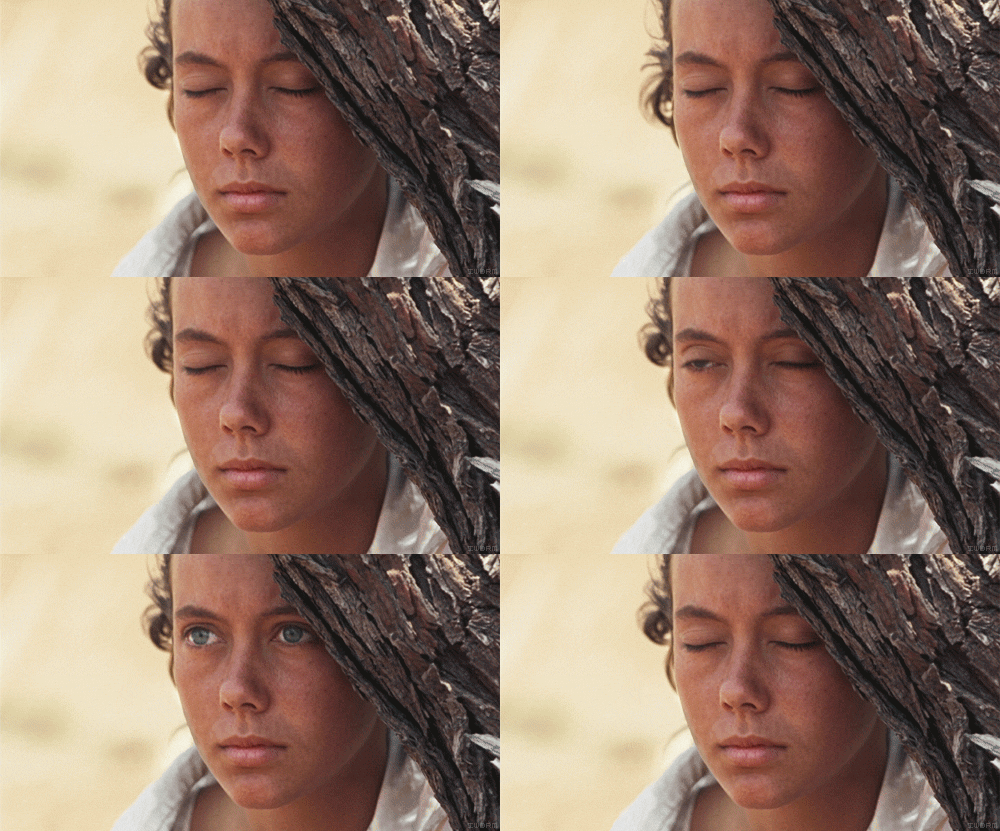
Walkabout.


The morning after, kilometres further on, alone, she stopped to reflect.

Walking could never be enough, in the desert she had lost her bearings.

How many hours had it been?

She had lost all notion of time.

She closed her eyes to see better.

She felt the breeze, the sun beating down, she was elsewhere, far away.

She knew herself to be intensely alive.

In an instant his words made more sense. 

He had opened her eyes.

She was thankful.


Walkabout.

Yesterday, I was walking around Freire, trying to breathe some life into a relationship with a distant voice captured in the lines of a paperback.

I had to blow the dust off it.

Today, after reading Keith Hamon's post, Connections, Flows, and Freire in #moocmooc  and returning to Freire, he (Freire that is),  appears to be more alive.

Keith underlines for me the connections of radical pedagogy with Dave Cormier's ideas around Rhizomatic Learning.

Keith emphasies the constant, dynamic, chaotic act of learning, of becoming.

He connects the distributed rhizomatic network with learning, with active community formation.

I quote Keith here talking of Freire,

"His words imply movement: knowledge emerges … restless, impatient continuing … human beings pursue. Inquiry is not passive, cannot be passive, but is active, moving, flowing. It reminds me of Deleuze and Guattari's flows of desire that drive all human activity—and I would say desire drives all natural activity."

Yes, our learning requires movement.

Freire needs no resurrection, but careful reading, walking, reflection, acting...

"Education is constantly remade in the praxis. In order to be it must become."

In dialogue with Pedagogy of the Oppressed through this act of writing, I am becoming aware of the friction, of the texture embedded in its language.

I make a mental note of the importance of this reflective writing for the students that I work with.

"The teacher-student and the student-teachers reflect simultaneously on themselves and the world without dichotomizing this reflection from action, and thus establish an authentic form of thought and action."

We must take our time, our time together; no deadlines for this post...

I am conscious of my breathing which is slowing, as I fashion this.

I am beginning to appreciate more and more the militant act of what Terry Elliott calls 'slow reading.'

How unlike traditional timetabled, unit managed, 'education'!

How ironic that they talk of linear on-line courses as 'learning paths'!

Not much scope for wandering off the one true path...

Ha!

Occupation.

I am beginning to better appreciate how difficult it is for students who are constantly stuffed, who are constantly occupied.

Occupied seems to be the appropriate term.

'Education', if that is what we may call it, occupies as it colonises their time.

They show me their 'busy' time tables.

"I need to get a Master's degree. You need a Master's degree now..."

Ha!

"The oppressed, having internalized the image of the oppressor and adopted his guidelines, are fearful of freedom."

How alive is that quote??

I hate how they speak about their 'post-education' - 'when I am in 'active life' they say.

How much time must they kill to be able to live actively?

How long will it be before they choose their 'professional occupation'?

I am convinced that we must strive to change that framing of education.

Who says it better than Dewey?

"Education is not a preparation for life, education is life itself."

Who emphasises our task as radical educators better than Freire?

"If the structure does not permit dialogue the structure must be changed."

  • I am beginning to list fellow teachers/fellow learners, with whom I can again engage in dialogue, locally...

I am reminded of a comment of Michael Lewis about English language teaching.

Teachers often conduct 'needs analyses' at the beginning of a course, 'the course', he said 'IS the needs analysis.' I like that formula, I heard so many years ago. I stick it here for future reference....


Colonisation.

In my last post was asking myself about Critical Pedagogy in an era of online learning, of distributed networks..

I remember the work of Shyam Sharma, in particular his comments on the absurdity of MOOCx's which are conceived to educate the 'world'.

I make a note to reread, to spend more time with Maha's latest post on Hybrid Pedagogy entitled 'Embodying Openness as Digital Inclusive Praxis'.

"One cannot expect positive results from an educational or political action program which fails to respect the particular view of the world held by the people. Such a program constitutes cultural invasion, good intentions notwithstanding."

Yes, I think to myself, we cannot simply read and then talk Freire.

He leaves us, all of us, each one of us to do our walk/work.

Walkabout.

There is no route, there is no Sat Nav, this is our walkabout.

It is our task to accompany and encourage students to embark on their own.

"The teacher is of course an artist, but being an artist does not mean that he or she can make the profiile, can shape the students. What the educator does in teaching is to make it possible for the students to become themselves."

Yes, I say to myself, blogging is, or at least has the potential to be more than careless talk...


I am reminded of Dave Cormier's post, 'Learning's first principle' in which he talks of the importance of caring.

Yes, that has resonance for me, I shall remix it: 'Teaching's first principle' is about caring.

I have decided that I am rather enjoying Hybrid Pedagogy's  #moocmooc.

These people care about learning.


refers to a rite of passage during which male Australian Aborigines would undergo a journey during adolescence and live in the wilderness for a period as long as six months.[1][not in citation given]
In this practice they would trace the paths, or "songlines", that their ancestors took, and imitate, in a fashion, their heroic deeds. Merriam-Webster, however, identifies the noun as a 1908 coinage referring to "a short period of wandering bush life engaged in by an Australian Aborigine as an occasional interruption of regular work", with the only mention of "spiritual journey" coming in a usage example from a latter-day travel writer.[2]
To white employers, this urge to depart without notice (and reappear just as suddenly) was seen as something inherent in the Aboriginal nature, but the reasons may be more mundane: workers who wanted or needed to attend a ceremony or visit relatives did not accept employers' control over such matters (especially since permission was generally hard to get).[3]

Image credits

Walkabout image. http://iwdrm.tumblr.com/post/32668491068

Careless talk costs lives.  http://www.clker.com/cliparts/e/e/2/b/126059857219020457199wdqme.png


Thursday, January 22, 2015

On a human scale.

A mass of anonymous humans, they are standing together as one, what does it express?


What does it (such a mass) express objectively?

A mass, a mob, a crowd, a people, a class, a race, a religion, an army, a species?

Are they oppressors or oppressed?

Are they free, are they enslaved?

If I ask such questions it is that I have been rereading Freire today, "Pedagogy of the Oppressed."

If I am rereading Freire, it is because I accidently got drawn into a Twitter chat last night.

It was a Twitter chat for Hybrid Pedagogy's Critical Pedagogy course #moocmooc.

There was one tweet which caught my attention:


There is something about  some of the language in "Pedagogy of the Oppressed" which is raising questions for me.

I suspect that it is a result of my experiences during Dave Cormier's Rhizomatic Learning Course.

I suspect that it is related to deconstructions of identity, of authorship, of community, of knowledge.

I suspect it is related to learning in chaotically, distributed networks.

Pedagogy of freedom

As a language teacher, I have spent a number of years deconstructing classroom approaches to teaching English.  Freire's writing, I came across a few years ago and inspired an earlier post entitled 'Noman's land.'

I bought into (irony) Freire's pedagogical approach of teacher and student working together to analyse the failure of the system to enable students to develop their voices.

I bought (irony) into his analysis of traditional education's 'banking concept' (amongst other aspects) as being a means of maintaining an elite (oppressors) in power over the 'oppressed'.


On the other hand, there are some of his language that I am beginning to struggle with:

Pedagogy of the oppressed

A quotation from Freire;

"the more the oppressors control the oppressed, the more they change them into apparently inanimate 'things'. This tendency of the oppressor consciousness to 'in-animate' everything and everyone it encounters, in its eagerness to possess, unquestionably corresponds with a tendency to sadism."


I am far from sure that considering people as 'things', as 'objects' is specific to oppressors.

This is a question that I have already blogged about in 'Internet of things.'

Objects of oppression

Is language a means of freedom and/or a means of oppression?

I say 'I', is 'I' not object?

I say 'I', am 'I' colonised?

I see myself in a mirror, is 'I' not  become object?

I dream of myself flying. js 'I' not become object.

In writing this, am I not objectifying myself?

In following people on Twitter am I not objectifying them?

In participating on Twitter am I not objectifying discourse?

"For the oppressors, 'human beings' refers only to themselves; other people are things."

I see a crowd of people from afar alive or dead, how can I not see them as objects?

'I' return to Freire...

Ownership and oppression

"The earth, property, production, the creation of people, people themselves, time - everything is reduced to the status of objects at its disposal."

Here again, I am far from convinced that the idea  that "the earth, property, production, the creation of people..." being reduced to objects is necessarily specific to a relationship of oppression.

"In their unrestrained eagerness to possess, the oppressors develop the conviction that it is possible for them to transform everyting into objects of their purchasing power; hence their strictly materialistic concept of existence. Money is the measure of all things, and profit the primary goal."

I am far from convinced that a 'materialistic concept of existence' is specific to oppression.

Would a Massai's 'ownership' of cattle be considered as an indication of oppression?

Would a house communally built of dried earth, an object of possession,  be a 'reduction'?


Objects and bodies

"the objects which surround me are simply accessible to my consciousness, not located within it. I am aware of them, but they are not inside me."

I am not at all sure that objects which are 'accessible to my consciousness' or even those which are not 'accessible to my consciousness' , of which I am not aware, do not become part of my 'body' and thereby 'inside me'.

This refers me back to my reflection on embodiment of 'classroom ritual' of Nexus Analysis, mentioned in a previous post:

Indeed, for me the analysis and deconstruction of material and emotional space is a major part of becoming critical, of becoming free. This is a subject on which I have already written in a post entitled 'The Doll's house'.


Two is company three is a crowd.  

I return my attention to critical pedagogy and the relationship between teacher and student.

If we are really to work 'with' a learner as a learner/teacher in a new 'authentic' relationship, must such relationships be located in a local community?

I am asking myself the question of the pertinence of binary labels, of dichotomies between 'oppressors' and the 'oppressed' in a world understood as more and more complex and experienced increasingly from a personal and (perhaps potenially alienating) from a global perspective.

To what extent are the social, cultural, and economic 'systems' usefully viewed in simplistic terms of 'exploiters' and 'exploited'?

In a world in which learning may increasingly be experienced in distributed networks, with individuals from distant communities, to what extent will a physical teacher student relationship be able to work towards any significant form of freedom?

Is Twitter a space of liberation, or a space of virtual liberation and distant enslavement?

Freire is dead, we must resurrect him.

While rereading Freire, how can we draw from his ideas and adapt his teaching to our new circumstances?

I am struggling with fleeting thoughts, with fleeting impressions, which fell by accident, the day after an unplanned Twitter chat with a few friends last night...

I shall close with a few words of Freire's

"Knowledge emerges only through invention and re-invention, through the restless, impatient, continuing, hopeful inquiry human beings pursue in the world, with the world, and with each other."


Wednesday, March 7, 2012

Noman's land.

The lines are drawn up, the roles are defined, the territories are determined.  At one side of the class-room, stands a teacher. The students are grouped together waiting for any lull in the content offensive to engage leisurely conversation.


The teacher draws up a plan of action for the new campaign on the board. The exercises are ready, the instructions are well-rehearsed, the number of future failures are statistically modelled. Survival is for the fittest. Success is for the elite. Cohorts of students are evaluated, streamed, trained, tested, decorated. Competition is good for the character, team-work is carefully regimented, unsupervised collaboration is suspect.


I was a reluctant RAF cadet, the uniform was scratchy, I was a poor shot, I loathed dehumanising drill. Taking orders from a teenage moron who gleefully made us march into a brick wall killed  off my Action Man dreams of becoming a commando...  


A breezy Anglican church school, the bravery of fallen heroes in the World Wars was celebrated here, the dates of battles were memorised; critical analysis was viewed dimly. 


Glorious were the victories on the rugby field, the cricket pitch,the hockey shore!


Somewhere else,further afield, Paolo Freire would write,


"Education either functions as an instrument which is used to facilitate integration of the younger generation into the logic of the present system and bring about conformity or it becomes the practice of freedom, the means by which men and women deal critically with reality and discover how to participate in the transformation of their world."


Technology plays a vital role in enabling the change of relationships in society. With the railways came massive industrial expansion, the public school, the public holiday. With the machine gun and heavy artillery came the trenches, the Somme.  With the railways came mass-mobilisation and monumental casualty counts. The 'in between' enemy lines, countries, or classes  would become 'No man's land.' 


  • No man's land is a term for land that is unoccupied or is   under dispute between parties that leave it unoccupied due to fear or uncertainty. Wikipedia  

This space, allotted for daily butchery during the Great War was also spotted with odd outbreaks of peaceful dialogue. Bizarre truces would be negotiated when troops from the opposing sides would exchange presents, souvenirs and a passion for football. Such events remain eery tributes to the absurdity of a system. 

With new technologies come new challenges, new opportunities for transforming societies or maintaining conformity. Ubiquitous connectivity enhances peer to peer communication, disrupts old hierarchical organisations, blurs the lines between work and play, challenges the roles of teachers and learners. It is not sure that we are for the moment in any way freer.


If drones have replaced soldiers, shiny interactive tablets might deliver expertly conceived global uniformity to hungry pupils. Games which let you win engage. Such edutainment however seductive does not necessarily enhance independent criticism or creativity. If predictably achieved 'educational outcomes' are reassuring for the stake-holders, they may be useless to the individual in the long-term. Curiosity requires peace to develop. 


Should we venture into the Noman's lands which exist between individuals, between informal and formal learning, between physical and virtual presence,between generations and cultures, we might aim to imagine a more diversely sustainable future.


"Through dialogue, the teachers-of-the-students and the students-of-the-teachers cease to exist and a new term emerges: teacher-students with student-teachers."
Paolo Freire.


Learning together, Noman's land might just become Everyman's land. Lines can diverge~converge. Conversation, however leisurely will inevitably be more essential than content.


Paolo Freire Pedagogy of the Oppressed 1968