Showing posts with label society. Show all posts

Thursday, April 6, 2017

Non-adjoining rooms.

Where were they all?

I was beginning to feel distinctly alone.

I looked at the link in the mail.

I looked at the link in the hangout.

They were not the same.

The others were in another room altogether.


I sent a tweet to Martin Weller over in London with the new link.

I sent a mail to the others.

Martin arrived,

"The others are waiting in a different room;" he said.

"We don't have much time." he said.

I quickly went to find Mark in the other room and called him over from Oakland.

Dinah arrived from her library from somewhere in Ghana.

Graham Steele arrived from somewhere in Glasgow.

By the time everyone was together, we didn't have much time.

I fluffed through the introductions.

Darn.

Open in transit.

I got a tweet from Nadine.

Could she join too?

Nadine arrived in transit at a London airport.

Lucy Crompton-Reid, Lisa Taner, Maren Deepwell, Martin Weller gave us their generally positive impression from OER17.

All of them remarked on a growing internationalisation of the voices and the participants at the conference.

That was all very positive.

Then, Martin briefly mentioned a session from the first day:

Perspectives on Open Education in a World of Brexit & Trump [1559]
Type: Discussion
Authors: Maha BaliLorna CampbellJames Luke, and Martin Weller

I asked them their impressions about Brexit from their perspective.

As representative for Wikimedia, Lucy couldn't really get involved in the politics of it but she noted with Maren and Martin a generalised feeling of dismay.

Martin said something to the effect that it was too complex a question for the time they had.

Indeed, they didn't have much time, they had to leave to the afternoon sessions.


We continued an "after-conversation" with Nadine, Mark, and Dinah who was typing in the chat.

Nadine, travelling from Egypt was already having to travel/work around the laptop ban.

The battle of open.

I shared a story of how I fell upon a Twitter trolling of the Scottish first minister.

I looked at the tweet.

He was calling Nicole Sturgeon a traitor.

And what do we do to traitors he asked?

They hang.

I saw an avatar with an English flag.

I looked at the name.

With horror, I thought to myself: this is someone I know.

I checked.

It was a childhood friend.

I thought of how our lives had taken such different paths.

I, to safe middle-class higher education and ex-expatriation in France.

He, to work in a factory from the age of 16, and premature unemployment.

I, increasingly internationally connected, with a growing intercultural "awareness" of how little I am aware.

He, increasingly internationally connected, locally disconnected, with a growing frustration at intercultural exploitation and a clear awareness of what he has lost.

I fear for the future.

He has no future.

Shrinking privileges

I thought of how a few years earlier I had travelled to London for a conference.

This would now be impossible for me due to current economic constraints.

Privileges are shrinking.

Pressure on people is rising.

Mark spoke of similar experiences with old school friends who were now unemployed Trump supporters.

Platforms which carried such promise a few years earlier are being used to squeeze the life out of people around the world.

Californian dreams.

I remembered a Microsoft ad with images of Woodstock.

I remembered the free iPad I got at a London conference a few years back.

Those were the days...of being a roaming autodidact.

Now I roam mostly virtually.

Imagined communities.

I remembered the feeling of being European.

I had a British passport but I was European.

I think now of learning to sing the Marseillaise with my daughter.

I have to be French to be European now...for how much longer?

Shall we go back to singing old battle songs.

Aux armes, citoyens
Formez vos bataillons
Marchons, marchons!
Qu'un sang impur
Abreuve nos sillons!
Allons enfants de la Patrie
Le jour de gloire est arrivé!
Contre nous de la tyrannie
L'étendard sanglant est levé
Entendez-vous dans les campagnes
Mugir ces féroces soldats?
Ils viennent jusque dans vos bras
Égorger vos fils, vos compagnes!
Aux armes, citoyens
Formez vos bataillons
Marchons, marchons!
Qu'un sang impur
Abreuve nos sillons!

There are those who are winners in an increasingly polarised system.

There are those who are now losing and will look for others to blame.

There are those who were always losing and who say to us now:  "This is how it feels guys."

There are those who will continue to be winners.

They will share their smiling photos from conferences in far away places.

Shall we applaud their openness?

Making a moocery of us all?

I heard about exciting new ventures at OER17

I am sorry if I am not always able to find cheer.

There are those who are refugees and who are offered a MOOC.

MOONLITE


I know that I should be crediting the photographer.

Who will credit the refugees on the beach?

A MOOC financed with European funding while kids are drowning in the Mediterranean.

What will it be?

Swimming lessons?

I don't go and learn more about the project, I fear upsetting people, knowing one of the authors.

I simply write how my ignorance makes me feel.

I am sorry.

I heard about a Wikimedia scheme to help kids identify fake news.

Are we going to get European funding to help students see what is fake?

I think of my childhood friend and the promises made to him by successive governments.

I wonder what lies I am living?

Do we need bloody hours to work out a simple equation?

People are being screwed.

I heard John Casey talk about educational technology.


What was Alek Tarkowski talking about in an earlier virtually connecting session?

That he wanted to theme OER17 an open learning party or some such?

The party is over.

For many there never was a party...ever.

They paid for our party.

Non-adjoining rooms?

For a few moments sitting in that empty hangout room, I felt panic.

I felt fear that I wouldn't be re-invited to be a virtual buddy.

It was my anxiety to do well which was at the origin of my technical downfall.

I get anxious.

I remembe what it feels to be given your cards.

I remember the boss calling me over for a chat.

I remember how it feels to be excluded.

There are some of us who share hope and happiness.

There are some of us who have only anger and despair to share.

There are some of us who have only anger and despair but no means to share.

I find myself caught between feelings of  hope and despair, between belonging and longing.

Those feelings are in adjoining rooms, perhaps in the same room.

Virtually connecting


Friday, March 6, 2015

In a tangle.

That's it, now I am completely lost.

I am not at all sure how to draw a/the line.


I am in a bit (?) of a tangle.

I am not at all sure whether drawing a line is appropriate.

I am only sure that drawing or should I say typing this is making me feel like it's a life-line.

Where there is life there is hope as they say.

Yes of that I am sure, I am typing this here...

I can see it.

I mean I could see it when I was typing.

Existential questions.

I am not even sure of myself!

Who am I?

Am I: English, French, a learner, a teacher, a researcher, a facilitator, an academic, a writer, a pundit, a critic?

I am not sure that one answer is ever adequate to such a question.

I shall settle for, in this present context:

Simon, @sensor63, Simon Ensor. Simon David Anthony Ensor. Learner.

What is this?

Is this:


a) careful reflection?

b) instinctive nonsense?
c) emotional?
d) rational?
e) a useful contribution?
f) useless noise?
g) respectful?
h) disrespectful?
i) offensive?
j) inoffensive?
k) etc
l) none of the above?
m) all of the above?
n) other.

Will this be:

a) read?
b) unread?
d) misunderstood?
e) understood?


Where am I?


I was reading Frances Bell's post 'Cool Webs for Rhizo 14'  and an ensuing discussion about the value of spaces which are 'Cool'.


For some people 'cool' is associated with a blog.

So is this blog space 'cool'?


If I then post it on Twitter or in a FB group does it remain cool?  

Is a back-channel (where I let fly my feelings) cool?

I am at a loss to understand this concept of a 'cool web'.

Frances explains in her comments:

"I am thinking of the cool web as a safer space where people with different assumptions/ languages/ cultures can try to engage in dialogue without too much pain."

I am not at all sure that this space on my blog is necessarily safe from pain. 

Is this an issue of a particular space or an issue of a particular relationship that I might have with someone?

Marianna Funes continues this discussion and chips in with:

"When I teach cross-cultural psychology in a business context we often focus on the need to attend to what is taken as self-evident and to presuppose that, even that which seems ‘outrageous’ to somebody in a culture they do not understand, has a basis that makes sense for the group of people adopting the given action."


I am getting the distinct impression that this is not about 'cool webs' but about 'cool people' who are able to question their assumptions, their own ways of being and of communicating.

So this is not a question of a particular space but of developing a trusting relationship?

On the whole I would say that Rhizo 14 has been a 'cool course' with 'cool people' .

(but maybe I am using a different meaning of cool here - sorry).

I would include Frances and others who comment on her blog as 'cool people'. 

(provisionally, until I decide they slip momentarily into another category; it rather depends on if/how they respond to this blog post).

Ultimately we will all be 'cool people'.

 (I digress and in my attempted humour I make an elementary mistake, I think even dead people are not at all necessarily cool. Indeed SOME very DEAD PEOPLE are definitely NOT and will NEVER BE COOL).

I apologise for the shrieking capitals here, but I rather like them, and this is my domain.

(no I know it is not a domain of my own cos I am lazily still on Blogger, sorry)

What is loud? What is silence?

I have been having a continuing discussion with Marianna (so silent that she may not be aware of it) about the question and value of silence. 

I am very much intrigued about this question. I always remember the power and importance of silence from my days as a counsellor, and as a salesperson and now as a teacher.

Silence has the potential for great power in a relationship.

Stony silence is in my experience undoubtedly NOT 'cool'.  

So being silent would not necessarily be a means to establish 'cool webs', it might have exactly the opposite effect.

If I participate actively in a space am I facilitating conversation or silencing others?

What is the appropriate volume of participation?

Must we take turns? 

If that is the case then we might have to wait a LONG time (and it wouldn't be really very rhizomatic IMHO).

If I leave silent participants be silent am I excluding them or am I being respectful?

I remember my father at the end of his life who would find the 'noise' of his grandchildren oppressive. I can fully understand that. His grandchildren were not being noisy (I can assure you I know the difference) they were excited to see him and wanted him to play with them.

When he was younger he would have loved the rough and tumble and the noise.

It was so frustrating for all of us when we were divided by volume.

I remember being sad at the volume of the television which stopped all conversation.

What was low volume for him was high volume for us.

I have been intrigued at conversations going on around this issue of 'noise' and 'silence' on the web.

I am not sure if I am in a 'cool web' or a 'hot web'.

Maybe I carry my own personal micro-climate with me, whereever I am?

I noted a twitter conversation the other day.
I loved that tweet.

I even replied to it.

Then I thought better of it.

I deleted my reply.

I agreed with Nick Kearney, yes 'sometimes the only response is silence'.

Is his tweet an example of the 'cool web' the  #stillweb?

I suppose if he puts the hashtag #stillweb it must be.

If I put a grisly image on the hashtag #stillweb will it still be #stillweb? (probably not).

I am not sure about this 'cool web' business.

Maybe it is not about a space but a relationship?

Should I tweet him a link to this post?

Will he regard it as noise?

I am not sure.

Nothing is clear for me.

What is pain? 
Frances talks of pain in her comments to her post.
What is painful for me would certainly not be painful for others. 

I may have developed high resistance to pain.
She says: 
"We might cool down the conversation with explicit norms, clarifying our objectives and assumptions,offer facilitation and other support in an attempt to achieve real dialogue. Over time the constraints could be loosened."
I wonder who it is 'we'? I wonder what 'cooling down conversation' means? 
Will this blog post be cool and within explicit norms?
I am not sure. I shall ask Frances (that is a joke Frances).
Would an emotional blog post be cool and within explicit norms?
Who will decide on the emotional charge? 
I don't know.
Wouldn't a legalistic or scientific article be a cause of pain for someone?
I am in a (bit) of a tangle.

I suppose this is my attempt to ask respectfully the question.

I am sorry if I offend.

I shall be a little upset (emotional blackmail and silencing tactic?).

THE COMMUNITY

There has been much talk 'in' #rhizo14 of community, all over the spaces.

I suppose Dave Cormier should be happy about that.

He did entitle his course  'The community is the curriculum'.

I am having great problems with this idea of 'community'.

I am having so many problems with it that I shall have a short pause to muster strength.

Here is a  musical interlude offered by the great (my opinion) Serge Gainsbourg.


For those of you who can't be bothered to listen to Serge Gainsbourg, he sings in French and he asks a large number of times:

"Who is in? Who is out?".

So this is my question for THE COMMUNITY (you know who you are if you are reading this):

"Who is in? Who is out?" and when and where and who decides?

Frankly this is quite clear for me now.

There is not one community.
There are multiple communities.
These multiple communities are not fixed (much).

I am not sure that I feel that I  belong to any particular community.

I don't do belonging very well.

Of course this feeling doesn't mean that I don't belong to a or several community/ies.

I have clearly identifiable traits - I am a man for example. (of this I AM SURE).

I have behaviours which mark me as a community member, like speaking English with a more or less middle class pronunciation with twinges from the North West and some French derived borrowings.

I am a human tangle embodied.

Dave Cormier, I think that he agreed to the idea that there were a number of communities in #rhizo14 in an interview that I vaguely remember with Maha and Sarah.

However I still have a few questions:

How long do a bunch of people have to stay together to consider themselves a community?
How long do a bunch of people have to stay together for others to consider them a community?

I think that the "rhizo14" community has never ever been fixed if we consider that there might be one.  That being the case there can never be A CURRICULUM, but multiple, dynamic, oscillating and competing curricula.

So I suppose I could say that the varied and fluctuating communities in and around rhizo14 have varied and fluctuating curricula.

If we consider that the course was about Rhizomatic Learning, it would seem to me that this is as far as we can take it.

There can never be at any time A COMMUNITY or A CURRICULA.

Ethics.

If there is no 'cool web' or 'hot web' and no 'COMMUNITY' nor 'CURRICULUM' then that is chaotic, exciting and potentially full of risk and power struggles - a bit like life.

Keith Hamon has written a great (IMHO) post about complexity ethics. I shall put a link here:

Ethics for MOOCs: Assertive Humility.

I think we could change that title and just write:

Ethics for life (and a better world): Assertive Humility.

If there is no one 'COMMUNITY' then there can only ever be personal ethics and desires which will vary and fluctuate according to who, with whom and when and where people interact.

There are moments when I prefer (like now) a bit of peace to sit down and reflect.

There are moments when I am moved to formal academic research.

There are moments when I love larking around on FB telling Sarah Honeychurch she's a typical anarchist. She doesn't appear to take any offence. (I worry Sarah.)

There are moments when I find people in general and people in particular annoying, hypocritical, contradictory, bossy, noisy, disrespectful, snooty, superior, confusing,  boring, egocentric [add any negative adjective] and I include myself in those negative qualificatives applied to people.

I prefer to be inclusive.

Hope and forgiveness

There are two stories associated with rhizome and rhizo 14 which I would like to highlight.


There is a story of hope and there is a story of hopelessness.

There is a light side and there is a dark side.

On one side of the coin (the light side) there is the possibility that diversely humoured and skilled people can learn to live like the baboons in the video 'Understanding the Effects of Hierarchy in Society" that Howard Rheingold shared with me the other day.  With the Alpha males dead, they lose their desire for dominance and hierarchy and become increasingly forgiving and open.


There is the hope that we can learn to live with our differences, value our different perspectives, take a deep breath or two when we feel like we are being talked down to or ignored, or excluded, or... (add any negative feeling towards others) and try to work towards more open, perhaps less rigid societies which allow for diversity and mutual respect.

On the other side of the coin (the dark side) we can take from #rhizo 14, an impression of fixed positions, fixed labels, fixes spaces, hierarchies, stories of power struggle, memories of the inabilities of humans to use their imaginations to see the other peoples' point of view.

We can imagine rigid and unchanging community lines, a need for rigid policing of behaviour, a need for a quota of words written, a series of instructions as to acceptable forms of expression.

I doubt that anybody in #rhizo14 would really want that.

I hope that I am mistaken.

On the other hand there might be another group of extremists who might emerge and become dominant.

They might decide to follow the actions of Pol Pot and decide that all Alpha males, and in particular those who they consider to be senior academics should be sent to the killing fields, with the objective of achieving an earthly paradise and a 'less violent society'.

It worked for the baboons...

The rhizome, nature, and  humans in particular do have an ugly side.

I prefer to live in hope (perhaps stupidly).

Yes, I accept that Rhizo 14 is an experiment.

I often change my mind.

I am hopelessly and annoyingly inconsistent.

That in itself gives me some cause for hope.

I am in good company.

I am happy to be in a tangle.

Thank you for your part in my tangle.


Thursday, October 16, 2014

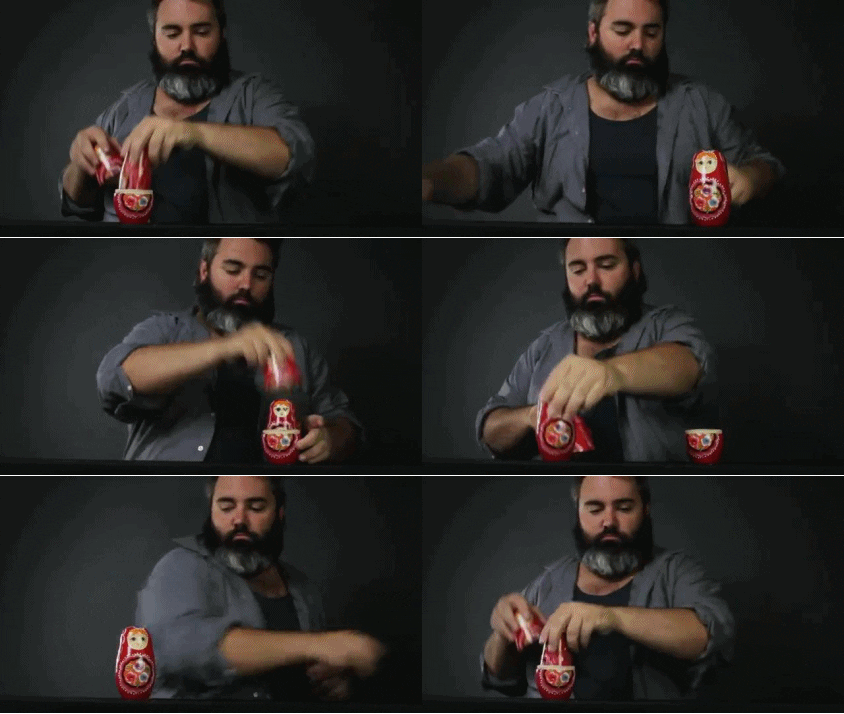
Russian dolls...

It is an image which keeps coming back to me.

I escape one enclosure to find that I am in another larger enclosure.

It is the image of a Russian doll.

I have been spending much time reflecting on my place on the web, on the earth over the past few years.

I have recently been working my way through issues connected to the 'Reclaim your domain' movement.

I am struck by the 'self-proclaimed' impassioned pleas of Howard Rheingold and Gardner Campbell to build the web that we want to build.

I am convinced that they are putting their fingers on a burning issue which we need to work through.

An immediate reaction to the question of 'Reclaiming your domain' was expressed in my post of the same name. 

Auvergnat dolls.

I feel that we can not divorce our thinking about the 'web' space with our thinking about the physical spaces in which we relate locally.

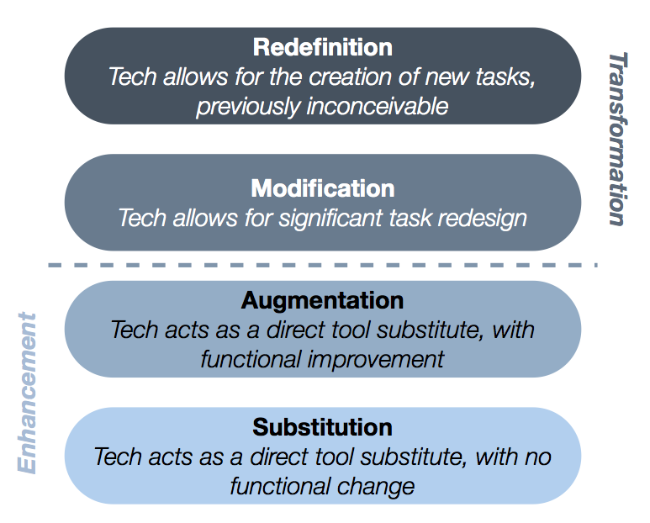
One lens which has helped me think about role of technology in education has been Puentedura's SAMR model as presented by Doug Belshaw here:


There is a short presentation in this video 


I remark that the narrator in this video talks about 'the classroom' - transformation of the classroom.  

I can't help thinking that the 'classroom' lens is one which stops us thinking through a wider transformation of education.   

There is no question that mobile web-enabled personal devices are disrupting 'classrooms' and 'educational institutions'. 

Of the obstacles to building new models, we can note 'habitus' of teachers, the 'classroom discourse', we can mention 'standardised assessment' amongst others.

The real question is what are these boundaries obstacles to?  

Who or what is protected by boundaries which have been built physically or virtually? 

Who stands to gain from crumbling frontiers, from blurring of boundaries between work and play?


As a child I never imagined seeing the Berlin Wall fall.

I remember witnessing the moments of joy when the Berlin Wall came tumbling down. 

What were we witnessing in these moments? How were once disconnected people connected?


I remember using the image of the Trabant to talk about the contrast between Walled Gardens of the LMS/VLE and the construction of Personal Learning Environments enhanced by Web 2.0 applications and Google cloud computing.  

Institutional enforcement of the use of out-dated communication tools was, I reasoned an obstacle to the learning of the students.   

It wasn't just an obstacle to the learning of students, it was also a means to protect the positions of a technological elite, who had the power to dictate the tools to be used.  

Outsourcing of net hosting and institutional virtual environments would/will inevitably mean de-skilling, cost-cutting measures and dependence on massive corporations.

The Trabant disappeared from production, replaced by Western-made models.  It's disappearance was symbolic of the defeat of a political system and its socio-economic elite.  

A Trabant

There is no doubt that learning spaces in which I am working are being transformed physically and virtually by the possibilities to connect more widely via affinity with people around the world.  

This is exciting, we are moving towards a new era, of that I have no doubt.

I am constantly brought back to my image of Russian dolls.

We can not concentrate our attention simply on education without seeing how it relates to economic, ecological, social, and political contexts. 

One thinker who has helped me reflect more widely on Learning Futures has been Keri Facer.  


'Non-stupid optimism' is an expression which resonates for me and 'educated hope' is what I aspire to. 

Hope and power

As educators we do have real power to enable sustainable change, we must realise together we do have real power, we do have a voice, which can be heard, the young are our hope. 

I come back to 'Reclaiming my domain', again and again.

I am quite happy with the idea of running my own server.

I am quite happy with the idea of building my own WordPress space with a name of my own.  

I would however not want to stop there.  

When I hear, we can build the net together, are we speaking about building our own computers? 

Are we speaking about running our own cables? 

Are we speaking about becoming our own ISP's?  

Building our web is one thing. 

Building relationships locally with those globally is quite another. 

How does all of this relate to the bigger questions of society as evoked by Keri Facer?

How do we react to writers such as Douglas Rushkoff?

“Our enthusiasm for digital technology about which we have little understanding and over which we have little control leads us not toward greater agency, but toward less...We have surrendered the unfolding of a new technological age to a small elite who have seized the capability on offer. But while Renaissance kings maintained their monopoly over the printing press by force, today's elite is depending on little more than our own disinterest.” 
Douglas Rushkoff.

Is this what Howard Rheingold and Gardner Campbell are talking about? 

If this is the case, then we need to start thinking much more widely about the societies in which we are living, and how power is structured.

We need to think through what these Connected Courses are really preparing us for?   

We need to ask our friends:

What it is we are working towards? 

We need to spend much time on this business of building new relationships with ourselves and others. 

We can not expect to embark on new relationships without accepting that our relationships with ourselves will inevitably be transformed.  

New environments require new language.

I can not conceive that this map is 'our territory'.

Do others consider that they own this?  


Might 'owning your own domain' be an outdated metaphor?  

Maybe we need to start thinking over our ideas of what constitutes 'ownership' of what constitutes 'capital'. 

How can 'capital' be other than social?

What are we educating ourselves for? 

I am only too aware of my ignorance, of my inability to find answers for my questions.

We must educate ourselves beyond our 'stupid optimism' to build a web of  'educated hope.'

What will be our legacy my friends?

I am at a loss for words.

And as I ask one question, another appears, incessantly...


Monday, October 13, 2014

Fear of flying.

"When I say you have control, you say 'I have control.'"

OK. Roger.

"You have control."

"I have control."

I was a little heavy-handed on the joy-stick. 


The Chipmunk Trainer took a dramatic dipping turn to the left...

"Errrr, I have control."

OK.  Roger.

The instructor, audibly shaken, resumed a normal flight angle.


Fear of flying 

There is something unnatural about sitting in an aeroplane and knowing that you are about to fly over high mountain ranges, zoom across wide oceans to most probably arrive in some distant destination.

I am always brought back to footage of early attempts to take to the air.  

Man will never fly.

I can only imagine the hours of imagining, designing and building what now appear naive death-traps.


Of course, the machines invariably either stay land-locked or drop like bricks.  

I am somewhat reassured that repeated testing of materials, engines, pilots, makes an Air France journey less of an adventure - give or take one or two strikes. 

"Oh what's the point? I shall never be an artist." 

I was always pretty fed up with my mother's defeatist attitude to her art-work. I loved her 'naive' drawings, her delicate touch.  Of course an art-critic might not have seen genius but wasn't that missing the point?

"Je suis nul. Je ne vais jamais parler anglais."

I am always pretty fed up with my students' negative attitudes to their English abilities.  

They have been told that they are useless for so many years that I spend much time explaining to them why it is that they are not incapable of learning a language. 

We speak about the difficulty for an adult of accepting a loss of communicational competence, the need to learn to play with the language. 

We try to find ways that they can assess their progress rather than concentrate on their 'mistakes'. 

Little by little, they discover their voices, they gain confidence, they make large leaps. 

Of course an examiner for a certification may not take into account their transformation but isn't that missing the point?

"I am useless, I shall never find a job."

I typed and retyped the CV, over and over and over. 

Having convinced myself that I was useless, I tossed version 12 into the waste-paper basket.  

Months later, I plucked up courage to send one perfect CV, waited for three weeks for an answer. 

My hands were trembling as I opened the envelope. 

It was what is termed a 'rejection', I was devastated. 

Mulling it over.

As I dealt with the idea that my career had finished before it had started, I spent some time reading about the early 'careers' of brilliantly successful advertising executives.  

Far from demonstrating immediate genius, they often had spent years being apparent failures. A penny started to drop. Not knowing what direction to take was perhaps OK. 

Looking back, I am sort of amazed at how naive I was. 

Looking back, I am sort of amazed at how useless the experienced, sensible 'adults' appeared to be in encouraging discovery, how reluctant they appeared to be to admit their own vulnerability, their own doubts.

Mulling it over

I was reading a few comments on a #ccourses Twitter stream this evening.  

Here is one which caught my eye:

“If you’re not falling off it, you’re not really exploring the edge.”

I like taking risks - that is why I love acting, adventure, rock-climbing.  

I love learning.

I am not sure that I would be a great 'climbing instructor'.

I am brought back to a near death experience at school. 

The teacher didn't check the descender was attached to the rope.

I saw the problem. 

If I had been too trusting, I would have had a nasty fall...

I would prefer rock-climbing instructors to be properly qualified.

Here is another one that caught my eye:

I don't want my doctor exploring the edge.

Yes, I would prefer the doctors who are called to operate on me, to have practised their delicate gestures repeatedly, to have sensitive hands.  

I would also like them to be able to recognise that my body parts are connected together to constitute a person, namely me.  

We can speak together. 

I would like them to be able to speak with me with sensitivity.


Fears of success and fears of failure

I am brought back to the ideas of success and failure.

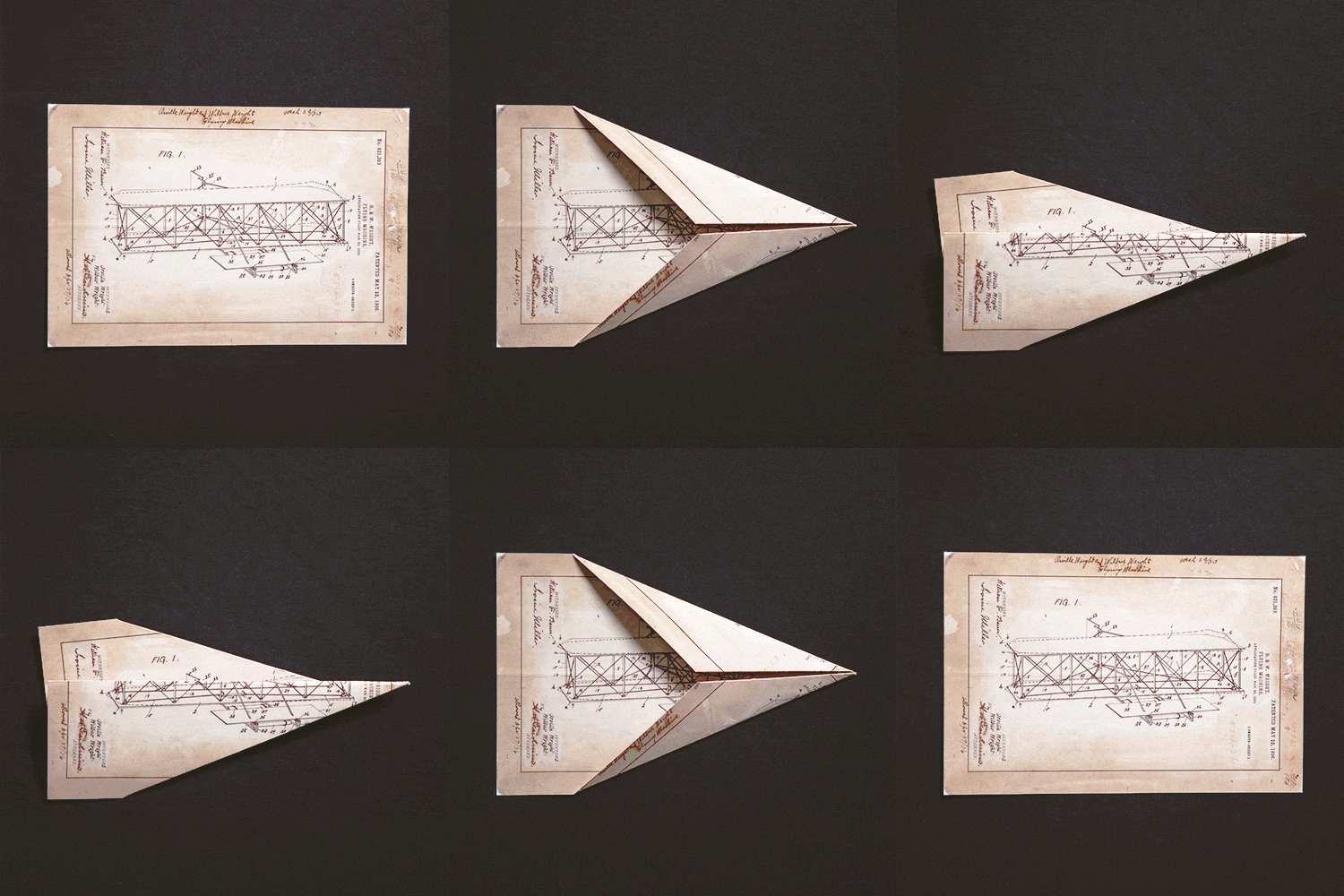
I remember the hours and hours that we spent at school making paper aeroplanes, testing their flight, whooping with delight as the various designs nose-dived, glided, loop the looped.  

How are we to judge the success or failure of these childish test-flights? 

I would suggest that the real success lay in the community of play.

I remember the hours and hours that we spent at school doing exercises on paper, testing our grammar, irregular verbs and what have you.  

I remember little of the successful answers or the failed answers.

I would suggest that real success of education does not lie in getting the largest numbers of correct crosses on an answer sheet.

There are good reasons for enabling students to become qualified pilots, rock-climbing instructors, surgeons, aviation engineers.  


I don't believe that we can learn without making mistakes.  

I don't believe that it is a good idea to compare oneself with inaccessible models. 

I do believe that we can only progress through repeated and reflective work.

I do believe that we can waste hours arguing about completely different contexts as if they were comparable.

I don't believe that we can progress as communities, as societies, without play, without taking risks.

I don't belive that we can work with people as if they were disconnected parts to be machined.

I believe that we are in the dark ages of human social development. 

I believe we all must take  leaps of faith to reach out to distant destinations.

I am not convinced that our current instructors know how to avoid a nasty crash.


Saturday, September 13, 2014

Rough field notes. Inklings of hope.

Field notes 

(I suppose this is part of what has been described as autoethnography - experts comments please)

Introduction
I shall attempt to change tack for this moment (perhaps this will continue? I don't know) in my writing in this space 'Touches of Sense".


It has served its purpose very well as a personal tool of research. I shall come back to this point.


I do not know in what forms this research will continue from now on. These are remains to be seen :-)

There is little doubt, however that I feel the need to take stock of my experience.

I would also here, like to share my questions and my lines of reflection with others.

I am beginning to question a number of concepts and limits to methodology of research, that I perceive as barriers to necessary transformation of education and I would venture societies.

I have been interacting with people spread out around the world (though that terminology itself is to be questionned) in a number of online and offline spaces. I shall attempt to identify and list those spaces.

1) Interior space. Historical Body/Space (note Scollon and Scollon)
Emotional/Spiritual/Cognitive/Body/Cultural/Narrative/Linguistic/Family/Friend/ ( I shall need to develop this further. at a later date). As a result of events and personal stories, it has been necessary for me to conduct psycho-analysis. This was clearly a turning point in my perception of my history and my relationship with 'myself' and others. I have also spent half of my life in a previously 'alien' culture and linguistic environment (France)

As a result of events in which I have been actor, it has been necessary to:

a) Go beyond comfortable emotional/moral/intellectual/experiential/physical limits.

b) Go beyond what I considered constituted my 'identity' - linguistic/cultural/philosphical/ (I shall need to develop this further at a later date)

c) Go beyond what I considered to be 'normality' 'sanity' (I shall need to develop this further at a later date)


2) Professional space (Note Bourdieu, Scollons, Habitus/Historical Spaces/Nexus of discourses/Interaction order)
My choice of 'professional activity' was (like for many) a combination of accident, design, and a response to economic/linguistic/competence constraint.

Coming from a family in which 'normality' was dealing with questions of 'life and death' (being child of generations of clergymen) and from a family in which there was 'vast inherited economic' wealth but no professional activity to mention, it was extremely difficult for me to make any sensible decisions as to how I wanted to 'earn my living' or that matter lead my life. My only sensible reaction to dissonance was to go towards a form of 'tabular rasa' - starting form scratch.(of course that in itself is a fiction).

I was rather marginalised in my proposed peer-groups being the 'youngest child' ,an unbeliever, a boy who lived in a big house in a mining town, or a boy coming from a relatively poor family and son of a clergyman in an expensive and distant private school. Identification with others was difficult. (I am aware that I share these difficulties with many others)

Academia, has been until very recently a mystery for me. I was able to float through university without a great deal of thought, I frankly had no idea what was going on.

I have in my life been witness to one thesis presentation (last year) which appeared to me to be fascinating but rather unattractive theatre.

I found little reason to engage with the form of 'learning' that I was presented with at school or at university.

I simply fulfilled minimum requirements until I managed to do what I was passionate about - research and story-telling et al. (to be detailed perhaps at some later date)

I was disappointed at the lack of 'adventure', the lack of 'ambition' of researchers that I met indeed it would be true to say they were not I felt an exception.

I did not find any university academic to identify with.

They appeared to me to be extraordinarily dull.

Coming from my social background, I was disconnected from any 'career' mapping, never have had any real ambition apart from to play, and pay the bills and to manage to do what I have seen of interest to finance - travel, children's education, clothes etc.

My relationship with money is one rather of boredom, I find the obsession with financial gain and acquisition of objects to mark 'social success' of little interest if entertaining at times. I can quite appreciate beautiful objects but I retain a mostly critical relationship with acquisition and accumulation.

Coming to English language teaching after miscelleaneous and diverse 'professional' experience, (note perhaps to be extended at later date) I discovered an environment in which for  a while I could play with satisfaction.

I enjoy experimenting and reflecting on my experience. I have always observed from a distance and played different roles to see how one or another role would have an effect on the environment in which I have found myself.

I have noted with interest the various 'given identities' that I have been tagged with.

'serious' 'fun' 'geek' 'dangerous maverick' 'difficult to work with' 'trouble-maker' 'insane (often that one' 'Cantonaesque (NB Eric Cantona see Wikipedia) 'elecron libre' 'fonctionnaire d'etat' (teacher employed permanently by state) 'associate member of research laboratory'.


I have noted how the introduction of particular technology has had a disruptive effect on the teaching environment. I have been fascinated by these evolutions. This curiosity has driven research and experiment.

As a result of diverse professional experience/personal experience I have been able to increase my resilience, and my distance from the professional environment in a way that some people appear unable, or unwilling. It is clear that I share neither the values, nor the competences, nor the fears, nor the perspective of many of the people with whom I have worked with. There have been a few notable exceptions. (references)

I have embarked on an experiment to transform education from within, from my own classroom.
(See references)

I have found great help in considering the environment in which I act through a number of lenses:

(Notes: note refs)
a) A Complex system
b) Ecologies
c) Narrative spaces
d) Nexus of discourses -(ref - Scollon and Scollon)
e) Through Social Network theory
f) Through rhizomatic metaphor - though I feel that this is reaching its limits (to be investigated)

Clearly such reflection is having a major effect on my action choice.

3) Onlining learning spaces 2014
(Notes - Downes/Siemens/Cormier/Stewart/et al to be continued Scollons again/Activity Theory Engstrom/Research areas to be defined and not yet done to my knowledge See all lenses above)
I shall fast forward to my recent online learning experience.(note intermediary online experiences have already been documented elsewhere). In January 2014 I signed up to participate in Dave Cormier's Rhizomatic Learning Course (see blog posts tagged #rhizo14, pinterest curation, twitter (archive - to constitute), various interactions - blog comments, twitter maps (cf Hawksey) - to be detailed at later date). I then played in CLMOOC (refs to add) and am currently participating in Connected Courses (refs to add).

I would like here to note a number of points to investigate:

1) There appears to be resistance of certain researchers to question their methodology, their role as researchers, the objectives of research and relationships with questions of
a) recognition
b) authorship
c) status
d) means of representing dynamic emergent complex systems
e) cultural domination in a globalised 'economy'
f) assumptions of supremacy of 'scientific method'
(to be extended/detailed at later date)

2) We appear to be reaching the limits of terms/concepts to describe and to imagine learning in a globally networked environment (notes to detail and review)
a) Spacial/temporal issues to conceive networked learning
b) Lack of distance from cultural frames of perception to make sense of globally networked learning. (Note I have been looking at Gestalt theory as a means to partly explain such problems)(points for reflection here)
c) Lack of distance as concerns 'technological framing' (this includes language/semiotic environments(see Mcluhan/Blommaert et al)
d) Problems of distributed and disassociated identity (to investigate and reflect on)
e) Concepts such as 'class' 'institution' 'course' seem more and more hazardous.
f) Learning 'management' appears absurd.

3) We appear to be stuck in an obsolete politico/economic system whose deficiencies are being amplified by globally connected technology. The results of this on an ecological level and human level are dramatic.
a) Relationships between man and machine to address urgently.
b) Relationships between corporations/governments/finance to address urgently
c) Relationships between ..(to be continued at later date)
d) Relationships between territory and national boudaries (to be continued)

4) We appear to have great difficulty in recognising healthy humans from unhealthy humans.

On a personal level, I have begun to understand why I have been marginalised and aggressed as my discourse/behaviour is for many intensely destabilising and threatening.

We appear to have great difficulty in recognising and dissociating 'manipulative' from 'reciprocal' relationships (Note discussion with KW Hamon and Terry Elliot - ref) which respect diversity and complexity.

5) I have cause for hope.

a) I have finally met individualswho appear to question assumptions of what constitutes the differences between:
  • religion and spirituality
  • freedom and freedom to exploit
  • education and manipulation 
  • learning and assimilation of models
  • dialogue and parallel monologue
  • research and academia
b) I am finally meeting individuals who appear to question assumptions of how to express 'knowledge' , its 'value', 'artificial separations between spheres of activity' notably the following:

  • Art and science
  • Text and other media of communication
  • Immediacy and reification
  • Individuals and communities and networks
  • (to be added at a later date)
  • Flow and distance
  • Emotion and reason
c) I am beginning to experience apparent transformations in:

  • My own perception of my identities
  • My own trust of my action, reflection, and means of expression
  • My level of competences (to detail)
  • My relationships with academia/research/education/other spheres
  • My lenses of analysis and vision of future transformation of education and social environments.
These 'field notes' are shared in the hope that their perspective will enable me and others to further advance in this process towards advancing critically within a chaotic environment for my own and others' benefit.'

I note that 'poetic' 'artistic' expressions as evidenced in this space are a means of research in what constitutes unknown spaces which would be for me impossible with other more traditional methodology.

It is extremely difficult when venturing beyond what one has been used to, to map new territorities.

This venture can only be done in association with my fellow adventurers and in no way can this current or previous pieces of expression/reflection be realistically limited to being the voice of an author by the given name:

Simon Ensor.

I have the strong impression that I am beginning to identify with unauthors who have gone by the given names of Deleuze and Guattari.

PS. Thank you for your patience. I feel that is quite enough neurone crunching for one evening.

Interestingly, 'Enso' pieces (of which I do not claim particular authorship - rather editing-rights) are both more enjoyable, and much less tiring.

My only hope from these field notes is that I shall take control of at least a part of this process of research. 

Frankly, this work/play at times is draining.

To be continued.


Note to self. attempt to define 6D learning.

Note to self.  I shall add bold, refs etc etc when I have had a break.


PS. To those doubting my sanity, please don't forget to include doubt as concerns your own frames of reference.  If there are any fears for me in this process.

Please allay your fears, I have very good friends who I trust. I am well armed for the journey.

I am fed up now. I shall publish.

Que sera, sera, whatever will be will be etc.
(Football song - note irritating change of genre)


PS Having just see Maha's post. It seems that there is a lot of what I have just done going on.
Am I English/French? etc etc.
Am I me?

Frankly I am fed up with absurd boxes which we put people in.
Yesterday somebody said - ah you must be a buddhist.
For years people grilled me - Are you a Christian?

This is really getting on my nerves this obsession of categorising.
Note I must study Gestalt.


PPS Maha I think we have an article brewing.

PPPS Having written a letter to Jim Groom, reading a comment of Susan Watson and a tweet from Maha, I am feeling more courage and have even edited bits of this.