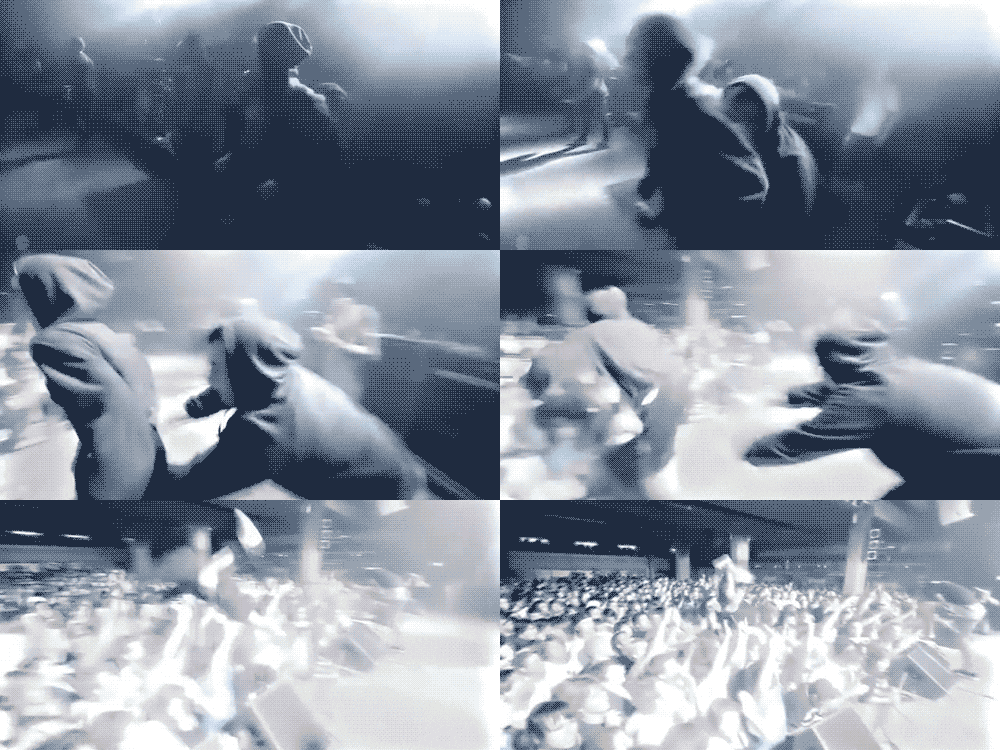
"By all means push people's ideas...
please do not push people..."
Dave Cormier
Participating in the pre-course warm-up for Dave Cormier's #rhizo15 course, I am already beginning to ask myself questions.
(Not that I ever stop asking myself questions.)
It was these lines from his 'Practical guide to Rhizo15' which caught my eye:
"One of the central narratives of rhizomatic learning is the idea that learning is at once a deeply personal, individual process and something that only happens in collaboration with others. We are all different, but we need each other.
By all means, push people’s ideas… please do not push people.
Connect with everyone. Try and understand what they are saying and why they are saying it. And, on the other side, understand that when people push your ideas, they aren’t pushing you. We do not need to agree with each other, to learn from each other."
So can you really separate people from their ideas?
Is it really true that: "We do not need to agree each other, to learn from each other."?
How do we know what the acceptable idea-pushing limits for people are?
We can perhaps look at extremes:
It would be not advisable to challenge the ideas of some people in power.
They might respond to any such challenge with violence.

"I am only pushing your ideas..."
It might not be advisable to challenge some people's beliefs:
Moreover, how do we separate ideas from beliefs?
If I have ideas about your beliefs, to what extent do I have the right to challenge these beliefs?
Clearly, that will depend on the country in which I am doing my challenging, and in some cases even using my right to challenge them will not protect me.
 |
"We are all different but we need each other."
I am not sure that we need to be with some people - rather the contrary.
I am not sure that we need to be with some people - rather the contrary.
I think it would be fair to say that we do need to agree on some basic rules of behaviour before we start upsetting each other.
So yes we do need to agree with each other to learn from each other...up to a point.
We do no doubt feel confused, upset, at times when working with other people.
We all have different limits which are often unknown to us until they are tested by others.
We all have different limits which are often unknown to us until they are tested by others.
"We’re going to take a look at some of the practical implications of saying that learning is messy and uncertain. It can be confusing. It can, sometimes, be upsetting. It’s super fun though, and it’s a great way to push your thinking with the ideas of folks from around the world."
What might appear 'super fun' for some people will definitely not appear 'super fun' for others.
That's unfortunate, we don't all love jumping around in a mosh-pit.
It is normal that the music will just be too loud for some of the people who turn up.
That's unfortunate, we don't all love jumping around in a mosh-pit.
It is normal that the music will just be too loud for some of the people who turn up.
We surely don't need to stick around with everybody being all Teletubby inclusive - that might limit learning.

"It's super fun..."
People need to find others that they can learn with safely.
"We need each other" but not in the same way.
I don't believe you can separate people from their ideas.
I suppose that that is what articles in scientific journals try to do by 'being objective".
I think that that idea (that you can separate people from their ideas) is of itself potentially dangerous for people.
I think that the focus on the word 'ideas' already says something about expected interactions.
- What about media?
- What about language?
- What about spaces?
"Saying that learning is messy and uncertain." is indeed a potential recipe for tension and conflict.
What mess is acceptable? What constitutes mess?
Answers to those questions can only be subjective.
"Saying that learning is messy and uncertain." is one thing but saying that education should embrace messiness and uncertainty is quite another.
How much mess is acceptable? What constitutes mess?
"Saying that learning is messy and uncertain." is one thing but saying that knowledge can only be fuzzy and uncertain is quite another.
I finish with another question about rhizomatic learning.
"One of the central narratives of rhizomatic learning is the idea that learning is at once a deeply personal, individual process and something that only happens in collaboration with others."
I am far from sure that learning 'only happens in collaboration with others'.
I am far from sure that most of my learning during rhizo14 (the course before rhizo15) was done 'in collaboration with others'.
Certainly I learnt much in interaction with others, in cooperation with others and sometimes in confrontation with others but not really so much 'in collaboration with others.'
I think I learnt much about different people's limits as to what constituted acceptable 'play', 'learning', 'knowledge', 'language', 'education'.
Those limits are never clear from the outset and inevitably depend on the relationships between people.
Those limits are never clear from the outset and inevitably depend on the relationships between people.
People will accept things said by certain people but not by others.
What I can take from my friends, I won't take from anyone, particularly someone who I feel no affinity for.
Some people are better than others in judging how to say things to others.
Some people are better than others in judging how to say things to others.
I think that is what learnt most from rhizo14 - that you can't hope to learn in pushing peoples' ideas without pushing people themselves, unless of course what you say is unheard, or what you write is unread.
Perhaps that is the most important thing to try to learn from these courses: how to push ones' own limits and continue to live peacefully with others who challenge them.

