Showing posts with label conversation. Show all posts

Thursday, September 7, 2017

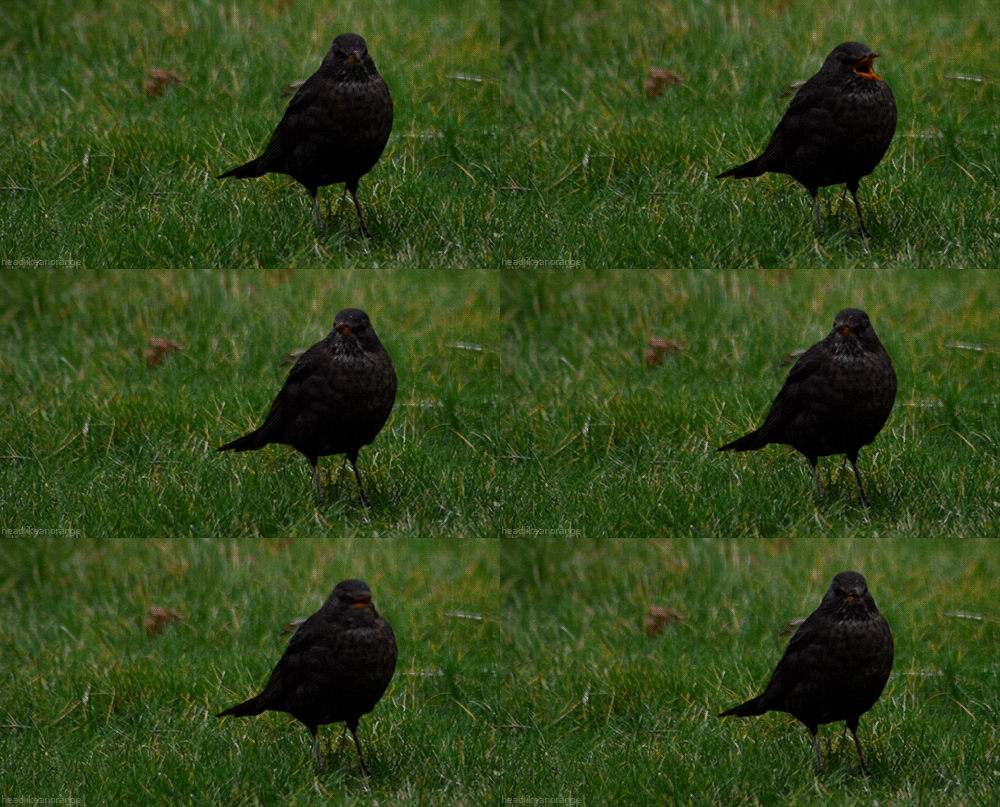
Blackbird.

Stop.

NO REALLY.

STOP.

An instant.

Can you hear the beauty?


That song?


"What are we/they ACTUALLY doing? That's what matters." Peter Goodyear.


I sat down this morning with my friends and colleagues, early.

Early enough to REALLY appreciate the coffee.

Somewhere, PEOPLE had decided on PLATFORM POLICY which was stressing out my friend.

WE DIDn't FUCKING EXIST (on their platform).

That was causing problems.

Because despite the digital policy evidence to the contrary,

WE DO EXIST.

REALLY.

For a moment, I am brought back to listening to Bonnie Stewart's keynote at the ALT conference.

In the light of recent discussions, in the light of the morning coffee, I am feeling that I need to come back, to walk slowly with Bonnie's keynote, to listen to it with new ears.


Years and years of Inuit oral culture.

I think for a moment of that story that Bonnie refers to:

Sir John Franklin, a Western explorer, undoubtedly well-financed, attempts to "force passage."  

His ship sinks into an oblivion.

SIR was remembered by Inuit oral histories but lost to Western science for 168 years.


Bonnie, in the light of her experience attempting to "teach" the Inuit asks us to think critically about our use of educational technology, of education (which is a technique, a technology) and challenges the "NORMAL".

Where is the space for those without voices?

How can we learn from those whose voices are SILENCE?

How can we learn from those whose science are STORIES?

I think of this as a parent of children who use SILENCE as a weapon.

ANONYMOUS

The day before in the VConnecting session with Sian Bayne, Peter Alston and others, we had spoken about anonymity.


How do we situate our practice in a world governed by platform capitalism?

I wondered.


I wondered.


Wendy took her time, a napkin, a pen, Twitter and amplified and extended the WONDERING.


So there I was after coffee with my friend Leisha.

We were brought together to talk of connecting students in France and the UK.

Being just the two of us, we took our time.

Documents, led to photos, to videos, to VConnecting, to a research survey which stopped me in my tracks. (NB TRACKS - WHOSE TRACKS?)

I had written about being stopped in those tracks here:

"Survey and Surveillance".

I had wondered.

"How can I position myself as a researcher with friends and colleagues?"

I had lined up a conversation with my friend Maritta Riekki to talk about this tomorrow.

I have always had a problematic relationship with research and researcher identities.

I had noticed my colleagues' intake of breath on the mention that I was working towards a thesis.

"Who does he think he is?"

"What am I?"

"Who do I think I am?" IN DEED.

IN DEED.

Quite naturally during our conversation, we moved from a submission to a conference, from informal conversation to agreement that we would capture our conversation, to agreement that we work together on reflective practice and extend our conversations within our local community.

What REALLY counts is the TIME we spend giving attention to OUR COMMUNITIES.

I underline the words: OUR COMMUNITIES.

I remembered a post of Maha Bali: Keynoting and Impostering ,talking of the conflicting feelings which concern the words:

OUR COMMUNITIES.

In the light(darkness?) of:

  • WESTERN COLONISATION, 
  • MERCHANT CAPITALISM
  • SLAVERY CAPITALISM
  • PLATFORM CAPITALISM, 
  • NEOLIBERAL MONETISATION of ACADEMIA
  • NORMED ATTITUDES to GENDER/SEXUALITY/ETHNIC orgins.
  • GLOBAL WARMING

What constitutes  OUR COMMUNITIES?

Who do we spend our time with?

Who do we really give our attention to?

Who do we ignore?

Do we extract resources data and privilege from from subjects, THEIR COMMUNITIES?

Do we protect ourselves in WALLED COMMUNITIES?

Do we protect our power behind PERMISSIONS TO EDIT/CODE/MODERATE?

So that we may add value to our brand in OUR REPUTATION ECONOMY?

I hear a blackbird singing.

Who is the TROLL/TERRORIST/IM-MIGRANT/EXPERT/TEACHER/LEARNER/FRIEND?

What constitutes OUR COMMUNITIES?


COINCIDENCE?

It so happens that at noon, I had a VConnecting session.


It was, amongst others with the morning's keynote speaker: Peter Goodyear.

I went back and noted some words.
And some other words:

And some ideas:
And some pictures which echoed conversations with Leisha.
It was perhaps a coincidence that a question came to the fore:

"How do you, as a researcher, present yourself to "'practitioners"?"

This came from my conversation with Leisha about how our colleagues perceived the words:

"RESEARCH" "RESEARCHER".

We decided that the power differentials inherent in the terms made the colleagues defensive.

I mentioned to Leisha that I myself had been aggressively defensive to what I considered appropriation of my work for the benefits of "researchers" and their CV's.

I remember "What are you?"

I remember feeling excluded and belittled by academic language.

I remember a conversation with a student who talks of academics deliberately marking rank with "academic language"

I remember Bonnie talk of IQ tests, Bell Curves, and how they are culturally biased.

Innuits: "What is this dahlia?" "What is a blackbird?"

What might we learn from Inuits about orality - history, knowledge, song?

The conclusion that I am coming to is the following:

We must walk the walk, taking time to treat people right, to respect our differences.

Science may give us massive data sets, neutral objectivity.

Does Google do no evil? (ERR?)

Can we trust Facebook at face value? (NOPE)

Do researchers have the right to do wrong to the anonymous?

The darkness that binds us.

Life reminds us that however distant we are from others' reality there are universal facts.

We are born, we move, we die and then we know no more.

We spoke of that with Leisha, we have a duty to revise the old odysseys with our learners.

"Love all, trust a few, do wrong to none."

William Shakespeare.

All of this entails: care, love, humility, trust, time, attention, craft, artisanship.

I am reminded of a little girl who used to play in the sand-pit with me as a child.

She used to play with the Inuit in the snow, as her parents were missionaries.

She opened her eyes to the reality of life dying in the street in India.

KNOWLEDGE may BLIND more than it allows us to see.

I wrote about her story.

It was called "Blinkers and Socks."

I have a difficult relationship with my missionary past - Nagasaki Mon Amour.

I am reminded of the writing of my friend, Paul Prinsloo.

Who consitutes OUR COMMUNITIES my friends?

I hear a blackbird sing.

Blackbird singing in the dead of night
Take these broken wings and learn to fly
All your life
You were only waiting for the moment to arise

Blackbird singing in the dead of night
Take these sunken eyes and learn to see
All your life,
You were only waiting for the moment to be free

Black bird fly, black bird fly
Into the light of the dark black night

Black bird fly, black bird fly
Into the light of the dark black night

Blackbird singing in the dead of night
Take these broken wings and learn to fly
All your life
You were only waiting for this moment to arise


What/Who is on your "to do list" today?

"What are we/they ACTUALLY doing? That's what matters." Peter Goodyear.


Friday, March 24, 2017

Vectors of virus.

"Mais qu'est ce que ça veut dire, la peste? C'est la vie, voilà tout."

Albert Camus. La Peste.


"Mais pour parler de tous et à tous, il faut parler de ce que tous connaissent et de la réalité qui nous est commune. La mer, les pluies, le besoin, le désir, la lutte contre la mort, voilà ce qui nous réunit tous."

Albert Camus. 

Discours de la réception du prix Nobel 1957

"I'm a rat." 

I said to the teacher between classes.

It had suddenly occurred to me that I had identified my role.

It is an image that has crossed my mind over the past few days.

I get into places where I shouldn't.

I am a carrier of  viruses.

There are positive viruses, there are negative viruses.

Those judgements depend on your values.

A virus is value neutral. 

(I write that and then I find the idea strangely troubling.)

For better and for worse the internet is a vector of infection.

Elections are vulnerable to viral fake news carried by simulacra of recognised media.

Education systems are vulnerable to global means of measurement and thereby corporate exploitation.

Societies at threatened by dangerous ideologies.

Capitalism for example, infiltrates every aspect of our lives, our food, our beliefs, our leisure, our sex lives.

Powerful images of domination, sky-scrapers, souped up tanks, fine robes, freedom to roam, to build, to convert, to massacre, to save, to escape, midas-gain, fame, groupies, harems, monastic harmony, respect, heroism, glory, promises of eternal life in paradise feed on fantasies and fears of individual and communities alike.

Is it any wonder that the title of Deleuze and Guattari's seminal work was:

A thousand plateaux: Capitalism and Schizophrenia.

"There is no escaping the bloody rhizomes." He mutters...with resignation.

It is in this context that I am trying to make my way as a witness, as a carrier of values, as an educator.

Stateless, homeless, paperless...

I have been thinking about my role within my institution in a cross-disciplinary service that works with teachers and students across boundaries.

I have been thinking of how people who are stateless, transient, nomadic, struggle for the freedom to to roam or just to survive.

Interlude.

I think back to concepts of "freedom of movement" of "freedom of speech" , of "freedom of ideas" and then think back to  "explorers" and ensuing colonies.  

I think of a recent post:

Great explorations 

http://tachesdesens.blogspot.fr/2017/03/great-explorations.html 

I think of how white men carried viruses that wiped out indigenous peoples:

The Impact of European Diseases on Native Americans.
http://www.encyclopedia.com/science/encyclopedias-almanacs-transcripts-and-maps/impact-european-diseases-native-americans .

I think of this systemic racism which names the others "underdeveloped" and which underpins "our freedom".

Stateless, homeless, paperless...

Is it any wonder that Gypsies, Jews, immigrants, refugees, merchants (pirates?), have always been viewed with suspicion and yet have been vectors of trade, innovation, culture, and life?

What are the derogatory terms that have been used to talk of these people recently?

WHY ARE MANY DISEASES BACK, DECADES AFTER BEING WIPED OUT IN THE USA?
http://www.breitbart.com/big-government/2015/12/25/why-are-many-diseases-back-decades-after-being-wiped-out-in-the-u-s/

RASHID KHALIDI WORRIES THAT JEWS WILL "INFEST" THE TRUMP ADMINISTRATION.
http://www.nationalreview.com/article/444457/rashid-khalidi-nazi-slur-jews-rats-infestation

DONALD TRUMP JR COMPARES SYRIAN REFUGEES TO POISONED SKITTLES.
https://www.theguardian.com/us-news/2016/sep/20/donald-trump-jnr-compares-refugees-poisoned-skittles-twitter-reacted

People who are in between the lines are alive, kicking, and, it seems, dangerous to the status quo.

What the hell is democracy if it is not vibrant, debated, fluid?

"Give me your tired, your poor, 
Your huddled masses yearning to breathe free, 
The wretched refuse of your teeming shore.
Send these, the homeless, the tempest-tossed, to me:
I lift my lamp beside the golden door."

Emma Lazarus.

What the hell is education  or learning if it is bounded by discipline(s)?

Freedom of movement is once again being restricted, walls are going up, old discourses are being mongered.

Nationalistic, patriotic, jingoistic, militaristic memes are being trotted out.

If ever there was a time for education rather than drilling or training it is now.

It feels like we are in the final death throes of a colonial body that has its arteries hardening.

In between...

And yet to move forward in my institution, in my community, I am compelled to use the language of those in power.

I am reminded of all the invisible work which goes on in homes and at work of those who feel a moral responsibility (often traditionally women) who are taken for granted, or for a ride.

I am reminded of all the invisible (to those in privilege) sacrifices which are made by people afar.

I glance up an instant to the ASUS branding on the PC I am using to write this.

To what relationships are we complicit?

Far from view, far from the heart, far from our minds.

The irony is that the only way I will ever get to speak with those people afar is via this PC.

The internet is both the plague and a potential remedy it seems.

How would I be so infected with the reflections of those friends of mine who live afar, who live in contexts where there barriers to their movement are for ever more rigorous/absurd, without these means to connect?

UK BANS LAPTOPS AND TABLETS ON FLIGHTS FROM SIX MIDDLE EAST COUNTRIES
https://www.theguardian.com/world/2017/mar/21/uk-set-to-ban-laptops-on-flights-from-middle-east-countries

I am reminded of a piece written by Maha Bali and Kate Bowles:

On both sides: networked learning in a world of walls.
http://www.digitalpedagogylab.com/sides-networked-learning-world-walls/

I fall upon a quote that Maha and Kate use at the beginning of the article:

For when you cross a border, you are not only affirming its permeability, but also changing the landscape on both sides. ~ Lina Mounzer


And then this one:

"The only way to make borders meaningless is to keep insisting on crossing them: like a refugee, without papers, without waiting to be given permission, without regard for what might be waiting on the other side. For when you cross a border, you are not only affirming its permeability, but also changing the landscape on both sides. You cross carrying what you can carry, you cross bearing witness, you cross knowing that you are damageable, that you are mortal and finite, but that language is memory, and memory lives on." Lina Mounzer

And they finish their article with:

"This time of walls and travel bans demands conviction and ingenuity from critical digital educators concerned with gestures of openness and hospitality. To change the landscape on both sides of the walls that are being built to keep us apart, we need to show up and collaborate wherever we can."

Maha Bali and Kate Bowles.

Criss-crossing borders.

As I look towards OER and VConnecting session, as I look towards my work with CLAVIER and my own boundary breaking within my institution, I am convinced of the value of this open infection that I carry from colleagues who are afar but who touch me greatly in my everyday work.

After yesterdays conversations with my colleagues in France and Finland about our roles and possibilities of collaboration across the frontiers of our institutions, I sat down to collate and to reflect on parallel conversations about pedagogy in higher education that I had on Twitter the same day with people who help me think and give me courage to continue crossing the lines...


Saturday, December 10, 2016

Mapping ground up.


Here I am again...imagining a play-space.  

The photo above is representative of open space in which I want to play. 

The photo above is representative of the call of open space in which I want to walk.

Past experiences have confirmed that I need to follow my intuition but at the same time to be realistic about the scope of the play.

Thinking about the remarks of Dave Snowden concerning heroic disasters brings me to Terry Elliott's media stream in Twitter. 


I stop an instant and pick and choose some pertinent landmarks.


I remember previous experiences of spinning off into the ether.

Icarus comes to mind.


I am comfortable with poetry. I am suspicious of "master-plans".


I keep telling myself, that curiosity has its dangers...


I shall attempt to remain grounded...this time.

In the meantime I have rediscovered my Popplet cloud space.

I map out a play space which I shall embed here.

It gives me possible directions - no certain outcomes.

I remember the importance of conversation and time.

We can get lost in the webs or our own making...

“Oh, what a tangled web we weave...when first we practice to deceive.”

― Walter ScottMarmion

I am wary of webs...of lies.


Friday, October 24, 2014

Are we not content?

Halfway through scene one, I realised that I had been wildly optimistic....

My mind was a horrific blank.

I would never get to see Birnam wood for the trees.

It was perhaps the curse of the Scottish Play.

So proud had I been to be given the starring role, so confident was I that I would be able to pull it off with a minimum effort, I usurped my position, I didn't respect the author who had given us custody of his work.

I grabbed a copy of the book, nobody seemed much to care, the other kids didn't know their lines either.

That didn't make any difference to how I felt.

I felt that I was cheating.

As the play advanced, fragments of the key monologues came back to me, I was able to pocket the book. 

"Is this a dagger that I see before me, the handle toward my hand?" 

"Out out brief candle."

"It is a tale told by an idiot...signifying nothing."

Apart from breaking a glass just before the appearance of Banquo's ghost, things went pretty well.

The audience seemed generally enthralled by our performance.

We even got a laugh when the ghost screeched out in agony (he walked on the broken glass).

"Ow, ouch, ow..."

 "Blood hath been shed ere now..."

Thrilled by the applause, I decided that I would have to take things a bit more seriously and learn my lines.

With mastery of the text, I would really be able to appreciate the play, immerse myself in the action.

I decided that I loved Shakespeare.  

I was very fortunate that I had teachers who let us play, and one in particular who let us discover the blood, the terror, the laugther, the beauty of the text which might have seemed so disconnected from us.

We went to Stratford, we marvelled at the Tempest, he shared with us his passion. He made the content of the class come alive.

We were the content.

I have thinking recently about the apparent separation between 'content' and 'conversation' between 'transmission' and 'dialogue', I am coming to the conclusion that there is a false dichotomy being made.

As an actor, I learnt how to memorise text, how to leave myself behind, how to reach out to my memories embodied to create not illusion but theatrical reality.

As an aikidoka, I learnt how to repeat movements, to mirror my partners movements, to experience the energy in the connection between us.

As a learner, I learnt which authors would excite me, would arouse my curiosity, would teach me what I needed to know.

Lecture.

I have been thinking about the teachers who really performed, who really educated, and those who made no connection with us.  Even their texts were poor, not even a brilliant performer could have brought them to life.

Content is nothing without connection.
Learning is nothing without dialogue.
Education is nothing without morality.
Connection for connection is pretty vacant.

Eye-candy, junk food, common core

I think of the time that young kids spend on junk, on the net, in the canteen, at school.

There is no beauty, no risk, no care, no feeling, just numbers, numbers, numbers.

Click, click, click, click.
Glazed expression.
Pretty vacant.

Connected courses

Click, click, click, click.

I have been thinking about one or two of the issues presented on Bill Benzon's blog 'New Savannna' quite a lot recently.

He has a place of rich content for me. He has an intriguing way with dialogue...

I like that. 

I am reflecting on this business of 'Connected Learning.', on education more generally.

I think that he is right when he talks about the importance of authority in education in a blog post entitled 'Authority, Trust, and Responsibility in Education.'

I also think he is right to change his choice of collocation from 'submit to authority' to 'respect authority' as he has done in the comment stream.

I don't think that 'content' disconnected from a respectful relationship between co-learners is a vision of education to which I adhere to.  I am pretty sure that Bill would agree with me on that.

When an actor performs on stage, there is respect for the authority of the author but there is also respect for the essential role of the audience in bringing the story to life.

When a teacher attempts/learns to transmit knowledge, there must be a respect for the dialogue between himself and the learners - they are sharing in an educational performance.  It is for this that I would use the term 'co-learner'.

Aikido for me is an educational model, the master transmits humility to his student in the pursuit of a common journey towards deeper understanding, through a series of learnt movements which only have meaning when enacted together.

It appears to resonate for me as a metaphor for connected learning.

Is this : "Just playing around?".

No it is not.