Showing posts with label rhizome. Show all posts

Wednesday, June 13, 2018

falling, failing, feeling, fleeting, fearing.


falling, failing, feeling, fleeting, fearing.

Falling,

I find my gravity.

Full stop.

Aller à la ligne.

Falling,

I find my legerté (fr), legerty (sic), 

Failing?

Tsk, tsk!

Mais non!

A Tisket.
A Tasket.


Rhyming Legerity.

Words, sounds, rhythms, rhymes, times, dimes,

A Tisket.
A Tasket.


Tsk, Tsk!
Huh?

Feeling, 

What?

I tâtonne in the dark.
Tâtonne donc.

Huh?

I tâtonne in the dark.

I collect sounds.
I collect words.
I collect songs.

Tâtonnement

I collect words par tâtonnement thus.

Huh?

Fleeting, 

I sense my pulse,
I sense étonnement.

Huh?

Suprise, astonishment.

I sense fatigue,
I sense peace.
I sense my soul.

Etonnement.

Tonnement?

Non, non, Ton Ton...

Tsk, tsk!

Tonnère fera ici.

S'il tonne au mois de juin, année de paille année de foin.

Huh?

Fearing,

Hold your breath,

Respiration.

One, two, three, four, five, six...

En apnée.


Huh?

Seven, eight, nine...

Minutes, hours...days, years.

Seconds?

No, no time, no time at all.

Tsk, Tsk!

Plunge deeper...


Footnotes.

Legerity


alert facile quickness of mind or body
When "legerity" first appeared in English in 1561, it drew significantly upon the concept of being "light on one's feet," and appropriately so. It is derived from words in Middle and Old French and ultimately Latin that all mean "light in weight." These days, "legerity" can describe a nimbleness of mind as well as of the feet. A cousin of "legerity" in English is legerdemain,meaning "sleight of hand" or "a display of skill or adroitness." "Legerdemain" comes from the French phrase leger de main, meaning "light of hand."

A Tisket A Tasket

The rhyme was first noted in the United States in 1938[3] as a children's rhyming game. It was sung while children danced in a circle. One of the number ran on the outside of the circle and dropped a handkerchief. The nearest child would then pick it up and chase the dropper. If caught the dropper either was kissed, joined the circle, or had to tell the name of their sweetheart.[2] An early noted version had the lyrics:
A-tisket a-tasket
A green and yellow basket
I wrote a letter to my mom
And on the way I dropped it,
I dropped it, I dropped it,
And on the way I dropped it.
A little boy he picked it up
And put it in his pocket.[2]
In some variants, the second line is "I lost my yellow basket". In other variants, the last line is "A little girl picked it up and put it in her pocket".
In nineteenth-century England, the rhyme used in the same game had somewhat different but evidently related words:
I lost my supper, last night,
And the night before,
And if I do this night,
I never will no more.
I sent a letter to my love,
I carried water in my glove,
And by the way I dropped it, I did so, I did so:
I had a little dog that said bow-wow!
I had a little cat that said meow-meow!
Shan't bite you, shan't bite you,
Shall bite you.
I dropt it, I dropt it,
And by the way I lost it.[4]

Wikipedia.


Monday, February 29, 2016

Masquerade!

"Take it Alice, it's yours now," said the Dodo distinctly.

"But you've given me nothing," retorted Alice, a touch miffed.

"Are you sure?" came the enigmatic reply.

Lewis Carroll. Masquerade. 1872


It was this unlikely reference, from a lesser known work of Carroll which came to my mind.

I had just read Dave Cormier's edited title for his "Rhizomatic Learning Course" on its Facebook group:

"Rhizomatic Learning - designing for people, not content."

Masquerade!  

Actually it wasn't Carroll's Masquerade which first came to my mind.

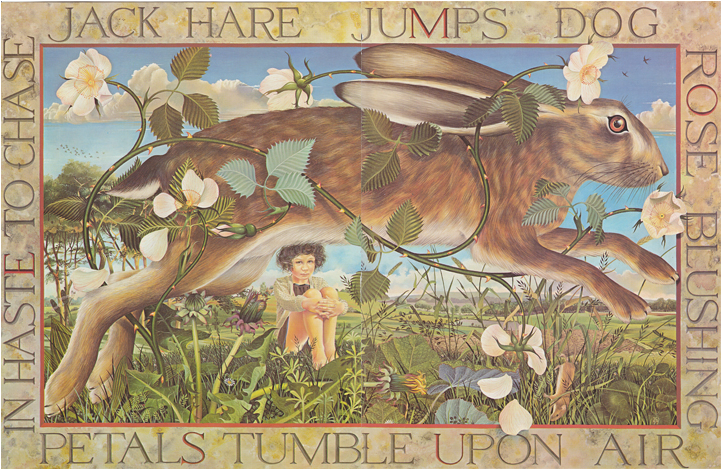
It was the story of a hare, a golden hare.

I shall explain.

Kit Williams' Masquerade.

Masquerade was a book by a certain Kit Williams.

It was elaborately drawn, beautifully designed and at its heart was an enigma.


Not only were the readers attracted by the book's artfulness, its killer feature was its promise of a puzzle which might lead the attentive reader to a dream of great riches...

Kit Williams had fashioned a golden, bejeweled hare and had buried it somewhere in the UK.

The whereabouts of the enormously valuable treasure would be revealed to those readers who deciphered the code hidden in the book.

The book became a publishing phenomenon.
Tens of thousands of the books were sold.
It had captured the public's imagination.
It was in phase with the zeitgeist of its epoque.

There were complaints from householders who became fed up with people digging up their gardens, convinced that they had found the hiding place of the Masquerade hare.

Eventually the hare was found in 1982 by a Mr Ken Thomas.

Masquerade and Scandal!

This discovery would be the source of a later scandal.

It was alleged that the winner had cheated!

The finding of the hare did nothing to discourage certain treasure hunters who convinced themselves that there was not a single hare but two, or perhaps three...or more.

The story of the hunt for the hare would be documented by a Mr. Bamber Gascoigne, a popular TV presenter of the period.

 Bamber Gascoigne, having been asked by Williams to witness the burial of the hare and to document the contest from beginning to end, did so in his book Quest for the Golden Hare. Gascoigne summarized his experiences thus:

"Tens of thousands of letters from Masqueraders have convinced me that the human mind has an equal capacity for pattern-matching and self-deception. While some addicts were busy cooking the riddle, others were more single-mindedly continuing their own pursuit of the hare quite regardless of the news that it had been found. Their own theories had come to seem so convincing that no exterior evidence could refute them. These most determined of Masqueraders may grudgingly have accepted that a hare of some sort was dug up at Ampthill, but they believed there would be another hare, or a better solution, awaiting them at their favourite spot. Kit would expect them to continue undismayed by the much publicised diversion at Ampthill and would be looking forward to the day when he would greet them as the real discoverers of the real puzzle of Masquerade. Optimistic expeditions were still setting out, with shovels and maps, throughout the summer of 1982."
Source Wikipedia.

Dave Cormier's Masquerade.

Dave Cormier's "Rhizomatic Learning" is Masquerade I thought...

I think that "Rhizomatic Learning" is a great story for people who enjoy intellectual enigmas and digging around with like and unlike-minded others.

Just find a few fellow learners amongst the throng, wait for them to drop their masks or dance along aside them regardless.

Masks are fun!

Learning is a ball.

Mystery adds spice!

The "Rhizome" can provide a backdrop to any learning treasure hunt you care to engage in, particularly on the web!

Educational.
Political.
Poetical.
Philosophical.
Esoterical.

Just choose your -cal, the rhizome is unequivocally adaptable.

Deleuze and Guattari's Masquerade.


Deleuze and Guattari, provides boundless territory for the intellectually challenged, over a thousand French plateaus of mindful/less digging.

An ultimate Masquerade!

Yes "Rhizomatic Learning" reminds me of (a) Masquerade.

It captures zeitgeist for postpostmodern, hyperconnected complexity...

We live, we learn, we chatter, we quest for (a) meaning...

We dig here, we dig there.

We find no(some)thing very, very, much.

Lewis Carroll's  Kit Willim's, Deleuze and Guattari's,  Dave Cormier's Masquerade.

Footnote.

A handsome prize awaits for the reader who finds a first edition of Lewis Carroll's version.

I have been looking for it for so long...


Thursday, February 25, 2016

Voice incubator

I have a confession to make.

I was scared of letting you read this.

I was my own worst judge.

I am not alone.

There are too many others who are scared of letting others hear their voice.

I have come across others...

Sometimes that makes me angry.

There are days like that.

What the hell is a blog?

I was never quite sure.

It seemed important for me to try to answer the question.

As far as I remember, I started off by reading Stephen Downes' blog.

I suppose it was as good a place as any.

I didn't think that I would ever write a blog.

What the hell was a blog anyway?

So here I am writing this blog.

I can't answer for anybody else but this is my answer to what a blog is. It's this. It's writing when I feel the desire, the need to fling a few words down onto this white space, this comfortable white space.

What the hell was Twitter?

I didn't know.

I spent six months being an egg.

I felt ovally dumb.

I didn't know what Twitter was.

I was an egg.

I took a long time to hatch thus...

I needed an incubator.

Incubation.

The incubator for Touches of Sense...was Learning with E's.

It is a story I tell my students now.

I had read Steve Wheeler's blog for a a fair old time before I thought I might be able to comment.

Like many people I feared that I had nothing to offer to a wider public.

I wasn't quite sure if comments like I might write would be appropriate.

I wrote to Steve asking if it was OK to comment on his blog.

Looking back on it, this seems ridiculous.

It wasn't ridiculous then.

I would read his blog every day.

It made sense to me.

I connected with his willingness to write himself openly.

There was a humanity, a personality expressed which I appreciated.

I was thinking about it the other day (a couple of years back now).

Comments that I wrote on his blog became progressively more like blog posts.

A couple of years ago, I went and found a few comments and saved them in a Google Document.


Yes, looking back the voice is recognisably mine, or at least the voice that I have become familiar with.

A Twitter Chat

I was participating in a Twitter chat yesterday.

I am no longer an egg.

I am a swirl.

It was an #edenchat hosted by Steve Wheeler about "rhizomatic learning".

He announced the theme in his blog: #EDENCHAT Growing Minds.

I got wind of it via my PLN on Facebook.

Autumm Caines did a great job Storifying it here:


I wouldn't have been able to develop the Twitter skills necessary to participate in the chat had I not attended the Learning Without Frontiers Conference in London in 2011.

The photo above that I dug out was from a presentation which Steve Wheeler gave about Edupunk.


Incubation

Steve Wheeler asked a question:


I suppose this is where I connect those dots...


Rhizomatic Learning

Touches of sense is a space where I connect my learning openly, rhizomatically.

I don't start with a plan and then work backwards.

I don't have a structure in my head before I start writing.

In writing, I am learning.

In writing, I am learning what I will think, not what I think now.

In writing, I am learning to listen to a voice which was silenced for so long...by others, by myself.

Searching for patterns.


I looked for patterns in my titles here in my last post.

I come back and read and read anew.

This is a blog for me. It is a space to pattern search.

This is a mapping of  haphazard rhizomatic learning.

I look at the people that I have had the pleasure to learn from and with.

How can you not learn from people who wear shoes like Howard Rheingold's, or paint in pink like Amy Burvall?


Search for Steve Wheeler in this blog's search box, you will see how often his ideas connect here.


Search for Dave Cormier in this blog's search box, you will see how often his story of rhizomes connects here.


Knitting strands...

We are all so densely complex to unravel.

How I feel of what I know changes constantly.

There is no knowledge without emotion.

There is no network without nuture.

Nature, nurture, network

Learning with e's.

I posted a link to an old post about anger to #edenchat.

I noticed a kind comment of Steve Wheeler's

Thank you Steve for your voice.

It touched me.

Here are some Touches of Sense:

Learning without emotion is nothing.

Our role is to enable each learner to listen to the sense their patterns make.

Here are some of my patterns.

This is my story.

This is my voice.

Thank for your part in its incubation.


Monday, May 11, 2015

An Assemblage too far?

"In the rhizomatic model of learning, curriculum is not driven by predefined inputs from experts; it is constructed and negotiated in real time by the contributions of those engaged in the learning process."

Dave Cormier


In his article Rhizomatic Education: Community as Curriculum, Dave Cormier sets out a "Rhizomatic model for education".

Might this be an assemblage too far?

Deleuze in a quote taken from what he sees (conveniently) as a 'box of tools', is rather clear about what he sees as the role of education:

"The various forms of education or 'normalization' imposed upon an individual consist in making him or her change points of subjectification, always moving towards, a higher, nobler one in closer conformity with the supposed ideal. Then from the the point of subjectification issues a subject of enunciation, as a function of mental reality determined by that point. Then from the subject of enunciation issues a subject of the statement, in other words, a subject bound to statements in conformity with a dominant reality."  

Deleuze and Guattari, Mille Plateaux.


To cut a long quote short, it appears to me that education and the rhizome make for unhappy flowerbed fellows...

Returning to Dave Cormier's introducton to his 'Rhizomatic Model for Education', he suggests that curriculum is not driven by 'predefined inputs from experts.'

So, here I am, reflecting on a 'predefined input' from Dave Cormier for week 4 of his #rhizo15 course.

I am beginning to wonder what he means by 'input'?

My reflection and that of the other participants is indeed 'driven by input'. Even if we can accept that this particular input has been 'negotitated by those engaged in the learning process', it has been officially sanctionned by the 'course convenor', the 'master of ceremonies', the 'teacher', Dave Cormier.

Aren't participants to this form of educaton being asked to conform to his 'supposed ideal'?

Isn't this a process of 'normalization'?

The giant rhizome.

I note with interest the connections being made between learning in the twenty first century and the internet, or the web.

How often have I heard that we are 'learning in an age of abundance'.

It is so easy to connect this ever linking web with the image of the rhizome.

I am not convinced that we are really 'learning in an age of abundance'.

We might be learning in an age of impoverishment.

The web is a source of the wildest fantasies (singularity), fears, and educative business plans...

It would be difficult to imagine an education today which simply ignores the existence of the World Wide Web.

However, what is the 'dominant reality' of the internet?

What are the dominant values of the internet?


Is learning without bounds education?

If so what is this education that we are proposing?

Isn't it necessary to be critical about this 'dominant' virtuality?

Practicalities of 'connected learning'..

"In the practical example of Couros's class, students created their own rhizomatically mapped curriculum by combining their blogs with information to which Couros pointed them and linking the combination to the particular knowledge that they discovered through discussions with key people in Couros's professional community."

Dave Cormier

OK, in the example taken from Alec Couros's class, we are given what might be described by some as an example of guided, connected learning...in a Canadian university.

The key node in the class is clearly Couros, Couros, Couros.

He is defining the activity, the form of knowledge, the means of knowledge sharing, the professional community, and predefining the discussion probable within the community.

This is one vision of education.

"The role of the instructor in all of this is to provide an introduction to an existing professinal community in which students may participate - to offer no just a window, but an entry point into an existing learning community."

Dave Cormier

OK, what is the difference between the role of the instructor here and the role of an instructor in a 'traditional academic course? Going through various steps towards the gaining of a doctorate and a gown, students are given an entry point and the defined path towards becoming a recognised and robed member of the learning community.

Isn't just that the rituals are changing?

Isn't it that some would like the rituals to change?

Rhizome as metaphor for learning...

"In a sense, the rhizomatic viewpoint returns the concept of knowledge to its earliest roots. Suggesting that a distributed negotiation of knowleged can allow a community of people to legitimize the work they are doing amony themselves and for each member of the group, the rhizomatic model dispenses with the need for external validation of knowledge, either by an expert or by a constructed curriculum."

Dave Cormier.

Pff..

Hasn't this always been the case within academic communities in the past?

Don't offshoots of existing communites connect with other people and enable a new 'plant' to emerge?

Isn't this the same thing?

This "rhizomatic model dispenses with the need for external validation of knowledge", if we are talking about a "rhizomatic model of education", I do not believe that this "dispenses with the need for external validation."

Isn't education precisely about 'external validation'?

In the case of Alec Couros's program, the curriculum may be rather open but it is most definitely constructed; it is not organic, even if the learning is, or will always be...

Conclusions...

A teacher is not required for there to be learning.

I don't believe that you can have an education without a teacher, even if the teacher is distributed by a MOOC.

In  #rhizo14 or #rhizo15 there are clear curriculum choices being made, very clear tool choices and very clear modes of behaviour being encouraged (even silently).

There are indentifiable educative values present in Dave Cormier's videos, introductory statements and blog posts.

I share many if not most of these values.

Rhizoheresy?

I believe the rhizome may be a useful image for the construction of knowledge, a metaphor for learning, for the evolution of society, and for the emergence of dominant groups and theories...

I am coming to believe that it may provide the background to endless debates, parlour games, and soul-searching.

I think that Dave Cormier uses it well as a means of entertaining educative dissimulation, like a skilled conjurer pulling a rabbit out of the hat,  to attract people to his vision of education.

I am coming to the conclusion that the 'Rhizomatic Model' for education is a nonsense.