Showing posts with label space. Show all posts

Thursday, October 12, 2017

Blinkered

I mean what are we paying attention to?

I was quite proud of my newly acquired skill of focussed listening.

I sat quietly, I turn my head to the group to my left.

One is speaking French.


"Oh your French is excellent."

I compliment.

The student smiles.

He speaks English.

He notices my attention elsewhere, he speaks French.

I turn my head to the group on the right.

"I did went to the park."

"I'm sorry, what did you say?"

The student looks confused.

"Er.....you er....to the park? 
(teacherly rising intonation)"

The student looks even more confused.

"Er....to the park?"

"I go to the park."

"Yes, you.....to the park" 
(accompanied by hand gesture to indicate past.

The student looks even more bloody confused.

He is now concentrating on interpreting my illegible hand gesture.

The other students are getting frustrated, tapping their fingers.

Three minutes of embarassed silence.

I give up.

This elicitation nonsense is lost in the park.

"You went to the park."

"Yes, I went to the park."

The student looks non-plussed.

I feel him shrugging his shoulders.

He continues trying to perform.

Who is he performing for?

Taking off the blinkers.

What was I trained to do?

How are we having our attention directed?

Who is directing our attention thus, for what, and for whose purposes?

How is such training making teachers ignorant of what is essential?

Blinkered.

"He is dead," said Boxer sorrowfully. "I had no intention of doing that. I forgot that I was wearing iron shoes. Who will believe that I did not do this on purpose?"

George Orwell.

"He's so lazy," my colleague said to me of one student.

"He's so lazy," I said to myself of another student.

How do we know what harm we do with our iron shoes?

This year, I decided to reassess all my previous judgements.

Those students are not "lazy" this year.

They may not have done any "observable work" or shown any "observable learning" but "lazy" is not a useful lens through which to view people.

I thought I might question my judgements, my practices, my certainties, my perceptions.

I thought I might learn, really learn.

I thought I might go about analysing things more systematically.

What does learning really look like?

What does learning really feel like?

Where do we really need to be directing our attention, our efforts?

Seeing with new eyes.

I had to open my eyes differently, I had to experiment with shifting my attention.

I had to deliberately and continuously test my assumptions even more often than usual.

To what extent are we basing our judgements, our attitudes, our behaviour from positions of ignorance?

Blinkered.

"Our sense of how the world works is often vastly cruder than we think."  Keil

(quoted from "Want a Deep Understanding? First, Know How Little You Know." Winston Sieck).

A student is holding his head in his hands.

"Is he disinterested?"

"Is he bored?"

"Are you OK?" I ask.

"How do you say malade?" He asks.

"Er ill or sick."

"I am sick." He says.

He goes on holding his head in his hands.

Taking off the blinkers.

I started writing this having just read Terry Elliott's piece entitled:

Epiphany: C. Wright Mills Sociological Imagination Is Also a Pedagogical One

In it he writes:

"More and more I feel like an anthropologist in my classroom.
For example, having read 54 summaries over a very challenging article by Jonathan Haidt, I had one extremely powerful insight.  And I only had that insight because I had a set of 30 minute conferences as well.
I am so lacking in sociological and pedagogical imagination that it only became clear to me after the dust settled that students ignore what they don’t understand."
This reflection connects with my current research.
I could echo Terry:
"More and more I feel like an anthropologist in my classroom.

Taking off the blinkers.

This reflection reminds me of conversations with Terry about grass...of how he, as a farmer with a close relationship with sheep, is able to read stories in grass which appear here in "Spring Flowers."

I am grass illiterate.

This reflection reminds me of the work of Gee and his "Critique of Traditional Schooling." and a quote of Kramsch:

"Context is not a backdrop to learning the language, it is the very object of learning. Thus we need to study context itself and its relation to the texts that both structure and are structured by it." 


It is only through ongoing dialogue that one can hope to partially understand what is going on within the boundaries of the class.

It is only through ongoing questioning of the structure of the boundaries which give context to our activities that we can begin to understand what is going on within our classes.

I notice a major difference between a group of students being integrated by teachers into a professional community of ergonomists, whose work uses scientific articles as support to their work, and students of teachers in other disciplines who use academic texts as hammers to beat the students into submission to underline power differentials.

Are we reading so as not to understand or so as to understand?

Blinkers.

"Have you read Foucault?" I asked enthusistically.

My question was met with disgust from a student whose teacher had had her read Foucault.

Should I be surprised?

"Context is not a backdrop to learning the language, it is the very object of learning." Kramsch

Taking off the blinkers.

Asking the students to systematically provide language learning biographies has given me the means to focus my attention on certain students who were simply lacking attention, to help them analyse their own stories in relation to others and to question a system which leaves young adults feeling like failures.

Asking the students to systematically share their interests, passions, ambitions, opens up opportunities to connect them to documents, people, communities with whom they may be able to relate.

If I am doing such a bad job, maybe others younger than myself, closer to the students can be enlisted to act as more effective mediators?

I start to see the class not as a homogenous group but as an ecology of inter-twining networks with potential for more imaginative, perhaps more distant connections.

I have to get the students to share their own visions, their own feelings, their own perceptions of what is happening in the classroom and outside it.

In this way we can gain an insight into what is not observable.

One pair of eyes and ears become twenty pairs of eyes and ears.

At the same time I am looking to associate them to, or to co-imagine research projects concerning their own learning.

Student ergonomists' analysis of work situations becomes transferrable to our English classroom situation which has moved outdoors for the day.


Transferring a blackboard from the classroom to the space outside the building becomes an opportunity for these ergonomists to put into practice their developing competences.

How do they feel in this new environment?

Is their attention awakened?

Is their attention distracted? (interesting idea in itself)

Is this an "official" or an "unofficial" class?

Where are the boundaries?

Where are the emergent boundaries which shift according the ambient noise level with people having to move closer to be heard or closer to the board to read?

What happens when other people join the group sitting in the grass?

How does it affect relationships between the students and between the students and the teacher.

Do they feel more able to be themselves, or more at ease?

How does a passing plane or ambient nature affect their focus?

What happens when one student isolates himself from the class because he is suffering from allergies to the newly cut grass?

Should one simply exclude the student, go back in the classroom, ignore the student?

What should we think about "democratic" decisions when the majority decides that the minority should shut up and suffer?

I pick up the "grass" identifying three sorts of unnameable (by me) green plants and we speak about how blinkered we are when it comes to knowledge.

We think about how the green green grass of our home is a threat to others.

Indeed what is knowledge if it is not associated to our context...to our community?

This becomes a source for a discussion with students who take on different identities those of co-learners.

How does a classroom box induce ritual, learnt behaviour, phobic behaviour?

How does the conversation or the learning or the relationships become...in the words of the students:

"real conversation, real language, real learning."?

I am multiplying my efforts to enable student led activities to emerge in the classroom.

Whether that be training session led my students in adapted physical activity.


Or reflections on our own cultural barriers to eating insects.

Or the art of the artisan chocolate maker.

Or the relationship between the cocoa and the colony....


I am multiplying my efforts to enable student led activities to emerge outside the classroom.

A group of students link up with a foreign student to go rock-climbing in English.

Another Facebook group emerges around the idea of running in English.

Another ex-student pops up on a smartphone from Lima in Peru to speak to students inside the classroom about concepts and experiences of freedom.

Another musician pops up from the ranks of the unknown.

Another ex-student friend pops up to animate a personal development session with those wanting to understand the nature of travel.

I take a photograph of them to see what attentive learning looks like.


I see them stretching forward to listen.

I find myself being aware that my position of teacher has become that of the observer, the witness.

I come back to Terry's thoughts

"More and more I feel like an anthropologist in my classroom.

I find myself sharing a quote of Proust again.


“Le véritable voyage de découverte ne consiste pas à chercher de nouveaux paysages, mais à avoir de nouveaux yeux. ”

I share with the students the joy for me of teaching through learning, of learning through dialogue.

I spend some time after the lesson talking with the students about the importance for me of their observations, their analysis of the moments that we have spent together so that I may, with their help learn to read this our context(s).




Thursday, June 1, 2017

Dystopian tales

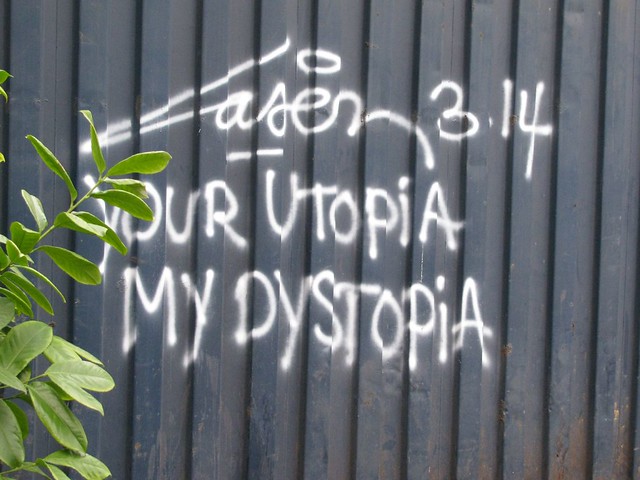
laser: you utopia my dystopia


Trigger tales.

“That is what you have to do before you kill, I thought. You have to create an it, where none was before. ” 

Margaret Attwood. The Handmaid's Tales.

He's hunched over, body taut, automatic weapon loaded, trigger taught, ready to shoot on sight.

Blood splatters across the wall as his victim crumples under the impact of the bullets.

Another kill is notched up.

I can hear my son upstairs, whooping with joy.

Subversive tales.

“By telling you anything at all I'm at least believing in you, believe you're there, I believe you into being. Because I'm telling you this story I will your existence. I tell, therefore you are. So I will go on. So I will myself to go on.” 

Margaret Attwood. The Handmaid's Tales.

"So what do you do then?" I ask them.

One, apparently the senior academic, chortles.

He nods his head to a silent partner across the table.

"So what do you do then?" he echoes.

"Subversive...huh? You have a lot in common with him." he adds.

His colleague, head down, speaks.

It's hardly more than a whisper.

"Well, there's a parallel system. If I like the guy and I want to help him out then I send a copy of my article freely."

Conversations flow naturally from academic pay walls, to walled gardens of VLE's,  to Berlin wall, to Trump wall, to Pink Floyd's Wall.

Surveillance tales.

“A rat in a maze is free to go anywhere, as long as it stays inside the maze.” 

Margaret Attwood. The Handmaid's Tales.

Here we are around the lunch table, talking of freedom to connect across frontiers, internet, social media, open education, the collapse of the Soviet Bloc, the Wild West East of capitalism, the rise of individualism, the threat to community, the greed, the misery, the miserlyness, the lack of care.

A guy from the STASI listening through walls to the lives of others.

A guy from Facebook collecting data on the interests, the emotions, the friendships, the movements, of others.

Tribal tales.

“Ignoring isn’t the same as ignorance, you have to work at it.” 

Margaret Attwood. The Handmaid's Tales.


Here we were, separated by a generation and a computer screen, talking of our (dis)connected lives. Listening to him, I felt both ignorant, and lacking in imagination.

Who was the researcher, who was the teacher, who was the learner, who was the mentor?

He talked of the differences between playing online solo, online in network, offline together, together.

Am I missing something there?

Who will be having to revise the lesson?

He talked of heroes, leaders, tribes, communities, affinity groups, generations, clans, castes, crowds, students, teachers.

He talked of roller, skate, scooter, bmx.

Conflicts over wax on rails.

Invasions of space.

Am I missing something there?

Who will be having to revise the lesson?

Measured tales.

“Better never means better for everyone... It always means worse, for some.” 

Margaret Attwood. The Handmaid's Tales.

She looked tired, she sounded downbeat.

Their ship had been swept away in the flood.

“I want everything back, the way it was. But there is no point to it, this wanting.” 

Margaret Attwood. The Handmaid's Tales.

Some guys had jumped ship.

Entire departments around the country had been wiped out.

Health services were up for sale to the highest bidder.

Cost cutting measures were on the agenda.

Debt schemes are being leveraged.

Wave after wave of management schemes had been sent to try the staff, to size them up, to cut numbers down to size.

Those in power lie as they breathe.

They have no care for care.

It's an economy measure.

Spreadsheets, efficiency, customer satisfaction.

Best practice no doubt.

"I feel no motivation whatever to work so that they can swan off around the world and be seen with the great and good."  

She said, to my unreliable memory.

Hand made tales.

“All you have to do, I tell myself, is keep your mouth shut and look stupid. It shouldn't be that hard.” 

"I almost left." He said, remembering those first months.

He wasn't to be bought.

He paid the price.

He almost left.

"I made you what are." came a thinly veiled  threat.

"You owe it all to me."  added the addition.

Silence.

Was there fear of power waning?

He stuck at it.

He learnt to navigate.

“We were the people who were not in the papers. We lived in the blank white spaces at the edges of print. It gave us more freedom. We lived in the gaps between the stories.” 

Margaret Attwood. The Handmaid's Tales.


Dystopian tales

“But who can remember pain, once it’s over? All that remains of it is a shadow, not in the mind even, in the flesh. Pain marks you, but too deep to see. Out of sight, out of mind.” 

Margaret Attwood. The Handmaid's Tales.

She shared her pain. 

She revealed the abuse.

She warned of vicious troll attacks.

Those words, those threats had cut deep.

She was vulnerable there in the open.

He talked of the joy of spreading fake rumours across the net.

"It's part of our culture, they've picked up on it."  he said.

How far, how fast will this fakery flow?

How much will it make a buzz?

Pooh Sticks. 

Broom Sticks.

Fidget Spinners.

Where the wild things go...

Sticks and stones may break our bones.

Words may forever mark us.

Does adolescence seems so far away?

I looked through the DVDs.

  • Maze Runner.
  • Hunger Games
  • Harry Potter
  • Divergent.
  • Matrix.
  • Inception.
We were on air. 

Virtually connecting, we were massive.

IN A GALAXY 
FAR FAR AWAY

"We are the good guys," he said, " The Jedi."

They were tiny specks on the stage.

Off air marked the exit.

"I am your father."


Does obsolescence seems so close?

“What I need is perspective. The illusion of depth, created by a frame, the arrangement of shapes on a flat surface. Perspective is necessary. Otherwise there are only two dimensions. Otherwise you live with your face squashed up against a wall, everything a huge foreground, of details, close-ups, hairs, the weave of the bedsheet, the molecules of the face. Your own skin like a map, a diagram of futility, criscrossed with tiny roads that lead nowhere. Otherwise you live in the moment. Which is not where I want to be.” 

Margaret Attwood. The Handmaid's Tales.

Image Credit

Laser: Your Utopia My Dsytopia.

Eddie Dangerous

https://www.flickr.com/photos/eddiedangerous/3141081281

Friday, May 27, 2016

Preface.


Emergent Reflection on Transcendence in Critical Digital Pedagogy.
A submission to Hybrid Pedagogy.


Act 1.
Starting points…

“IT” was only ever a draft, a doodle.


Given what emerged, only questions felt satisfactory.

He listed them as they appeared:

What space would these words take up?
How might they move?
What would be their destination?
How could they shape reflection?

Meaning was only forever fluid.

I, er You, We are forever fluid.

He wrote  ‘our reflection’ knowingly while thinking of his selves: those selves who carried the text forward and those selves who had fallen silent to enable it.

“IT”, it appeared, insisted on “ITs” voice(s) being heard.

Who would populate this space?”,  he thought.

It was doubt that drove his curiosity.

It was not text as product which intrigued.
It was text as vehicle of discovery.

Might such text be possible without the digital?”

We thought not.

I think knot.” he added, annoyingly.

How might one plan.?”they thought?

It would be “IT” which would count...

That is what this is”, he thought: “We (i, I, and I’s) are silent.”

“Then there was the word.”

He boldly wrote “TRANSCENDENCE” as a challenge and let whatever “IT” was shape the act.

It gave them hope that “IT” wasn’t finished.

There would be no full stop, no period, for now, space would be pitifully punctuated.

Would “IT” be space for others to draw breath?


Act 2.


Footnotes.

He had kept it secret.

It was a secret that only a few had seen.

IT (Act 2) gnawed away at him.

Release.

Release

IT (Act 2) was not a thing to be framed.

IT lost its potential.

IT was no longer there.

Sarah came and wrote there.

He looked at it.

No that felt wrong.

IT was ruthless.

He tried writing in the space himself.

IT was resistant.

He had sent the “proposal”.

He had waited for a response.

How could anyone depict transcendence?

He sent out a message asking for help to some friends on Twitter.

Terry had understood.

He shared the ineffable.


Those questions haunted him.

What space would these words take up?
How might they move?
What would be their destination?
How could they shape reflection?

Sunday, March 20, 2016

Dancing for credit.


Let's face it labels are a stumbling block.

I was never a big fan of labels - particularly for people.

We're for ever putting people into categories and then deciding into which box they will go.

Different boxes are given different values.

When that box is your life-raft we need to worry about who is doing the categorising.

"Women and children to the left, men stay on the ship."  

I have been lurking around the edges of Digital Pedagogy Lab's Cairo event.

Am I a participant?

How shall I be counted?

I watched part of a "keynote".

I noted a tweet:


"Hmm..."

I thought to myself.

"Is the instructor the lord of the dance?"  
"Whatever happened to co-choreography?"

What actually is the "instructor" bringing to the dance?

I thought of street dance and went and found an image.


I got a reply to the tweet from Jesse Stommel.

"Hmm..."

So what is key here is the space where it happens...?


So what are these spaces?

I listened in to the Virtually Connecting hangout in which people were talking about:

 "Digital Natives.." (and their death) based on an article which was being annotated in hypothes.is.


"Aghh..."

I thought.


I took a glance at the hypothes.is stream but felt unmoved to contribute

There were a few parts of the conversation which captured my attention.

Someone talked about innovation - about tech disrupting 'traditional' pedagogy.

I worry about the "disruption discourse" particularly as regards teaching.

What is this "traditional pedagogy" we're talking about and for whom does it require disrupting?


Someone was talking about "open" and the need to "scaffold open".

"How on earth does one scaffold open"? 

I thought.


I don't think that "open" is what you scaffold.

"So what is labelled "open" isn't really open at all."

I thought.

It's a label for something that some people want others to do.

"Is it like free?"

I thought.

"Free movement of capital, ideas, information, workers..."

I am not sure.

Labels mean different things to different people.

People gain different things from labels.

People put prices on labels...on tags.


I can put a price on training/choreography/drilling/education to achieve a tag...

Somebody talked about the need for "credit" - "credit" for their "learning."

The reason for needing "credit" concerned gaining money...to live.

For some people, time is money and it requires spending a lot of time to earn a little money.

Someone left a tweet about time.


Is critical pedagogy a conversation for the privileged?

Is critical digital pedagogy a conversation for the privileged?

I don't know.

I thought of kids.

"Are they digital natives?" 

I thought.

My kids dance.

Are they dancers?

They don't need a choreographer.

They follow dancers on Youtube.

Does that make them digital natives?

Kids dance.

Some kids dance in the open.


Is this "open"?

If their dancing appears on Youtube does that make them "digital natives"?

Why do they need a choreographer?

Do you only need a choreographer when you dance for credit?


Thursday, October 8, 2015

Metronome.


A metronome's going 
Tick, tick, tick.
And then it's suddenly stopped.
What on earth is going on?

When I'm writing...
Those pauses,
Those pauses,
To catch the next word...
You don't hear.


Friday, October 2, 2015

Fallow.


The hopper was filled to the brim with harvest.


The field is now, for all intents and purposes, empty.

It is close cropped.

I can do no more for now.

No will, no wherewithall, no whatmenot.

I am fallow.


The life of a creator is not the only life nor perhaps the most interesting which a man leads. There is a time for play and a time for work, a time for creation and a time for lying fallow. And there is a time, glorious too in its own way, when one scarcely exists, when one is a complete void. I mean when boredom seems the very stuff of life.
(Henry Miller)

Tuesday, September 22, 2015

(E)motion Capture

Who leads this dance?

Am I captive?

Am I freely enchained?


A breath, a breath, a breath...

Where might this spirit vessel sail?

A breath billows spinnaker.

A breath beyond...

My spirit keels to port.

No crew, no captain, no tiller.


Possessed, I am another...

another's voice.
another's frame.
anothers tone.
another's mood.


I submit to its form.

I tread in unfamiliar skin.

Are these wings?
Are these claws?
Are these scales?
Are these mine?

I see us now as vision composite.

I am becoming newly versed.

Arhymed, entranced, am I freely entrained?


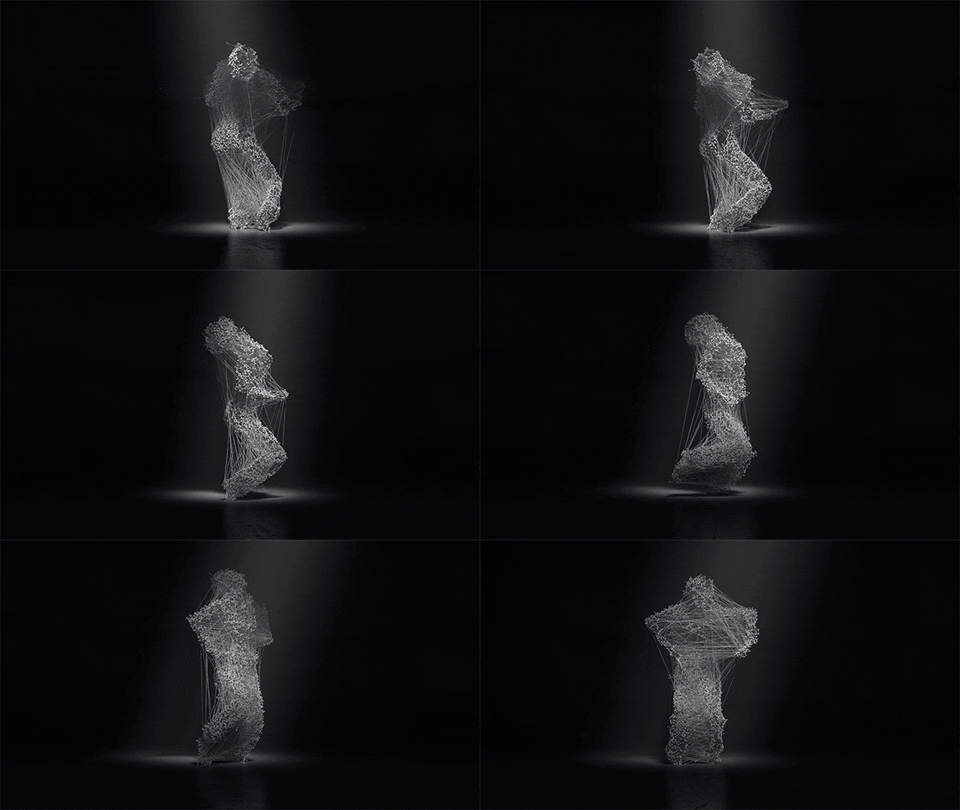
Image Source
http://links.thisiscolossal.com/post/113169745941/watch-asphyxia-a-striking-fusion-of-dance-and

Thursday, May 14, 2015

There be dragons.


Refuge...

I am tired of community. 

I pack my bags and head South.  

I am sitting here contemplating uncharted territory, listening to crickets.

Peace at last.

I am vigorously avoiding definition, rules, shoulds, ethics, responsibilities...

Sod them all!

The warmth of the sun on my back and the chirping of unseen birds will suffice.

I unfold a map, observe the landmarks, note lines of contours and choose to ignore them all.

I look out to space, out on the margins;  tangled lines lead out to mythological realms.

I write, out of desire...

Out there (?) is smooth space.
Out there (?) dwell dragons...
Out there (?) their unseen, unwieldy forms, arouse my imagination.

I can see dragons now.

Nobody can deny their existence.

Nobody will fight my dragons.

Somebody might chortle at a crudely drawn creature but not even ridicule will dismiss their imaginative reality.

Diving for cover...

I dive underground and am immediately entangled in resistant, unthinkingly, vigorous, rhizomes, weeds.

I valliantly, rationally, struggle, cut, thrash, burn.

DIE will you?

The more I gesticulate, the more I dig, the more they proliferate. 

Unseen bloody weeds!

Reading matter?

I pick up an opened copy of Mille Plateaux...sod it!

I throw the volume into a trash can.

OUT voluminous, tubered frustration!

Its sheer size, its reams of words, takes up most of the can.

It is impossible crap.

It is now real rubbish to be recycled. 

HA! HA! HA!

Dense, repellent, dark, dragon-infested shit.

Shit will make for good fertiliser...


Tuesday, May 5, 2015

Being here...

Where shall we start?

There's a dog barking in the garden, black-birds singing in the trees, the French lunchtime news on TV...

And here I am.


...................................................


I am contemplating lines, strata, circles, points...

This is all getting rather too mathematical or geographical.

Perhaps it is historical or biological?

Blimey!  It may even be ecologically philosophical!

Oh bloody hell!
Why worry?

How many more -cals can I find? (oh don't answer that)  

If I knew, would I understand more?

"Why do we acknowledge only our textual sources but not the ground we walk, the ever-changing skies, mountains and rivers, rocks, and trees, the houses we inhabit and the tools we use, not to mention the innumerable companions, both non-human animals, and fellow animals, with which and with whom we share our lives?"

Tim Ingold.

And then I was no longer alone.

Where are we?

This is a personal question.

I am rather aware that I am a flow of contradictions.


Should I be listening to the TV news?
Should I ignore the dog?
Should I put a photo there?


There's you and I and i and you and...

You are coming at this from a completely different angle..

Why stop at angles?
Why not dimensions?
Why not time zones?
Why not depths?
Why not stories?

What a bloody right tangle this is...being...written... here.

Completely Random Aside:

Why is Stephen Clarke speaking about Buffalo Bill?
(he was on TV that instant)

I have been getting to think a lot about native Americans these past few days.


This line of study was retriggered by an exchange with Dave Cormier on Twitter. (Oh gawd...)


We have been talking interminably about the myth of content.

It is the word myth that is intriguing me more.

The word content is beginning to feel like a pervasive prison.

We have all the content in the world but we appear to be unhappily self-contained.

I suspect that is why we speak so much.

Wonderings...

I am coming to the impression that the concept 'content' hides a distinct world view...the politics, the economics of enclosure, of appropriation, of extraction, of individual isolation/wealth/poverty/identity, of identifiable authors, of 'scientific progress', of superiority over nature..

WE SPEAK So... How MUCH? 

And listen oh...How little!

It seems to me that this is about religion versus spirituality, ambition versus becoming.

I tweeted a throw-away remark:

There seems to be at the heart of my wonderings a question....

as regards our relationship with space.
(our environment?)

as regards our orientation within what we call society.
(or should that be in what we call life?) 

Ah yes, I had forgotten that I had posted this tweet here:

Wanderings...

I am quite sure that it is no coincidence that I have come across (is that the word?) the writing of Tim Ingold, notably a book entitled Being alive.

I bumped into him (as it were) when investigating how to connect Deleuze and Guattari's rhizome with religion (as one does).

I found this article, entitled Rhizomatic Animism.

I immediately fell in love with the title.

It sounded lordily, seriously, scientific to me.

I felt immediately more intelligent.

It was incomprehensible but tripped joyfully off the tongue.

'TicMism' I have caught a 'Ticmism'.! Is that a sort of insect? 

I rather have the impression that if there are many who have stopped believing in GOD, we have been left with the cells of monks and a rather nasty empty space to fill.

Contradictions...

(I have no idea what this means - I am sorry)

(It's art - it doesn't have to mean anything.)

(Oh shut up!)

(Won't!)

Vivisection...

What was it that I read the other day about science killing life in order to dissect it?

I can't remember now.

I hesitated to go and look but the the dog barking distracted me.

Then I noticed a tweet of Aras

I immediately noticed the tiny spot accorded to GOD.
I immediately noticed the angled arrow of modern scientific progress.
I immediately noticed the tangled mess of Post-Modernism.

OOOH lovely another ism.

What does one have to do to become an ism? (don't answer that)

From animism to Post-modernism and back again. (if we are lucky)


Meanderings...

I am reminded of this is water.

I am reminded of Alan Levine's ever-changing perspectives...


I make a note to read Aaron's post on what counts.


I am reminded of Terry Elliott's work...inside...outside boundaries.


A light breeze is dancing on my skin.

I can feel the hairs on my arms moving.

I can hear the leaves in the trees...

There is an ad break on TV.

The news program is surely not finished...

The exams are.

I have finished counting.

Perhaps in #rhizo15 we are not learning so much.

I am not counting.

Perhaps we are rather learning 'being here'?

A wind is blowing.

Are myths a means of orientation in the wild or the walls of a lonely cell?

And at just that moment...