Value and vanity.
"Wow, that was a great class."
"Wow, what an inspiration."
God, it's great for the ego!
Open doors are not enough.
I was asked this week whether I was going to any interesting conferences.
I am not going to any interesting conferences.
"To what extent will communicating at conferences enable change of education where I am", I ask.
I do thought experiments:
"To what extent will becoming minister of education enable change of education where I am," I ask.
"Be careful what you wish for."
I conclude that many brilliant people and less brilliant people become ministers.
Nothing much changes...
I shall never be minister...
I shed a few tears.
I am preparing to speak with Daniel Bassill and Terry Elliott about strategy next month.
I keep having to accept that I am not
'just an English teacher', I am not
'just a teacher'.
It is an insidious message that repeats itself:
"But you're you, you're hopeless, you know you are...you've got no time, mind your own business....you're just a bloody English teacher."
"BE REALISTIC!!"
That's it, I have said it now.
Nothing, nothing will ever change.
Change for the better.
Over the past ten years, I have asked myself one question:
"What can I do to enable change for the better in language learning?"
Of course
'change for the better' is a loaded question.
What is to be our
'change for the better'?
Who is
'our'?
I am working on my answers to those questions...
To be quite honest, I have asked myself wider questions:
"What can I do to enable change for the better in education here where I teach?"
Of course
'change for the better' is a loaded question.
What is to be our
'change for the better'?
Who is
'our'?
To be quite honest, I have come to the conclusion that you can not enable change for the better in language learning, if you do not enable change for the better in education.
To be quite honest, I have come to the conclusion that you can not enable change for the better in education if you do no reflect on the role of education in society...if you do not reflect on the different players trying to 'enable change for 'their better' in education.
It is, it appears an open battlefield for our minds, for our money...for our activity...for our communities...
This is freedom.
This is one of many visions of freedom...
Freedom is both battlefield and battlecry.
Freedom for who?
Whose freedom?
Freedom for some is an anathema.
"Handle with care."
One can not remain, just an English teacher, neutral.
Just (English) teachers, just students, just researchers, just ministers are disposeable...
Other peoples' values judge us.
Nobody is irreplaceable.
If all the English teachers where I teach, were to adopt the same approach as myself and none of the other teachers in other disciplines, the effects of such a change would be contained...
If all language researchers only speak with other language researchers then the potential influence of such research is contained...
If all the language researchers only speak with other language researchers, then their language becomes increasingly opaque for those outside their conversations.
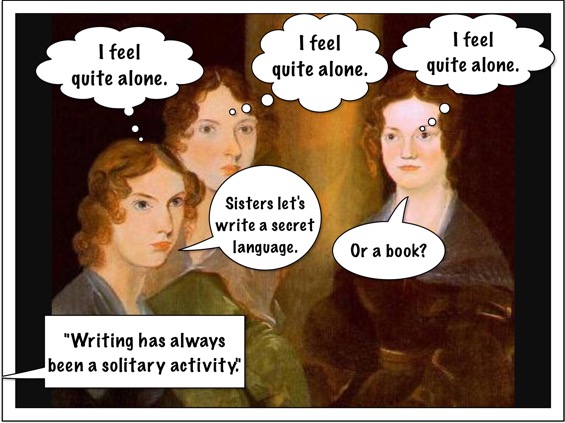
It is the Bronte Sisters' secret language writ large.
If researchers and teachers only ever speak with researchers and teachers what is the place of their institutions in the wider community?
Do institutions exist for the researchers? For the teachers? For the students? For the minister? For..?
Whose language do we speak?
Whose interests do we serve?
I read with interest a blog post of Maha Bali concerning a conference on education reform in Egypt.
http://blog.mahabali.me/blog/citizenship-2/reflections-after-an-education-reform-event-in-cairo/
She speaks of a keynote by Pasi Sahlberg
"It was an instance of a success of an international guest speaker who didn’t necessarily realize how controversial his speech is and so it was very satisfying for those of us on the more radical end of what education reform could/should look like. And possibly made policymakers cringe. Unless it totally went over their heads. For example he repeatedly said “don’t do what Finland did; do what would work for YOU” and people still continued to talk about copying snitches of the Finland model, often ignoring the emphasis on equity and trust in teachers in that model (possibly the main two “values” in it that are core and re-contextualizable)."
If Egypt is not Finland, then neither is Clermont Ferrand.
I return to my question:
"What can I do to enable change for the better in education here where I teach?"
I do a thought experiment:
"To what extent will my becoming Pasi Sahlberg enable change for the better in education here where I teach?"
I conclude: a little perhaps.
I resign myself to not ever being Pasi Sahlberg.
I weep uncontrollably. (he lies)
I must be more realistic, I am just an English teacher.
I read Maha's blog a little further:
"Some of the highlights of his keynote were his comparison between countries who have been failing at reforming education (GERM = Global Edu Reform Movement) and those who succeed (see screenshot in the Storify embedded below)
Some of the things that continue to frustrate me with Pasi’s work (also had this problem with his book, Finnish Lessons) is why he continues to use PISA as the evidence of good education in Finland. It’s a standardized test. Even if it tested reading, math and science literacy accurately, it does not test the things he talked of as key to the purpose of education, namely supporting the child to grow into their potential and find their passion. Every time he says PISA it disappoints me. It’s looking at a (pretty narrow) outcome and making inferences about education quality. I know it’s probably true in Finland, that they have good quality, but it doesn’t tell me anything about what truly matters about education in Finland. It doesn’t tell me that actually good learning is happening in the classrooms. It just tells me about specific literacies, not the whole student."
I conclude that I do not want to be Pasi Sahlberg if I have to cite PISA.
Pasi Sahlberg is not the change I am looking for.
I return to conversations between Daniel Bassill, Terry Elliott and myself.
"Breaking down walls, opening minds.."
What do elite schools in France (or elsewhere) consider valuable?
A good teacher to student ratio? Meaningful learning? Mentoring? Networks?
I look at the presentation of HEC in the Economist:
http://www.economist.com/whichmba/hec-school-management-paris/2013.
it would seem that 'student led learning' and 'quality time' are considered priorities.
Its MBA program ranks highly and was recently overhauled:
"HEC revamped its curriculum in 2012, with the help of Bain & Co, a consultancy. The result is a more hands-on approach to analytical thinking and leadership development."
Hmm...
'a more hands-on approach'.
"The school offers dual degrees with institutions such as New York University, Dartmouth’s Tuck school, MIT, Wharton, National University of Singapore, Chinese University of Hong Kong and London School of Economics."
Hmm...an extensive and wide ranging network of learning opportunities.
No doubt they have plenty of opportunities to learn languages within these networks...
An effective mentoring program:
Yes they have one of those...
Indeed, mentees are enthusiastic about the individual support they receive:
"Discussing my plans seriously allowed me to see things a bit more clearly, as I was forced to formulate my expectations in front of a “stranger”, while knowing that he was not there to judge me."
Mentee
Of course these people are privileged, they have extensive resources...
Don't poor people have...people??
Don't poor people have...time??
I think briefly that I need to study in depth what Daniel Bassill has been doing for the past 40 years...
I come back to Clermont Ferrand.
No we don't have the same resources as HEC....
No the students, the ones I teach at least, probably don't have the same 'skill-set' as those in HEC.
No they definitely don't have the same networks...
I reflect on what I can do...
I return to the question of mentoring.
I return to the question of wide ranging networks.
I return to the question of a more 'hands on approach' to language learning.
I return to the importance of communication.
I return to the importance of the diverse messages necessary to communicate.
I return to the question of who such communication should be most effectively targeted to.
I return to Daniel Bassill and his Tutor Mentor Program in Chicago.
I am just an English teacher.
I am not just an English teacher...
I repeat it to myself, it doesn't always help.
I think of all that money I am losing...all that time playing around.
I am weird, I continue all the same.
I reach out here.
"Discussing my plans seriously allowed me to see things a bit more clearly, as I was forced to formulate my expectations in front of a “stranger”, while knowing that he was not there to judge me."
Mentee
Change for the better would enable learners to find meaning in their activity and to realise that they can play a role to improve relationships within their own communities.
Change for the better would enable learners to contribute freely within their communities without fear of judgement.
Acting strategically.
Time and energy is limited.
I must act strategically with my resources.
My resources have increased dramatically since I connected to wider networks...
I should return to mapping my route, reflecting on strategy...
I realise that my messages to students are beginning to change...
I realise that the messages I receive from students are beginning to change...
I note the appearance of a growing number of mentors...
I note the positive effect of communicating openly...
How shall I act now?
("You're barmy" the insidious/sensible voice repeats)