
Was the blank wall an invitation?
Was this graffiti first seen as a criminal desecration of property?
Is the tagged wall accepted, protected now?
What do tags tells us about the vibrancy of citizenship?
Do they speak of inclusion?
Do they speak of exclusion?
Are they artistic statements, vandalism?
One house owner appeared to have taken things into his/her hands.
The double garage door appeared to have a commissioned piece of street art.
Would tags superimposed on the masterpiece be an embellishment or a sacrilege?

Was the art gallery a consecration?
Is this another example of cultural appropriation?
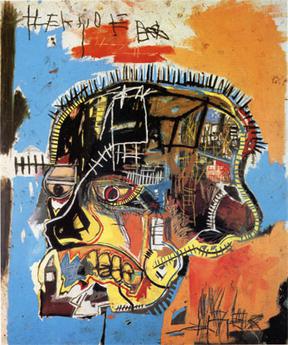 |
| Basquiat Skull |
Or is the presence of the artist here a Trojan Horse?
"How Basquiat Challenged Police Brutality Through Art."
I wandered through the gallery in Lyon.
At first sight the sculpture was a meaningless jumble of junk.

On closer inspection, the assemblage demanded reflection.
There was purpose in the positioning of objects.
There was a meeting of minds.
It begged attention.
We need to take our time to revisit, to explore, to question our own assumptions.
I read "It's like a Jungle" an installation of Henry Taylor.
"In his installation work It’s Like A Jungle (2011), Taylor presents an assortment of used objects, including boxes, crates, and furniture, suggesting the refuse that accumulates on L.A. streets from provisional downtown community housing."
What does the presence of the ensemble say about power?
What does the ensemble say about hospitality?
What does the title evoke?
It's like a jungle?
What is like a jungle?
Did the black oil cans evoke black power salutes as I read somewhere?
The Californian beach house was a burnt out wreck.
Viewed through the lens of John Divola, what is there left of our Californian dreams?

The hashtag was an "open" invitation.
How open was the invitation really?
Were the hosts ready for all comers?
Were the guests ready for all comers?
What were their expectations?
How did they imagine the stream in Twitter?
Was there an implicit injunction to bar transgressive behaviour, to bar transgressors?
I felt out of place.
I left a few tweets.
Was I tagging territory?
Was there an "in-crowd"?
It appeared so.
How did the "in-crowd" recognise each other?
Did they have history? Did they share gender? Did they share marginality?
Were the memes I left seen by some as unwelcome noise?
Was I an ungracious guest?
Having blogged angrily, having tagged haphazardly, having felt an outsider, I felt sensitive to criticism that might come.
I found a video left by Chris Gilliard.
I watched it. It made me sit up and think.
Was I a rude, invasive guest?I like this. The use of video makes it much easier to grasp spacialisation of conflict and brings me to question own practice. TY— Simon Ensor (@sensor63) June 19, 2017
I felt like jacking in the whole #digciz malarkey.
Then I thought a while.
I doubled back and reread Kate Bowles' comment on my post "For giving"
"Hello, I wrote a long comment but I think the Internet whisked it away.
So this is the shorter thought: is it the word "hospitality"? Does it come with something? Or is it the problem of conversation itself, in this world?
I'm really troubled by the idea that dialogue is the opposite of action.
(Have read your blog many times, thank you for writing it)"
I was all ready to rush off a reply - "of course hospitality is a problem!"
I felt like I had found myself back in bloody church with people all terribly nice.
I remember their knowing looks, "Poor boy, he's a lost soul."
I remember feeling an undercurrent of polite violence.
I went and read Betjeman - Death in Leamington (birth place of my mother).
Death in Leamington.
She died in the upstairs bedroom.
By the light of the ev'ning star
That shone through the plate glass window
From over Leaminton Spa
Beside her lonely crochet
Lay patiently and unstirred,
But the fingers that would have work'd it
Were dead as the spoken word.
And Nurse came in with the tea-things
Breast high 'mid the stands and chairs-
But Nurse was alone with her own little soul,
And the things were alone with theirs.
She bolted the big round window
She let the blinds unroll,
She set a match to the mantle,
She covered the fire with coal.
And "Tea!" she said in a tiny voice
"Wake up! It's nearly five"
Oh! Chintzy, chintzy cheeriness.
Half dead and half alive.
Do you know that the stucco is peeling?
Do you know that the heart will stop?
From those yellow Italianate arches
Do you hear the plaster drop?
Nurse looked at the silent bedstead,
At the gray, decaying face,
As the calm of a Leamington ev'ning
Drifted into the place.
She moved the table of bottles
Away from the bed to the wall;
And tiptoeing gently over the stairs
Turned down the gas in the hall.
On reflection Kate's comment stirred action.
Indeed dialogue is not the opposite of action.
Genteel conversation in conferences often feels to me like Death in Leamington.
Sorry.
Sorry.
I suppose being caught between boiled eggs with the bishop at the Rectory and pub talk with the apprentices from the factory, I felt drawn to those who lacked veneer but brimmed with candour.
This explains why I get allergic reactions to those who I feel (perhaps wrongly) are performing intellect.
Then I went and found a video that I remember I had watched before.
A bloody French seminar on the philosophy of hospitality.
Oh la la.
I confess to a weakness for French philosophers since Rhizo14.
Before going back and watching Anne Dufourmantelle's seminar for the fourth time, I try to remember some stuff.
First this idea of Derrida (if I remember rightly) "hospitalité inconditionnel" - the idea that one can not expect a foreigner to adopt the language or the expectations of the host.
Connections between host-hostis-hostile-hostility-hostage-hospice-hospitality.
Inherent violence in the relationships of hospitality.
Dialogue between host and guest, host and hostage.
On reflection, I started to wonder whether the video that Chris Gilliard had shared was not an injunction of my multiple meme posting but rather an story about the black man brought as hostage by the host to the white sofa. I thought of the language and the gestures of Rick James, who makes his mark on the white sofa not in the way that one might expect. There is no compromise given to the host who offers him his place on the sofa. There is no means for him to be a genteel part of the furniture. I began to wonder how others might react to the behaviour of others, foreigners, outsiders leaving their marks on a Twitter stream.
I came back to think about the conflict between Torn Halves and Maha Bali during the run up to the aborted Rhizo16. Maha has been hurting from the episode ever since, has blogged at least twice, and her trust in myself and others was undermined.
How could people who said that they cared for her be seen to support the rudely aggressive intellectual jousting of a Torn Halves?
I have hurt from this episode as well.
I posted at least three blog posts on the story, tried to talk it over with Maha.
Nothing would change how Maha felt it appeared.
It was an instance of what i said earlier: a white man mansplaining me on postcolonialism about something that happened to me he didn't see— ℳąhą Bąℓi مها بالي (@Bali_Maha) June 14, 2017
Thank you for your anger & helping me learn. People hurt. Labels are lazy. Forgiveness/trust is hard work. #digciz https://t.co/HhvkcSVwB9— Simon Ensor (@sensor63) June 14, 2017
I don't know what u mean, Simon, but I wrote an entire blogpost and a poem about this. But for 140 chars, mansplain works well 1/2— ℳąhą Bąℓi مها بالي (@Bali_Maha) June 14, 2017
People don't fit well in 140 characters.— Simon Ensor (@sensor63) June 14, 2017
2/2 and I love u so much Simon, I do, but you remember...this: https://t.co/poxH66sslC— ℳąhą Bąℓi مها بالي (@Bali_Maha) June 14, 2017
Of course. I do. We hurt. Learning important stuff hurts. #digciz hurts - If we are engaged. Love u too. https://t.co/brmaJABIyh— Simon Ensor (@sensor63) June 14, 2017
That hurt, that really hurt.Learning hurts, but ppl also hurt each other. And it hurts when ppl who say they care about u don't care if they hurt u, yeah?— ℳąhą Bąℓi مها بالي (@Bali_Maha) June 15, 2017
I do care. I cared about Torn Halves too...I don't know why.
I felt that there were no doubt good reasons for being apparently uncaring for others' feelings.
I tried writing about being kind to monsters.
Be kind to monsters.
That did nothing to keep Rhizo16 from splitting up into factions.
That did nothing to keep Maha from feeling that I had betrayed her.
I am reminded of "hospitalité inconditionnel" that Derrida suggests we should have as our horizon.
Of course, we all have different vulnerabilities, different levels of resistance, different burdens of oppression to unpack.
Retrospectively, it is unthinkable for people with some experiences to be able to confide in those who are members of an oppressive group - whether they be white, men, straight.
We all need places of safety.
We all need places where we can speak our minds and spill out our vile without fear of retribution.
Art is a start, it is not enough.
Hospitalité cadré.
For there to be hospitality one needs to have a witness.
For myself, I only survived this far thanks to the "hospitalité inconditionnel cadré" of a psychoanalyst.
With this person, I was able to say nothing, for hours.
With this person, I was able to explore what is was to hurt, to hate, to love, to fear, to live.
Nothing was taboo.
With each act, acte Sarte might say, I came to see the confines of the world in which I had been born.
With passing months, I came to see the implicit rules by which I had been expected to live.
One moment, I suppose they call it transfer, I took it upon myself to be host to the child that had been hostage.
I welcomed the child.
I learnt to speak anew.
I learnt to learn anew.
I came into being here, through dialogue, year upon year of dialogue in a place of trust, of safety.
There are those who don't understand this vital need to retreat into ourselves, to be with those who can listen to our stories without judgement nor aggression.
I found this shared by Maha
"marginalized perspectives have often been viewed as threatening to the status quo" #digciz #digped @katheryndwrighthttps://t.co/bethhfqydz— ℳąhą Bąℓi مها بالي (@Bali_Maha) June 20, 2017
Online hospitality.
I saw somewhere that Sundi had talked about starting not from "me" but from "us".
Considering "not starting from a position of me but rather us?" in convos on hospitality via @sundilu #digcizhttps://t.co/oP9l9e6ytl— ℳąhą Bąℓi مها بالي (@Bali_Maha) June 20, 2017
I started psychotherapy not from a position of me, but from them.
I is never ever singular it is always plural.
I think now of online hospitality.
I suggest that we are often starting from a simplistic idea about receiving others into our conversations - as long as they behave to our own rules.
We are hospitable in the sense that we say HI! Welcome on board!
We are jolly nice, we are jolly inclusive.
Until we are wounded by the guest who has not understood our rules.
Then we start being defensive and putting up the battens and calling people names.
"Anti-intellectual"
"Mansplainer"
"White privileged guy"
"Noisy neighbour"
We are never so hospitable as when we are not moved to question our own assumptions.
We are never so hospitable as when we are appreciated in our self-given role of host.
Oh thank you!
We speak of insertion.
We speak of assimilation.
We speak of coming onboard.
Fuck that my friends.
Let us rock this boat.
OK, Twitter is not a Quaker reading room.
OK, Facebook is a trap.
OK, Mastodon has a lot of echo.
"Hello, Hello, Anybody there?"
Let's look at what we have managed to do so far.
Never in my life have I been thus challenged.
Never in my life have I been able to be kind to trolls who shared my childhood.
Never in my life have I been able to have my own colonial family story put into such relief by those who now I count as friends.
Never in my life have I been able to simultaneously write poetry with people in three continents.
The value of "digital citizenship" is to constantly question my own visions of hospitality, my own practices of learning, my own prejudices concerning those who are noisy, those who are silent, those who are aggressive, those who are contemplative, those who frankly I would never ever come across in a non-digitally networked existence.
We must take time to be changed by the other, to celebrate the graffiti on our walls.
We mustn't run away from each other when faced by conflict, we must consider that we are in this together for the long term.
We must take risks to learn to live together in peace when our interactions spark fight or flight instincts.
When Maha talks of love, there is a choice.
We love despite our differences.
There is something there of a "cadre".
There is something there of "hospitalité inconditionnel."


