Showing posts with label order. Show all posts

Monday, November 13, 2017

Juggling.

I am up too early in the morning, juggling
in my head.

This is what researching complexity does to you  - you find yourself with two many balls spinning around in your brain.


Fuck it.

I dropped an F word.

I have diminished responsibility.

Sorry.

Some of those balls have been thrown into the air by others.

Stop it, stop it, bloody stop it.

There it is.

I dropped a B word.

It's your fault.

There are too many of them now.

All at once.

Damn.

I dropped a D word.

I keep trying, but I need to practice more to keep it up.

"Cheers."

Damn that Nietzshe.

What was it Sarah was saying the other day?

She had dream dialogues with a dead German philosopher.

Well as long as he left her to sleep and he didn't wake her up.

I am beyond dreaming.

I am regretfully awake.

At half past four in the morning.

I woke up to go and paste the juggling photo on a conference presentation.

That's what was keeping me up.

Up till midnight transcribing a conversation with a young teacher in a bar.

What was it that he said at the beginning of the dialogue?

"Cheers."

Then the conversation went on for another fifty two minutes.

"Cheers."

I have done eleven minutes of transcription.

It took me an hour.

"Cheers."

So here I am.

I have all these bloody balls in my head.

Some of them are nodes on networks - people, stories, discourses, smartphones, classrooms.

Others are spread out over time.

Others you need a zoom lens to see and study.

I have turned into some sort of biologist with a microscope.

I have turned into some sort of naturalist in a hide listening to bird song, watching a fox, watching an owl, watching a boar eating acorns, watching me, watching me.

I keep my head low, I wear camouflage for fear that I will disturb the wildlife.

Is this my bloody hide?

It will get me skinned.

Touches of sense?

Touches of madness rather.

It was Waldrop that set it off.

Well he dropped a bloody ball.

Well God...you have to blame somebody.

And muggins here picked it up.

And now it's spinning around in my head.

At dawn.

At.

At.

"The edge of chaos, the constantly shifting battle zone between stagnation and anarchy, the one place where a complex system can be spontaneous, adaptive and alive."
Mitchell Waldrop.

That's where I find myself at four forty eight in the morning.

At the edge of chaos.

I size it up.

I keep my eye on the ball.

I am clearly alive.

This is spontaneous.

I suppose this is some sort of  adaptive action.

I am alive.

But uncomfortably awake.

But, Mitchell did say "battle zone"... 

Desperation.

November 13th 2015.

Some die.

I am missing them.

I am missing them.

I am missing my friends out there.

In no particular order.

They keep popping up in my head.

Where's that juggling gif that I made?

There it is.

I thought it would come in some day.

It's a bit rough.

It will do.

Blimey, why did I choose those pictures?

I can't remember.

I am missing my friends out there.

In no particular order.

Terry, Kevin, Sarah, Wendy, Maha, Mia, Ken, Keith, Ron, Alan....uncle Tom Cobbley et al.

I could go on.

I'll be back.

Online....Offline, I have been juggling.

Incommunicado.

Concentrating on getting those balls up.

I have been juggling.

Stop throwing me bloody balls!

I already have too many.

I know they are juggling too.

My friends...that is.

I have been juggling.

But not here.

Not visibly.

I am juggling now.

On paper.

In my head.

Silently.

I am looking forward to having more play time.

No. I am looking forward to less solitary games.

Too many balls in my head.

I have been quiet quite a while.

The conference presentation is almost ready.

I am almost ready.

Learning on the edge of chaos...

Trying to map a route with/through complexity ain't easy.

It ain't easy.

It won't go in straight lines.

There are too many curve balls to catch.

Sod it.

That's my limit.

There's those students to throw a few balls to.

They can juggle too.

For me, for them, for you.

We all drop off eventually.

I am hoping this will help me drop off.

For an hour and forty minutes.

What was it that Nietzsche was saying?


Saturday, April 11, 2015

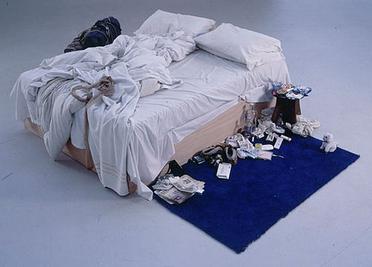
What a mess?


"L'inconscient est structuré comme un langage
Lacan

"What a mess!" I have often heard these words addressed towards me... 

They would perhaps be talking about my bedroom, my desk, my filing system.  

Of course, for other people, this apparent disorder would be considered chaos. 

They would be at a loss to find themselves in my 'mess' or should I say my 'order'.  

They would be, however, mistaken to imagine that my learning was messy.

Similarly, some people might find this blog, or my way of posting images on social media or whatever messy.  

They would be, however, mistaken to imagine that my learning was messy.

Others, might find that free association, brain-storming, creativity, abstract or conceptual art meaningless junk, or just a mess.

I would say that we have to learn to live with complexity, with what appears on first sight chaos. 

We are nurtured to gradually deal with a certain amount of liveable uncertainty which is culturally determined.  

In some cultures, and for some individuals, very little uncertainty is acceptable. 

In such cultures, and for some individuals, learning is not at all messy, or uncertain; it is quite the opposite.

When we come across, for the first time,  learning spaces or classrooms which are more freely ordered than traditional classrooms, we might think that they were 'messy.'

I would say that we have to be very careful to not imagine that introducing more 'freely ordered learning spaces' will inevitably result in more learning. It may well produce just the opposite effect.

(I am speaking from experience here.)

If I am writing this now, it is because I have been thinking through what Dave Cormier writes in his 'Practical guide for rhizo 15' where he says:

"I get the feeling that learning is a very messy place, and the story of the rhizome is one that i have found super useful in explaining things I’ve seen happen in learning spaces."

Well, I am not sure that we can say that learning is 'a place' messy or otherwise.

I suppose I might agree that learning can appear a 'messy process'. It certainly is a 'complex process'.

I am not convinced by the idea that learning is 'messy and uncertain.'

I would agree that without language, the world, and our lives, our relationships do indeed appear, are often,  'messy and uncertain' so from that sense what we will learn  may indeed be 'messy and uncertain.'  

However, I think that learning is really about make sense, putting some sort of acceptable (to us) order into our uncertain lives, onto this complex world.

We do this, as far as I understand it, in order to make it liveably legible and more comfortably predictable.

What is 'liveably legible' for me may well be 'unliveable chaos' for you.

So it can be argued that learning, being socially determined, can be seen from above or from outside as 'messy' and 'chaotic'. 

We can also argue, with vehemence, that learning can not ultimately be 'managed' in a classroom.

We can try, as people in some cultures have done, to limit all unauthorised learning by using drastic punishments. 

We can reward people for learning certain things or skills and thereby entice them to follow a certain predetermined pattern.

We can imagine the students are learning something but they may be learning nothing or something entirely different to what we imagine at a particular moment. 

We cannot stop people thinking differently to how we would like them to think. 

Social change, the learning within a society and the effect that it will have on that society is nonlinear, and unpredictable.

The pace and the means by which people will arrive to learn things or skills are varied, and complex. 

I agree that learning is a 'deeply personal, individual process', or rather a 'deeply personal, social process.' 

We wouldn't have survived so well as a species if individuals only learnt what was 'managed' by others. 


No child left behind?

So for me, learning is ultimately about ordering 'mess'.

What we are going to learn as individuals or as a species is certainly uncertain, of that we can be certain. 

Finally, what we perhaps all learn is one thing:  we are together in 'this mess'. 

This is our bed, we had better learn to live with it.


Image of Bed: 'My bed' Tracey Emin.


Thursday, March 26, 2015

Book-keeping.

He leant over to the box to pick up another one.

So engrossed was he in his task, that he hardly registered the cold of the early morning.

He picked up the paperback.


He turned it around in his fingers, squinting for its title in the pale street-light.

Where should he cataglogue this book?

  • Should it be classified in fiction or non-fiction?

  • Should it be classified by size?

  • Should it be classified by binding?

  • Should it be classified by author?

  • Should it be classified under 'T' for 'The'?

  • Should it be classified under 'B' for 'Book' and the 'T' for 'The' ignored?


The growing list of questions felt ever more menacing.

The passing time, measured with each breath,  was wearing him down.

Where should he put the book?

As his anxiety reached an unbearable level, he felt himself making another unsatisfactory choice.

No it woudn't stay in the 'T''s.

No that wouldn't be the right choice.

He resolved himself to another provisional placement.

He would come back to the question later.

He would find another one which would be easier to catalogue.

He looked over at the heap of books in the box.

He looked down at the neat lines of books on the grass.

Birds were beginning to wake to the first glimmers of dawn.

He had had no time to think about getting dressed; clothes in the circumstances had seemed to him superfluous.

He had gathered together his most precious belongings.

These were the only things which were of comfort to him.

He was there....sat, hunched over on the ground, quite naked, only a few feet from the railings.

There he was....

He was a castaway, washed up, one night on a traffic island.

He could only focus on the essentials now.

He reached over for another book.

The rest would have to wait.[1]

.

Image credits

The Library at Krotona, 2014

The Current Sea

http://thecurrentseala.tumblr.com/post/85128418799/the-library-at-krotona-the-current-sea-2014


Footnotes


[1]. This post arose on reading: I. Gilchrist "The Master and his Emissary" which I quote here:

"The systematic categorising process of the left hemisphere can sometimes begin to have a life of its own..."

"'Punding' (a form of stereotypy [2]) - the mechanical and repetitive assembling and disassembling of machines, collecting and categorising of inanimate objects, such as torches, TV's, stones, boxes, and so on."

[2] Stereotypy.

http://en.wikipedia.org/wiki/Stereotypy

In animals.
Stereotypies also occur in non-human animals. It is considered an abnormal behavior and is sometimes seen in captive animals, particularly those held in small enclosures with little opportunity to engage in more normal behaviors. These behaviors may be maladaptive, involving self-injury or reduced reproductive success, and in laboratory animals can confound behavioral research.[15] Examples of stereotypical behaviors include pacing, rocking, swimming in circles, excessive sleeping, self-mutilation (including feather picking and excessive grooming), and mouthing cage bars. Stereotypies are seen in many species, including primates, birds, and carnivores. Up to 40% of elephants in zoos display stereotypical behaviors.[16] Stereotypies are well known in stabled horses, usually developing as a result of being confined, particularly with insufficient exercise. They are colloquially called stable vices. They present a management issue, not only leading to facility damage from chewing, kicking, and repetitive motion, but also lead to health consequences for the animal if not addressed.[17]
Stereotypical behaviors are thought to be caused ultimately by artificial environments that do not allow animals to satisfy their normal behavioral needs. Rather than refer to the behavior as abnormal, it has been suggested that it be described as "behavior indicative of an abnormal environment."[18] Stereotypies are correlated with altered behavioral response selection in the basal ganglia.[15] As stereotypies are frequently viewed as a sign of psychological distress in animals, there is also an animal welfare issue involved."

This reminds me of an earlier post concerning sensory deprivation:

Zootopia?