|
| Simon Ensor |
 |
| Susan Watson |
What's the connection?
At first sight there appears little in common between the two images shown above.
To understand the connection between the two you will need some back-story.
Back story to the connection.
As mentionned before, I have been tagging along with Connected Learning MOOC, and their daily doodling prompts,
Susan Watson, the artist of the second image above is one of the leading co-learners and facilitators.
Without her and other key people (who and what is key fluctuates), who participate in different online spaces at different rhythms, with different objectives, and different perspectives, I wouldn't be learning what I am learning at the moment.
There are moments of distance from what others are doing, of apparent disconnection, of fatigue, demoralisation, boredom and then quite unpredictably moments of rapid progress.
I have found the same in learning languages, you can imagine that you will never ever understand a thing, that you will never be able to speak.
Given sufficient motivation, drive, urgency, given people around you to learn with, to support and encourage, given sufficient time invested in failing, failing, failing better, you suddenly realise that you are in a different place altogether.
Learning ain't linear.
So here's the connection:
Over the past few days, I have gradually been discovering new perspectives.
Indeed, it is this key concept which connects the two afore-mentionned images.
I had noticed a post of Susan's on Facebook which mentionned the word "perspective."
"Am not sure what part me seeing your work with Perspective has inspired me to go back to basics which I never worked at  🙂 Thank you"
🙂 Thank you"
I had also started following artists on Instagram to alter my attention feed.
Some of the artists' work appears formulaic and soul-less, they appear to weaponise technique.
I feel myself impressed by their photorealistic productions but left cold.
Where is the emotion?
Where is the human?
I find myself coming back to a conversation with Susan on Facebook.
Both of us are at a point where we are looking to go beyond what comes easily.
In my case, I can doodle and scribble and app smash to effect but I feel myself disatisfied with my technical limits. Susan was working on a big project and found herself limited technically. We found ourselves brought together.
this is how connected learning works 🙂 Started looking at online resources. Find this guy very clear https://www.youtube.com/user/LighterNoteProd
🙂 Started looking at online resources. Find this guy very clear https://www.youtube.com/user/LighterNoteProd
I had always looked to safeguard my childish soul and independence.
I note here a conversation with my daughter.
She came to draw a lantern with me.
She looked at her rapidly drawn lantern and then mine and said:
"Your's is really good."

Her frustration at not doing a "good drawing" damped her enthusiasm there and then.
She wasn't ready to give up her child's perspective, her independence.
She would much rather have drawn a unicorn with rainbow colours...
I remember getting bored at the still lives we had been asked to draw at school.
Bloody still life...more like dead life...
I had been unready to work on repetitive practice of perspective at school.
Art had little by little become another school subject.
Furthermore, any joy of artful expression had been quelled by their insistence on "sensible" career choices and time tables.
No, you would do better to work on more "academic subjects" they said.
I felt, over the years, a dull thudding of regret.
It had only been in Mr Edwards (if I remember his name) classes where we were left to our devices, and nurtured by Led Zeppelin.
He understood where it was at.
(I note a resonance of Howard Rheingold's story of school and the art classes taught by his mother.)
The rest of school was often times: do the exercise, do the test, do the exam...for marks.
FUCK MARKS...
Another riff: escaping echo chambers, halls of mirrors....
Academic feeds on Twitter have felt to me more and more about reputation economy management and less and less about learning these days, more and more about Western perspective economics...
But, what's the connection?
I find myself noting:
"Do we need to bow down to peer reviewed and anointed experts, or search...for personal perspectives...for recognisable wisdom?"
I think of our social media environment...our galleries...
From Twitter's, Instagram's/Facebook's/Google's business perspective model the quality of the content is secondary to the capture of attention...and the cash that comes from it.
If shit captures attention and shit is cheap then shit it will be....
If sufficient numbers of people like, share, buy into shit then shit it will be.
If sufficient numbers of academics cite your shit then shit it will be.
If sufficient numbers of key academics cite your shit then your shit is recognised.
If sufficient numbers of art collectors buy into your shit then your shit is recognised and your market value goes up.
Quantity of tweets, that is to say the frequency with which tweets are made is key.
Quantity of articles published, that is to say the frequency with which articles are published is key.
Quantity of pictures on the market with a high market value is key.
It's academic my dear AK.
A conversation with my friend Apostolos the other day about PHD's confirmed to me..again...the sterility of much of that world.
Repetitive technique...no soul.
Produce what sells...
AK was talking about a conversation with a supervisor who had noted a lack of "recognised references" to "key academics". It all seems more about paying tribute in some sort of feudal kingdom.
A conversation with my friend Sarah about academic voice led to a call to Nick Sousanis for support.
— Sarah Honeychurch (@NomadWarMachine) August 18, 2018
Quite! Stick to your guns. Use their voices as data to analyse, as part of process. This is exactly how I would write thesis. If you don’t challenge « objective » « academic voice » you may as well accept you are just another brick in their bloody wall...— Simon Ensor (@sensor63) August 18, 2018
Alternatively accept it’s (also) a bureaucratic passport to an academic status and do what they tell you. Your story reminds me of my friend and colleague Rosemary who did thesis on paganism.— Simon Ensor (@sensor63) August 18, 2018
I've never been very good at doing what I am told— Sarah Honeychurch (@NomadWarMachine) August 18, 2018
Inadapted to slavery or military.— Simon Ensor (@sensor63) August 18, 2018
I was thinking about Nick as I was writing. Coz, you know, I don't think what I am wanting to do is as big a step as his was, but apparently others see it as a digression— Sarah Honeychurch (@NomadWarMachine) August 18, 2018
The fact that Nick's wonderful, ground-breaking thesis, "Unflattering" was drawn connects here..."No, no, no"- is right - stick to your guns, you've got this! Great piece - thanks for tagging me...— Nick Sousanis (@Nsousanis) August 19, 2018
A look at Nick's technical brilliance in "Unflattering" is a tribute to time, attention, talent, independent research and personal inspiration.
No slavish, soulless academic pandering there.
The human shines out.
All that jazz...
So the prompt from the daily doodle was "jazz".
Jazz is the name of our dog.
I didn't feel any inspiration to start drawing a dog...again.
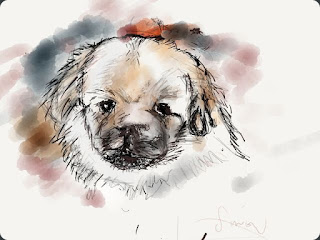
I didn't feel any inspiration to start drawing a saxophist either.
I was much too much taken up with failing to draw rectangles - boxes, cupboards, trunks, boxes, televisions, tables, boxes, et al in perspective.
BOXES, BOXES, BOXES...!
I found an artist's grid app to put on my phone.
I worked and worked at finding the right angles, the right lines.
I went and found a couple of Youtube tutorials to learn to get my boxes drawn with perspective.
I worked and worked repetitively at drawing and redrawing boxes, cupboards, books.
— Simon Ensor (@sensor63) August 26, 2018
One might even say that the work and the research was academic...
I think back to my child self...
He would have found it all terribly boring.
Jazz, Prog Rock, and Punk
The thought of jazz made me curious about the music.
For many listeners jazz can sound strange, improvisations, dischords may challenge.
For other listeners, jazz can sound academic, intellectual, opaque.
Being of that generation in the late seventies, I remember Emerson Lake and Palmer.
I have to admit to having bought records of "prog-rock" - hours of twiddling, pomp, and pretention.
Camel, Yes (oh no), Genesis, (at its worst), Rick Wakemen and his seven wives...and seventy keyboards.
I thought about the extraordinary technique behind the best playing of jazz, progressive rock.
Hour upon hour of practice.
THEN THERE WAS PUNK and TWO TONE.
In an instant, the twiddling and twaddling, hobbits and fairies gave way to ...
ANARCHY and GHOST TOWN.
BUT THEN THERE HAD BEEN JAZZ.
I went and found some information about the history of jazz and found an article:
You will be shot: Five ways jazz can be punk.
"Jazz is a sponge for outside sounds. Add another idea to it — say, European classical or gospel-inflected R&B music — and it absorbs, assimilating the sound into a new subgenre: like "third stream" or "soul jazz," respectively. Wring it out, and its own improvisatory essence remains in the mix.
It's hard to imagine something that could be further in sound and structure from jazz than punk rock, but punk and jazz do have elements in common — the most important being attitude. Whether it came from the boundary-pushing free jazz of the late '50s or the experimental electronic sounds of the late '60s and '70s, the spirit of adventure, creativity and thumbing one's nose at "the rules" has always been a part of jazz's historical trajectory."
Jazz and Basquiat...
I find myself thinking back to my Facebook conversation with Susan.
Jazz impro without technique very limited I find myself thinking back to my Facebook conversation with Susan.
🙂 Contrasting Punk and Classical/Academic. Basquiat and Rembrandt 🙂I went and did a bit of research into Basquiat.
At first sight, there doesn't seem too much connection between his work and jazz.
I would have thought about hip hop, street influences...
But...
Bowie, Bach and Bebop: How Music Powered Basquiat
If ever there were sponges it would be Bowie and ...Basquiat.
"When Basquiat was around, she recalled, “music was playing all the time.”
On Thursday, the exhibition “Basquiat: Boom for Real” opened at the Barbican Center in London. The show focuses on the artist’s relationship to music, text, film and television. But it is jazz — the musical style that made up the bulk of Basquiat’s huge record collection — that looms largest as a source of personal inspiration to him and as a subject matter."
"Basquiat’s tastes were eclectic: Curtis Mayfield, Donna Summer, Bach, Beethoven, David Byrne, Charlie Parker, Miles Davis, Aretha Franklin, Public Image Ltd.’s “Metal Box” album."
"Basquiat was especially devoted to bebop, the restlessly inventive genre typified by the likes of Parker, Davis, Ornette Coleman and Thelonious Monk. Basquiat’s love of bebop fueled his art, said Eleanor Nairne, co-curator of “Boom for Real.”
“Bebop was quite an intellectual movement,” she said. “It was also quite iconoclastic in wanting to break away from these older jazz harmonies. That idea of a kind of rupture, and of these musicians who were very young, vibrant powerful forces; there were lots of parallels he found with his own work and life.”
"The multifaceted nature of the scene gave Basquiat license to crisscross artistic forms on the way to developing his own style."
What is the connection?
"Connected learning combines personal interests, supportive relationships, and opportunties. It is learning in an age of abundant access to information and social connection that embraces the diverse backgrounds and interests of all young people."
"The research is clear: Learning is irresistable and life-changing when it connects personal interests to meaningful relationships and realworld opportunity."
"Learning is motivating when it grows out of personal interest. A growing body of research indicates that interest helps us pay attention, make connections, persist and engage in deeper learning."
Footnotes.
Like the succession of boxes, I will come back and study my scribbling here with new eyes.
I have already come back and cut and edited a bit.
We are constantly redrawing our lines.
I have already come back and cut and edited a bit.
We are constantly redrawing our lines.
I won't try to hide it.
I always preferred annotated artist's sketch books to uncontextualised finished "masterpieces" floating on a gallery wall.