Showing posts with label Teaching. Show all posts

Thursday, October 12, 2017

Blinkered

I mean what are we paying attention to?

I was quite proud of my newly acquired skill of focussed listening.

I sat quietly, I turn my head to the group to my left.

One is speaking French.


"Oh your French is excellent."

I compliment.

The student smiles.

He speaks English.

He notices my attention elsewhere, he speaks French.

I turn my head to the group on the right.

"I did went to the park."

"I'm sorry, what did you say?"

The student looks confused.

"Er.....you er....to the park? 
(teacherly rising intonation)"

The student looks even more confused.

"Er....to the park?"

"I go to the park."

"Yes, you.....to the park" 
(accompanied by hand gesture to indicate past.

The student looks even more bloody confused.

He is now concentrating on interpreting my illegible hand gesture.

The other students are getting frustrated, tapping their fingers.

Three minutes of embarassed silence.

I give up.

This elicitation nonsense is lost in the park.

"You went to the park."

"Yes, I went to the park."

The student looks non-plussed.

I feel him shrugging his shoulders.

He continues trying to perform.

Who is he performing for?

Taking off the blinkers.

What was I trained to do?

How are we having our attention directed?

Who is directing our attention thus, for what, and for whose purposes?

How is such training making teachers ignorant of what is essential?

Blinkered.

"He is dead," said Boxer sorrowfully. "I had no intention of doing that. I forgot that I was wearing iron shoes. Who will believe that I did not do this on purpose?"

George Orwell.

"He's so lazy," my colleague said to me of one student.

"He's so lazy," I said to myself of another student.

How do we know what harm we do with our iron shoes?

This year, I decided to reassess all my previous judgements.

Those students are not "lazy" this year.

They may not have done any "observable work" or shown any "observable learning" but "lazy" is not a useful lens through which to view people.

I thought I might question my judgements, my practices, my certainties, my perceptions.

I thought I might learn, really learn.

I thought I might go about analysing things more systematically.

What does learning really look like?

What does learning really feel like?

Where do we really need to be directing our attention, our efforts?

Seeing with new eyes.

I had to open my eyes differently, I had to experiment with shifting my attention.

I had to deliberately and continuously test my assumptions even more often than usual.

To what extent are we basing our judgements, our attitudes, our behaviour from positions of ignorance?

Blinkered.

"Our sense of how the world works is often vastly cruder than we think."  Keil

(quoted from "Want a Deep Understanding? First, Know How Little You Know." Winston Sieck).

A student is holding his head in his hands.

"Is he disinterested?"

"Is he bored?"

"Are you OK?" I ask.

"How do you say malade?" He asks.

"Er ill or sick."

"I am sick." He says.

He goes on holding his head in his hands.

Taking off the blinkers.

I started writing this having just read Terry Elliott's piece entitled:

Epiphany: C. Wright Mills Sociological Imagination Is Also a Pedagogical One

In it he writes:

"More and more I feel like an anthropologist in my classroom.
For example, having read 54 summaries over a very challenging article by Jonathan Haidt, I had one extremely powerful insight.  And I only had that insight because I had a set of 30 minute conferences as well.
I am so lacking in sociological and pedagogical imagination that it only became clear to me after the dust settled that students ignore what they don’t understand."
This reflection connects with my current research.
I could echo Terry:
"More and more I feel like an anthropologist in my classroom.

Taking off the blinkers.

This reflection reminds me of conversations with Terry about grass...of how he, as a farmer with a close relationship with sheep, is able to read stories in grass which appear here in "Spring Flowers."

I am grass illiterate.

This reflection reminds me of the work of Gee and his "Critique of Traditional Schooling." and a quote of Kramsch:

"Context is not a backdrop to learning the language, it is the very object of learning. Thus we need to study context itself and its relation to the texts that both structure and are structured by it." 


It is only through ongoing dialogue that one can hope to partially understand what is going on within the boundaries of the class.

It is only through ongoing questioning of the structure of the boundaries which give context to our activities that we can begin to understand what is going on within our classes.

I notice a major difference between a group of students being integrated by teachers into a professional community of ergonomists, whose work uses scientific articles as support to their work, and students of teachers in other disciplines who use academic texts as hammers to beat the students into submission to underline power differentials.

Are we reading so as not to understand or so as to understand?

Blinkers.

"Have you read Foucault?" I asked enthusistically.

My question was met with disgust from a student whose teacher had had her read Foucault.

Should I be surprised?

"Context is not a backdrop to learning the language, it is the very object of learning." Kramsch

Taking off the blinkers.

Asking the students to systematically provide language learning biographies has given me the means to focus my attention on certain students who were simply lacking attention, to help them analyse their own stories in relation to others and to question a system which leaves young adults feeling like failures.

Asking the students to systematically share their interests, passions, ambitions, opens up opportunities to connect them to documents, people, communities with whom they may be able to relate.

If I am doing such a bad job, maybe others younger than myself, closer to the students can be enlisted to act as more effective mediators?

I start to see the class not as a homogenous group but as an ecology of inter-twining networks with potential for more imaginative, perhaps more distant connections.

I have to get the students to share their own visions, their own feelings, their own perceptions of what is happening in the classroom and outside it.

In this way we can gain an insight into what is not observable.

One pair of eyes and ears become twenty pairs of eyes and ears.

At the same time I am looking to associate them to, or to co-imagine research projects concerning their own learning.

Student ergonomists' analysis of work situations becomes transferrable to our English classroom situation which has moved outdoors for the day.


Transferring a blackboard from the classroom to the space outside the building becomes an opportunity for these ergonomists to put into practice their developing competences.

How do they feel in this new environment?

Is their attention awakened?

Is their attention distracted? (interesting idea in itself)

Is this an "official" or an "unofficial" class?

Where are the boundaries?

Where are the emergent boundaries which shift according the ambient noise level with people having to move closer to be heard or closer to the board to read?

What happens when other people join the group sitting in the grass?

How does it affect relationships between the students and between the students and the teacher.

Do they feel more able to be themselves, or more at ease?

How does a passing plane or ambient nature affect their focus?

What happens when one student isolates himself from the class because he is suffering from allergies to the newly cut grass?

Should one simply exclude the student, go back in the classroom, ignore the student?

What should we think about "democratic" decisions when the majority decides that the minority should shut up and suffer?

I pick up the "grass" identifying three sorts of unnameable (by me) green plants and we speak about how blinkered we are when it comes to knowledge.

We think about how the green green grass of our home is a threat to others.

Indeed what is knowledge if it is not associated to our context...to our community?

This becomes a source for a discussion with students who take on different identities those of co-learners.

How does a classroom box induce ritual, learnt behaviour, phobic behaviour?

How does the conversation or the learning or the relationships become...in the words of the students:

"real conversation, real language, real learning."?

I am multiplying my efforts to enable student led activities to emerge in the classroom.

Whether that be training session led my students in adapted physical activity.


Or reflections on our own cultural barriers to eating insects.

Or the art of the artisan chocolate maker.

Or the relationship between the cocoa and the colony....


I am multiplying my efforts to enable student led activities to emerge outside the classroom.

A group of students link up with a foreign student to go rock-climbing in English.

Another Facebook group emerges around the idea of running in English.

Another ex-student pops up on a smartphone from Lima in Peru to speak to students inside the classroom about concepts and experiences of freedom.

Another musician pops up from the ranks of the unknown.

Another ex-student friend pops up to animate a personal development session with those wanting to understand the nature of travel.

I take a photograph of them to see what attentive learning looks like.


I see them stretching forward to listen.

I find myself being aware that my position of teacher has become that of the observer, the witness.

I come back to Terry's thoughts

"More and more I feel like an anthropologist in my classroom.

I find myself sharing a quote of Proust again.


“Le véritable voyage de découverte ne consiste pas à chercher de nouveaux paysages, mais à avoir de nouveaux yeux. ”

I share with the students the joy for me of teaching through learning, of learning through dialogue.

I spend some time after the lesson talking with the students about the importance for me of their observations, their analysis of the moments that we have spent together so that I may, with their help learn to read this our context(s).






Wednesday, September 27, 2017

Seeds for change.

Most comments go unread.

Most questions go unanswered.

Most efforts go unrewarded.


Most cries go unheard.

Most pleas go unheeded.

Most lessons go unlearnt. 

Most.................go un.................

Most ................go un................

Most ................go un................

Most.................go un................

Shift Change.


Seeds for change.

I was reading Terry Elliott's recent blog post "Seeds for change."

It's not very long.

It contains the germ of an idea.

"It might seem a lot for a little, but what I have bought is strong signal. Seeds are information beacons. I want to know if my soil fits that info. Will it sprout readily, will it take root well, will it winter, will it tolerate the oft-wet, sandy, jackrock soil? Each seed is a small story waiting to be heard."

Terry Elliott

Seeds for change.

The idea of being attentive to a complex, fragile, ecosystem.

The faith to invest one's energy in the faint hope of something growing.

Curiosity to learn what will take root, what will sprout.

Seeds for change.

I cast out a few ideas.

A story of bilingual rock-climbing sprouted via Facebook and seeded in other fields.

A story of craft chocolate appeared in the classroom, contained in a large carrier bag.

A story of athletes kneeling was murmuring around the rooms.


Seeds for change.

The idea of being attentive to a complex, fragile, ecosystem.

The faith to invest one's energy in the perhaps faint hope of something growing.

Curiosity to learn what will take root, what will sprout.


Seeds for change.

"It might seem a lot for a little, but what I have bought is strong signal. Seeds are information beacons. I want to know if my soil fits that info. Will it sprout readily, will it take root well, will it winter, will it tolerate the oft-wet, sandy, jackrock soil? Each seed is a small story waiting to be heard."

Terry Elliott


Sunday, September 24, 2017

At last...

Look. They are just thistles.

It's just a wasteland.

But it mattered to me at that moment.

It matters to me now.


I stopped.

I framed.

I paid attention.

Thistles. Just thistles. No arty filters.

It was just another day.

Today.

I was caught between conflicting feelings.

"Fuck it all."

"I'll read that book."

That book by that well connected, well respected, well accepted peer.

I reviewed the choices.

"Fuck it all."

That book.

"Pay attention to those students." 
"Show them you are there"

I was here.

Conflicting feelings....

Conflicting feelings...

Power to choose.

I chose the students.

A considered choice it was.

I took the spreadsheet.

The students couldn't do that.

Data.

Just fucking data.

It wouldn't really have mattered.

They were just students.

I clicked on a link.

It was a person, a real person.

A person with fears, hopes, expectations...

No expectations...

Low expectations...

A person, with memories, with stories, with stories to write.

"Fuck it all."

What is more important?

It clicked.

This wasn't really work.

It was life.

LIFE.

I got caught up in the joy, the curiosity, the responsibility that was a click away.

I clicked, I measured my words, I wanted the moment to count.

I am just a teacher.

They were just thistles.

She was just a student.

Make it fucking count.

I counted.

I even timed it.

With a fucking iPhone.

It took me two hours.

At last...

Two hours for twenty people.

I calculated.

6 minutes per person.

What counts?

How long is a song?

You don't need so much time.

A word, a reference, a link, a picture, a song.

Just a word.

Just a second.

Just a déclic.

Just a song.

"Fuck it all."

Another person.

Binoche.

Her again.

I shall go and Google her here.

Touches of sense...

There was a teacher they were talking about.

She was talking about her.

Being her.

For the other person.

For her.

So many years after.

At last...

There was a song on the TV.

I posted it here.

To mark the moment.

To remember an instant.


AT LAST.

"Fuck it all."

I'll read the book after.

I'll do the paper, the conference after.

What counts?

The applause?

The status?

The money?

Touches of sense...

I received a couple of mails.

Just students.

They said: "Thank you."

In so many words.

Nothing else.

Counts.

Interstellar on TV.

I am not watching.

I am writing.

I am aware of...

Etta James on Youtube.

Jazz chilling out on the sofa.

Another day.

I am here.

This was life.


Wednesday, August 23, 2017

This event is brought to you by...


A post event reflection.

Structured unpredictably...

A gif of dynamic systems.

"If one has to start anywhere..."

"Will this animation move when published." He wonders.

"Will it just become static on the net?"

"Whatever."

I keep trying to figure out where this should start.

Narrative(s) attempt(s) fail unmanageable reality.

It will have to do.

Such universal failings are, after all, what connect us.


"How do I express this with ever-changing feeling?"

"Oh damn it."

This is absurd.

“Writing has nothing to do with meaning. It has to do with landsurveying and cartography, including the mapping of countries yet to come.”  


"Fuck IT."

"Fuck Google."

It's all we have.

A fragile agency... 

"A speckulation?"

"I'd like to thank my mother, my father."

"I'd like to thank (GOD?)... er those who missed attempting to kill my grandfather in the war."

This is brought to you by...

A dog barking?

I hurriedly pulled on a pair of boxer shorts and a tshirt.

Modesty saved.

This is brought to you by...

FEDEX

"Do you have ID?" 

I went back for my passport and signed off the parcel slip.

This is brought to you by...

The cable for my laptop.

At two o'clock in the morning attempting hamfistedly...

 "Why do we say that?"

I type a blog post on a smartphone...

I lose the contents of the post three times.


This is brought to you by...

What was lost.

Sleep. 

A laptop with POWER.

This is brought to you by...

A caring community.

This is brought to you by...

A Slack backchannel.

"I am sorry, my laptop has died on me, I won't be able to set up the session for Eurocall tomorrow."

This is brought to you by....

A response from Helen DeWaard over in Ontario.

At virtually no notice, Helen really backs me up for Virtually Connecting at Eurocall.

She will share her? Google's?  our? POWER to allow? to enable?  us to hang out in Southhampton.

"What about Saturday?"

Ken Bauer, over in Mexico silently interrupts a meeting at his daughter's high school to offer help.

On Saturday, he will be up for 5:00 am in the morning.

This is brought to you by....

Friendship, fellowship, faith, love, hope....a belief in something bigger than each one of us.

This is brought to you by....

Teresa Mackinnon  she offered to be an onsite buddy at Eurocall.

This is brought to you by...

Steve Wheeler  who mentored me on his blog...like so many others.

This is brought to you by....

Rhizomatic learning...Dave Cormier...

"A rhizome has no beginning or end; it is always in the middle, between things, interbeing, intermezzo."

This is brought to you by...


"Will it ever end?"

"No...nooo!"

Martina Emke started it. 

She kept bringing up rhizomes.

We hadn't even gone live yet.

"A rhizome has no beginning or end; it is always in the middle, between things, interbeing, intermezzo."

I met Maha Bali, Apostolos Koutropoulos, so that's a sort of start to this story here.

"A rhizome has no beginning or end; it is always in the middle, between things, interbeing, intermezzo."

Rhizo15


"A rhizome has no beginning or end; it is always in the middle, between things, interbeing, intermezzo."

(I tire of fighting with html formating. It's small. It's small. )

"Fuck it."

This is brought to you by....

A common language...

POWER embodied? disembodied? 

POWER to order chaos? to give semblance of order to chaos? to command? to touch?

POWER to include? to exclude? 

This is brought to you by....

A language.

"An Open Educational Resource" offered AK.

This is brought to you by...

A keynote recording.

"Will it be available openly?" I asked.

"Well what's the point of putting it on a website if it is not available openly?" Martina responded.

"Academic publishing etc....?" I countered?

But will it be accessible?

Will the language be accessible?

This is brought to you by....

My interest in language learning.

It led me to reflect.

The more I reflected, the more I was led to experts.

This is brought to you by...


I fell upon a conversation which spoke to me.

This was accessible.

A recognisable conversation between recognisable humans. 

Humans. Speaking English.

This is brought to you by....

An ex-student and reluctant academic.

I remembered being a student at university.

I remembered struggling with what seemed to me to be densely alien gibberish.

"Why can't they just speak bloody English?" I remember complaining intolerantly.

"Why do they need all these barbaric terms?" I remember thinking.

I think of attitudes to scientists.

"Britain has had enough of experts," says Gove.

This is brought to you by...

Reading articles by Steven Thorne and other experts on the complex reality of language learning.

This is brought to you by....

Combining blogging with reflective practice.

Towards complexity-informed language teaching in higher education.

To what extent is it possible to adopt “complexity-informed perspectives” (Mercer, 2013) for language teaching in higher education? Considering the classroom as a complex adaptive system (Larsen-Freeman, 1997; Ellis & Larsen-Freeman, 2009), we use mixed methods adapted from Nexus Analysis (Scollon & Scollon, 2004) to explore evolving ecologies of learning (Van Lier, 2010) in a French university language centre’s English classes for non-specialist undergraduate and postgraduate students. Using qualitative and quantitative survey, pedagogical programs, capture of interactions: photo, video, and learner portfolios, we trace discourses in place and interaction orders. We study teacher and learner reflection, narratives and interview to highlight divergent perceptions of affordances. We observe how network-connected technology offers the potential to modify pedagogical practices and assessment in the classroom, to better respect learner diversity and to “situate learning” (Lave & Wenger, 1991; Gee, 2004) in diverse contexts, to facilitate observation and analysis of learners and learning activities. We attempt to identify “core components of the system - hubs where the effect of change is more likely to spread throughout the system” both of the learner and the institution (Mercer, 2013).  If research may enable us to identify “general principles which language educators can use to guide their actions” (Tudor, 2003), analysis of individual stories illustrates the complex, unpredictable, emergent nature of learning. What strategies might teachers adopt to facilitate dramatic progress in learning? In an institutional context ordered by program outcomes, marking grids, and time constraints, learners may be more concerned with gaming the system for credit rather than actually learning a language. Teachers’ “historical bodies” (Scollon and Scollon, 2004): experiences, beliefs, attitudes, competences,  and time and or financial constraints may enable or limit their desire or means to adapt practices. Going forward, we consider it essential to develop connected, reflective communities of exploratory practice (Allwright, 2003) including learners, teachers and researchers to work towards manageable pedagogical solutions and the recognition of diverse perspectives, competences and roles.

This is brought to you by....

A growing feeling of becoming part of academic communities.

Thanks to people that I can share common VALUES with.

Despite past feelings of disgust for everything academia.

"What are you?" He scowled.

This is brought to you by...

Something greater than the sum of its parts.

"What is it that brings us to work together here in these spaces?" Wonders Apostolos.

Words emerge chaotically.

This is brought to you by...

Virtually connecting, really connecting people who really desire to connect.


This is brought to you by...

An accessibly human American researcher, Steven Thorne packing an hour long keynote into 45 seconds, responding in dynamic whispers so as not to disturb adjacent partner/sponsor event...

"THIS EVENT IS BROUGHT TO YOU BY...."

speaking volumes about social issues in conversation with Parisa Mehran, an Iranian researcher refused a visa to attend Eurocall.

"SHHH!"


This is brought to you by....

Questions from Joe Dale and Teresa Mackinnon to Steven Thorne about how to connect theory to pedagogical practice.

Questions of how to be a teacher in a complex age of change.
("Was there ever an age that was not one of change?")

Questions of how to enable the work of researchers to be accessible.

Questions of what constitutes citizenship in a connected world.

Questions of identity, of language, of meaning, of POWER.

Questions of frontiers, of who defines our boundaries, our bodies, our movement....our lives.

"Teachers have never been so necessary." Steven Thorne.

"Accessibly human, caring, experts have never been so necessary." I think to myself.

"Working together across artificial frontiers has never been so necessary." I conclude.

"On est ensemble dans cette merde. On a chacun sa responsabilité." He thinks in French.

"Working outside the box, inside the box...tricky...hmm" I contemplate.


Postscript.

This is brought to you by....

Vialogues...


A desire to go back and listen again so as to better act.


Thank you to

Helen, Ken, Maha, Autumm, Vconnecting, Eurocall, Teresa, Kate, Joe, AK, Parisa, Dave, Steve, Steve, Francesca, Uncle Tom Cobley et al. (and er... Google)


Tuesday, January 24, 2017

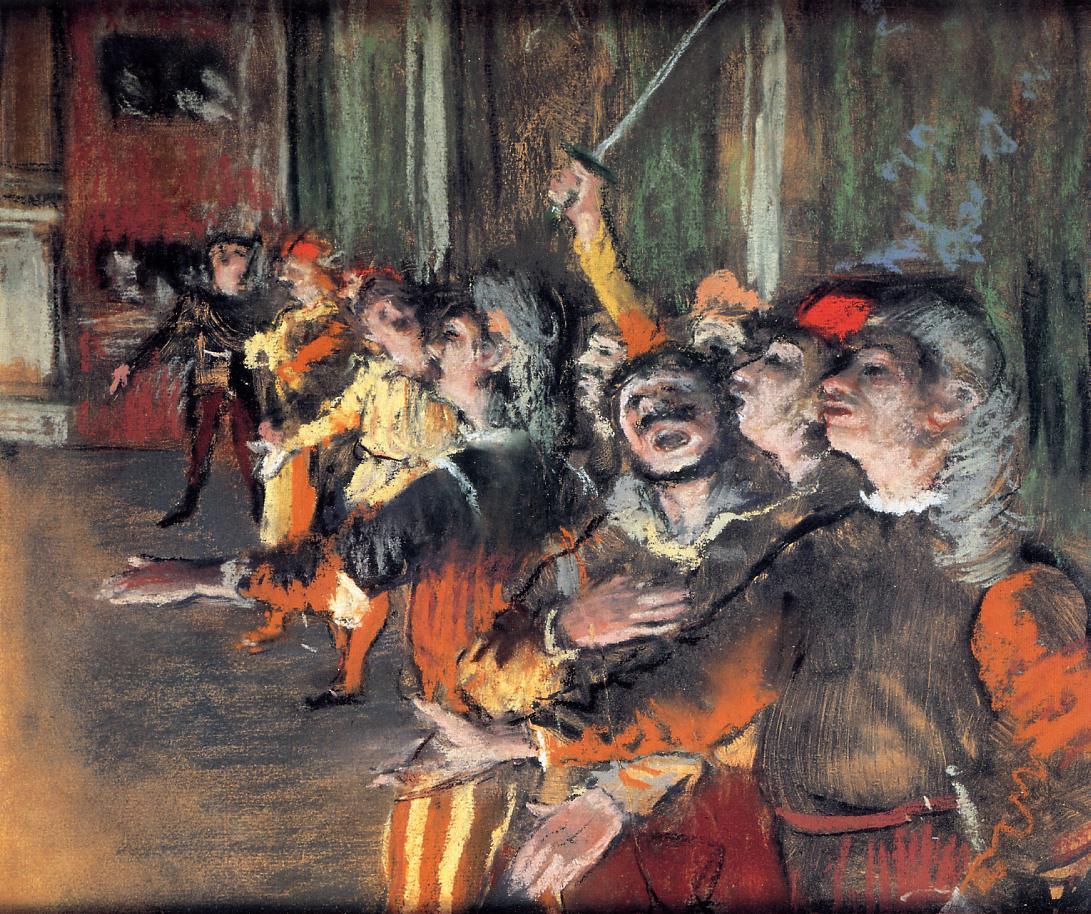
Dumb Chorus.

No one spoke.

Faces, kodachrome faded, once recognisable, had become nameless.


I scrutinise the rows of uniform.

Who was the boy on the left?

Who was the boy on the right?

They do not speak.

They stare.

Dumb Chorus.

Sitting and thinking, I furrow my brow.

I make a list.

Of the few faces that I retain:
  • an inspiring English teacher
  • the art teacher, 
  • the violently abusive headmaster, 
  • the housemaster, 
  • a chain-smoking French teacher.
  • a paedophile science teacher
  • a sadistic German teacher
  • a history teacher or two
  • a geography teacher.  
I can remember three or four names.

Hour upon hour of study... how many moments remain?

Hour upon hour of study... how many marks did I receive?

Two vivid bruises.

A dumb chorus.

Two or three people marked me for life.

Others left no apparent mark.

Image credit:

The Chorus (1876) by Edgar Degas, oil on canvas, Musée d'Orsay

Sunday, November 27, 2016

No child left behind.


The successful outcomes benefit from sophisticated monitoring and advanced data analysis, a continuous stream of the latest intelligence, distant human piloting and decisive engagement.


No child left behind.

The board meets to congratulate themselves on yet another successful year.

Training budgets for apprentices are up.

Local schools are flourishing.

Unemployment is at a new low.

Faith in freedom is reborn.

The president cuts the ribbon for a new line.


The people come to wave their flags and cheer.

No child left behind.

I watched as the young people around me froze.

A deathly silence fell upon us.

The camera moved around the room.

Chairs and tables had been overturned.

People seemed as if suspended in the air.

All activity stopped.

Nobody was laughing now.


No child left behind.

I looked at the data in the spreadsheet.

1 0 1 1 1 1 1 1 0 1 1 1 1 1 1 1 1 1 1 1.

It was marvellous news.

I tweeted to my colleagues in the UK.

The students seemed to be engaged with their distant correspondents.

Isn't this what we call "a global classroom"?

Don't we need a [global] "village to educate a child"?


No child left behind.


I concentrated my energy on the person behind the zero.

He was a high level sportsman..

That was what explained the zero.

Column 5 - Date.

Column 6 - 1 for presence 0 for absence.

He had done the work.

I didn't have a trace.

Fantasies fill the void.

"He's not interested in my classes."

"He's doesn't care about my subject."

"I am the One with power."

"Zero! He's worth zero."

Fantasies fill the void.

Dialogue 1 - 1 was facilitated by the tools.

Dialogue 1 - 1 helped us to build respect.

Dialogue 1 - 1 moved us to another place.

No child left behind.

Tools extend our reach.

Maps extend our reach.

Words extend our reach.


I look at the blog statistics.

"Touches of sense..."

142, 000 hits.

No child left behind.

Ronald reminded me.

@sensor63 Searching for children of Native Americans and aboriginals to bring them to the institutions to take their own culture out of them
— Ronald_2008 (@ronald_2008) November 27, 2016

I watched the video again.


No child left behind.

I did a search for Australia.

Education down under is nothing if not inclusive.


I watched Walkabout on Youtube with an English rose.

I watched the test match.

We won the ashes.


No child left behind.

"I reconciled myself to separation."

We learnt about 1066 and all that.

Shall we ever venture into  "Noman's land."?

We learnt to march.

We learnt to drill.

We learnt to bat.

We did "Target Practice."

Teachers inspired us.

Teachers abused us.

Teachers thrashed us "Behind closed doors."

We escaped an instant the day of the deluge.

No child left behind.

We have a common core, a common culture.

Standards are kept.

Competition is fierce.

Money speaks.

Scores cards are tallied.

Numbers never lie.


No child left behind.

I read Terry's post.


I listen to the song.

"Road to nowhere."

I tweet a response.


I see Kevin's response.


That gets me thinking.

Fantasy fills the void.


I think back to Kevin's tweet.

"We are on the road to somewhere...."

I think back to the spreadsheet.

No child left behind.

"We are on the road to somewhere..."


No child left behind.

I think back to the spreadsheet.


I think of all those zeros...all those ones.

At times, I despair.

"I do not think words alone will solve humanity's present problems. The sound of bombs drowns out men's voices. In times of peace I have great faith in the communication of ideas among thinking men, but today, with brute force dominating so many millions of lives, I fear that the appeal to man's intellect is fast becoming virtually meaningless."

Albert Einstein.


Sunday, October 2, 2016

An indian summer.

"Do you want to stay here, or would you prefer to go outside over there?" I asked them.

"I'll follow you." I heard myself saying.


It was a beautiful afternoon of an "Indian Summer" on a grassy plateau in the Massif Central.

The people (students) sat down together in groups of various sizes and configurations and started to exchange.

A pair of them had come with food that they had prepared for the occasion, they shared their offerings with the newcomers.

I (an English teacher) moved from group to group stopping to listen and to speak with some of the people I knew (students) and with the newcomers who were from Nigeria, Columbia, Senegal, Finland, the USA, Ghana, China.

Dancing in the wild.

The newcomers, I had learnt the week before, had come from all around the world to study dance and anthropology together. I thought that the opportunity for an informal meeting of the minds would be mutually beneficial to everybody.

English would be the lingua franca for the occasion...dance might also be a useful means of communication and reflection, I thought to myself.

The people were all engaged in different conversations, some sitting, some standing, some speaking, some listening, some kneeling, some lying down.

None of the conversations were scripted, programmed or determined by myself (the teacher).

I pointed out that they might find some things in common...

As the afternoon went on the people moved changing the group compositions, changing the conversations.

Stories of resilience.

I spoke to a guy from Ghana and another from Senegal or Nigeria (I am not sure now) about their learning stories. They spoke to me of the difficulties they had had navigating classical expectations of parents or institutions to focus their attention on what some might consider a marginal activity - dance choreography and anthropology.

They spoke of the thousands of students in amphitheatres...

One spoke to me of trying to take law classes to dissimulate what he was really doing which was to follow dance anthropology classes at the university.

They had showed remarkable resilience in their desire to follow paths which they felt were essential to them.  I made a mental note of their stories for future reflection.

Emergent learning.

After a little while, the interaction in one group had mutated from conversation to a break dance battle.

On hearing the music, which was coming from someone's portable wireless speaker connected to a smartphone, all the other groups stopped conversing and stood up on the slopes to become an audience within an emergent, natural auditorium.

The dance had changed the nature of the space, the nature of the ritual.

There were whoops of delight, expressions of encouragement, cheers and clapping as the pair of dancers showed their moves.

After what seemed a good few minutes, the dancers stopped, some people grouped in pairs and started taking contact information, others were attracted by drumming coming from across the plateau, others went off to retrieve their belongings.


Massively Open Offline Class.

I moved with some of the people over to the other side of the plateau, passing a couple of girls with hijab attempting to walk across a slack line, a boy that I knew from one of my classes hanging upside down from a trapeze, a group of jugglers.

I stopped to speak with them and was greeted with a smile.

The activities had been organised as part of a festival to welcome new students to the university.

I overheard one student say to another:

"Why don't you tell your friends to tell the teacher that you had to miss class, this is much more interesting."

I looked back at concrete boxed classrooms and thought of those that they contained.

Once at the other side of the plateau, I was met with a group of African dancers in traditional dress who were acting as a magnet, attracting others to dance with them.

I recognised one or two of the dancers as those who had been with the class of students in the "English" class just before.

I spoke with the students watching the now active dancers of their meeting.

"Had that been a valuable learning experience?" I asked them.

The expression on their faces was eloquent, they all noted that it had indeed been both memorable and of interest to them.

I noted that some of them had been taking contact information from their new friends, had started organising times to meet.

They had at first oriented themselves.

They had shared declarations.

They had networked with these strangers.

Weak ties were being strengthened.

Now, they were clustering.

There had been clear focus on the spontaneous break-dance battle.

I shall remember this class as one with many connections from which to learn, an open space within which to roam. I thought of how this connected to my own experiences of (rhizomatic) learning online and offline.

Education for community

I thought of the street festival that had been organised by students I teach the weekend before.

I thought of the connections being made between them and the local community.

I thought of the wealth of the learning ecosystem within which they had been the actors.

I am fortunate working with people whose sporting, academic and professional activity takes them into so many diverse spaces.


Learner Resilience

I am wondering now about learner resilience.

Not all the students that I meet demonstrate the same determination as those African dancers.

Many need time to orient themselves.

Many have been so institutionalised that they are looking only to go through the minimal motions to get a grade.

Many classes, many spaces, many rituals, relations, reinforce such minimal transactions.


Strategies of school and deschooling.

Opening them up to imagining different relations, different activities or means to learn within the institution or outside of the institution is not straightforward - particularly when the institutional culture itself is the major obstacle.

I am now faced with two quandaries,which in effect are similar:

How do I go about facilitating the development of resilient learning networks and communites from within an institution in the most effective way?

How do I go about enabling learners to view the people around them - classmates, people in the street, in the town, on the internet as potential members of their learning networks?

How do I go about enabling learners to benefit from paths trodden and links made (online or offline)without overwhelming them with my own paths, links, conclusions, beliefs, culture?

One problem for me concerns digital literacies, the need (or not) to develop the desire/skills/competences necessary to be able to learn effectively. In order to do this, it is essential that I build alliances and find convergences with my colleagues who may not necessarily see the interest themselves in developing those digital literacies which I would consider essential for some if not all of the students that I work with. I am thinking of the work of Ken Bauer, Gardner Campbell, Alan Levine and Jim Groom here...

I shall follow my curiosity...
Another problem concerns the visual organisation of existing learning opportunities, activities offline and online.  It is essential to use learner generated 'slug trails' to point to new possibilities within those over familiar boxes.

Photos, videos, personal testimonies, stories, demonstrations, all must play their part, I have been curating those over the past few years.

I have been teaching students how to create digitally, to research critically, to curate, and share, to network offline and online with CLAVIER.

I suppose what is essential now is to make those connections with other colleagues to enable that ecosystem to really weave deeper and wider. I am seeing more and more convergences in ways of thinking, and ways of teaching.

I must invest time on key nodes.

I must map, I think of Daniel Bassill.

I suppose that is what I have been doing with my research.

(idiot - you have been mapping continuously for bloody years - he says to himself).

I am collecting the bits, now I need to find the most effective ways to enable learners to access them.

I must find time, I must find time.

I think of Daniel Bassill.

It's not that I must.

It's that I want to.

I want to.

I have for some time been working towards setting up some sort of "learning bank/make bank".

I must develop connections further. I must map.  I must map.

Priorities, priorities.

Time is precious, my resources and influence are limited, the pressure to fit students, teachers and learning into 'managed paths' and standardised outcomes, in predictable rectangular boxes, with interchangeable teacher operatives is considerable.

I have already seen promising projects killed this year through lack of support...

It is no time to be a nobody.

Fuck that.

I shall enjoy my time as this nobody.

I am heartened by the idea that for the moment at least, in France, university is seen as a public service where students are not to be endebted for years thereafter.

How long will this last?

Fuck that.

We can only do what we can do, with our feeble means...

Learning in an age of abundance?

I think for a -moment of the term: "learning in an age of abundance".

I think we need to reassess what we mean by abundance.

I think of the term 'Indian Summer'.

I make a few mental notes to address

  • the idea of learning, the idea of colonisation in "the wild" and the notion of "wilderness"
  • conflicting notions of enlightenment and transcendence. (Note to self: Les Maux Des Mots.)
  • conflict between capitalism and sustainable ecosystems.

What is it that Dave Cormier says?

Content is people?

I can never remember.

An age of abundance can surely not be reduced to people, even less to bloody information, or data.

I rather hope now that he is thinking of inviting people to reflect on learning/learner resilience now.

I rather suspect that I am ready for that now.

He probably isn't.

Whatever...

Looking back, looking around, looking forward, looking around.

I look at the presentations that I was doing earlier in the year when I was in Poland.

Suddenly, they take on renewed importance.

I shall study them again.


I shall reorient.


Well that was an  unexpected flurry of typing.


Footnote.

Special note: Terry Elliott's recent posts sparked enthusiasm to review this post and to extend it.

Fuck knows why.


Footnote to self.

Note Cynefin Framework and Dave Snowden's Party Organisation. 

How not to manage complexity.